From the World’s Oldest Central Bank to the Architecture of International Finance
The history of the American Federal Reserve is generally told through the financial crisis of 1907, the secret meeting at Jekyll Island in 1910 and the Federal Reserve Act of 1913.
However, the origins of modern central banking extend much further back, geographically as well as historically.
More than two centuries before the Federal Reserve was established, Sweden had already created the institution recognised today as the world’s oldest central bank.
By the time American policymakers began designing their own central banking system, Sweden had accumulated extensive experience in monetary policy, private banknote issuance, commercial banking and the centralisation of monetary authority.
At the centre of Sweden’s commercial banking establishment stood the Wallenberg family.
By examining the historical connections between Stockholm, the City of London, Hamburg, Wall Street and Basel, a broader picture emerges of the financial networks surrounding the development of modern central banking.
1. Sweden: The Birthplace of Modern Central Banking
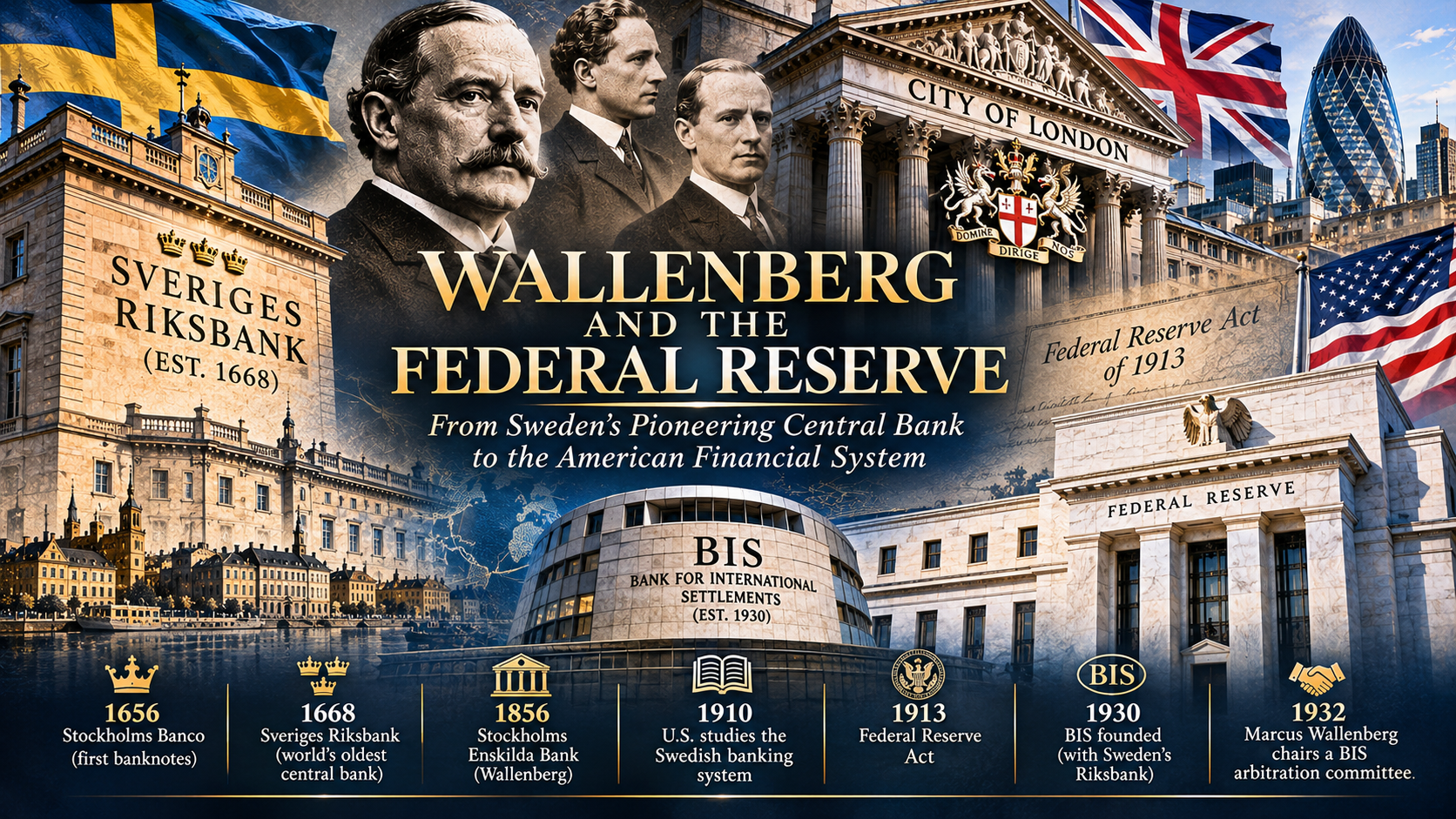
In 1656, Johan Palmstruch established Stockholms Banco, Sweden’s first bank.
In 1661, the bank introduced Europe’s first generally recognised banknotes, replacing cumbersome copper currency with paper instruments that could circulate more efficiently.
The expansion of banknote issuance eventually resulted in a financial crisis and the collapse of Stockholms Banco.
In 1668, the Swedish parliament established Riksens Ständers Bank, which later became Sveriges Riksbank.
It remains the world’s oldest central bank.
The Bank of England was established in 1694, the Banque de France in 1800 and the Federal Reserve in 1913.
Sweden therefore possessed 245 years of central banking history when the United States established its Federal Reserve System.
The Swedish experience included precisely the questions that would later confront American policymakers: monetary stability, currency issuance, credit expansion, liquidity and the relationship between private banking and public monetary authority.
Source: Sveriges Riksbank – The Foundation of the World’s Oldest Central Bank.
2. Wallenberg and the Development of the Swedish Banking System
In 1856, André Oscar Wallenberg founded Stockholms Enskilda Bank, the predecessor of today’s SEB.
The institution became an important force in the development of Swedish commercial and industrial banking, directing private capital towards industrial enterprises and infrastructure.
At the time, Swedish commercial banks possessed the right to issue their own banknotes. Stockholms Enskilda Bank was among the institutions operating within this system.
André Oscar Wallenberg was also politically active and participated in parliamentary debates concerning Swedish banking.
One particularly interesting historical detail is documented by the Riksbank itself.
When Sweden transformed its parliamentary system in 1866, the central bank required a new name. André Oscar Wallenberg proposed that it should be called Sveriges Bank, or the Bank of Sweden.
Following parliamentary debate, the name Sveriges Riksbank was adopted in 1867.
This episode illustrates Wallenberg’s direct participation in discussions concerning the institutional development of Sweden’s central bank.
Through subsequent generations, the family’s commercial banking operations expanded alongside Sweden’s evolving monetary system.
Source: Sveriges Riksbank – The Riksbank Is Renamed, 1867.
3. Sweden Centralised Its Monetary System Before the United States
During the nineteenth century, Sweden operated a banking system in which private commercial banks could issue currency alongside the central bank.
The banking reforms initiated in 1897 gradually transferred the exclusive right of banknote issuance to Sveriges Riksbank.
By 1904, this transition had been completed.
Sweden had therefore recently completed a major monetary transformation when the United States experienced the financial panic of 1907.
The Swedish experience offered American policymakers a contemporary European example of how a country could move from decentralised private currency issuance towards a centralised monetary institution while retaining an extensive commercial banking sector.
Stockholms Enskilda Bank had operated under both arrangements.
The Wallenberg banking establishment consequently possessed practical experience of precisely the type of monetary transition that American reformers were investigating.
4. The United States Congress Studied the Swedish Banking System
In response to the financial panic of 1907, the United States Congress established the National Monetary Commission in 1908 under Senator Nelson W. Aldrich.
Its purpose was to investigate the weaknesses of the American financial system and examine potential reforms.
The commission studied European banking institutions, monetary arrangements and central banks.
Among its official publications was a substantial examination of Sweden.
Published in 1910, the report was entitled The Swedish Banking System, written by A. W. Flux and issued as Senate Document No. 576.
The report examined:
- The historical development of Swedish banking.
- The operation of Sveriges Riksbank.
- Private commercial banking institutions.
- The issuance of banknotes.
- Monetary reserves and gold convertibility.
- The transfer of currency issuance to the central bank.
- The relationship between central and commercial banking.
The National Monetary Commission’s own publication catalogue confirms that the study was prepared for the commission in Sweden.
This establishes that Swedish banking experience formed part of the official research undertaken by the United States before the creation of the Federal Reserve.
The Swedish monetary model was not merely a historical parallel. It was a documented subject of American institutional research during the legislative development of a new central banking system.
Primary sources:
United States National Monetary Commission – The Swedish Banking System, 1910.
Publications of the National Monetary Commission, September 1911.
5. Wallenberg Was Expanding Internationally at the Same Time
While American authorities were studying European banking systems, Knut Agathon Wallenberg was expanding the family’s international financial operations.
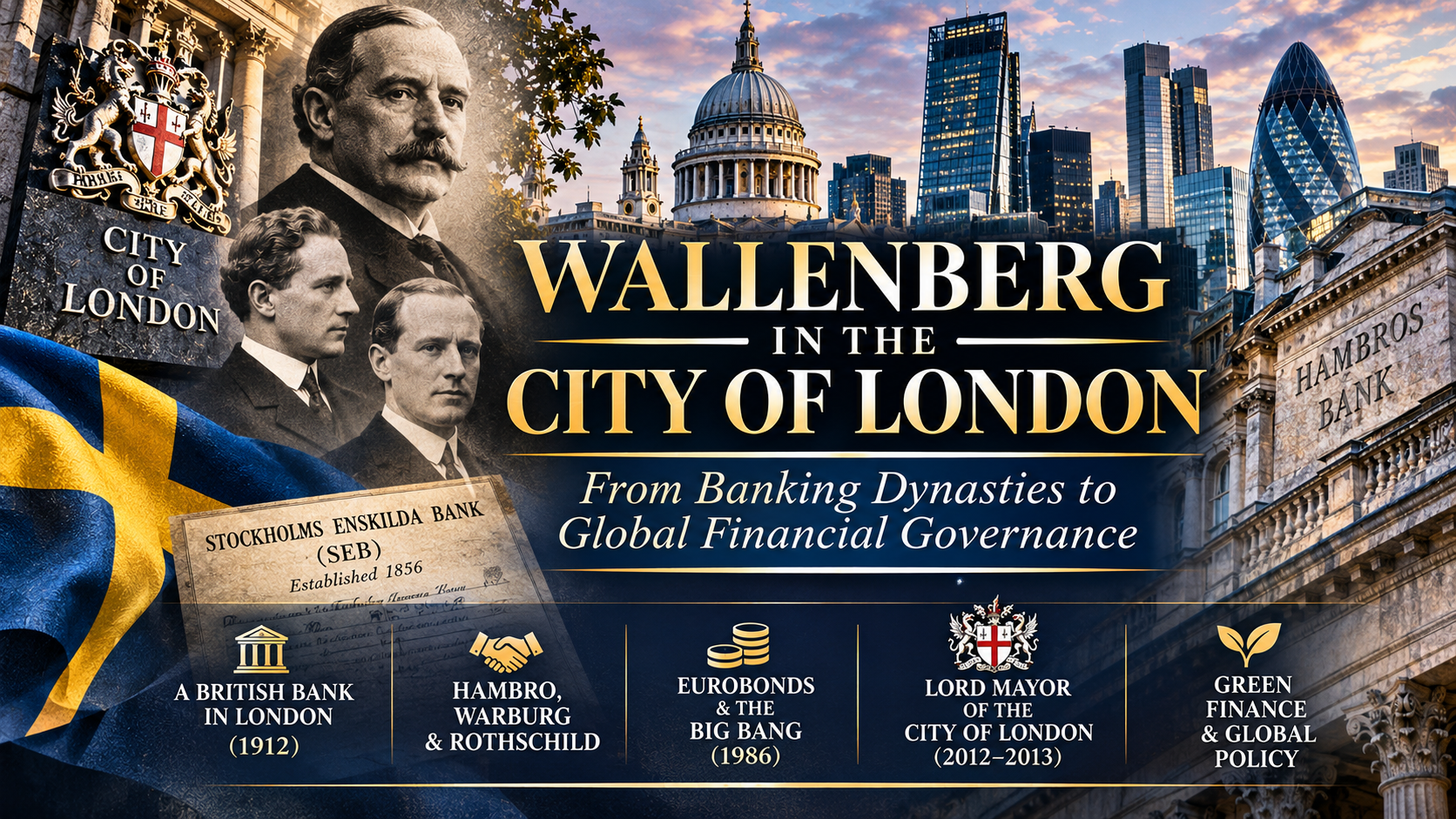
In 1912, just one year before the Federal Reserve Act, Wallenberg participated in the establishment of the British Bank of Northern Commerce in London.
The institution subsequently merged with the British banking house Hambro, becoming part of Hambros Bank.
Wallenberg was simultaneously active in Swedish parliamentary politics and banking reform.
In 1914, he became Sweden’s Minister for Foreign Affairs, illustrating the overlap between his commercial banking activities and public responsibilities.
The family’s financial network was already operating across several European capital markets, including London, Paris and Hamburg.
These were also among the European financial centres whose banking practices were being examined by American monetary reformers.
London was particularly important because American international trade depended extensively on European financial houses before the establishment of the Federal Reserve.
The creation of an American central banking system was therefore taking place within a financial environment in which the Wallenberg sphere was already an established participant.
Source: Uppsala University – The Internationalisation of Swedish Banks.
6. Paul Warburg and the European Origins of the Federal Reserve
One of the most important figures behind the establishment of the Federal Reserve was Paul Moritz Warburg.
Born into the German banking family behind M.M. Warburg & Co. in Hamburg, Paul Warburg developed extensive knowledge of European banking practices before becoming a partner in the New York investment bank Kuhn, Loeb & Co.
He became an influential advocate of American monetary reform.
Federal Reserve historical records confirm that Warburg served as an unofficial adviser to the National Monetary Commission and participated in the confidential meeting at Jekyll Island in 1910.
The six participants were:
- Nelson Aldrich, United States senator.
- Paul Warburg, Kuhn, Loeb & Co.
- Henry P. Davison, J.P. Morgan & Co.
- Frank A. Vanderlip, National City Bank.
- A. Piatt Andrew, United States Treasury official.
- Arthur Shelton, Aldrich’s private secretary.
The meeting produced the foundations of the Aldrich Plan, which subsequently influenced the technical provisions of the Federal Reserve Act.
Warburg also advised policymakers involved in developing the final legislation.
President Woodrow Wilson signed the Federal Reserve Act into law on 23 December 1913.
In 1914, Warburg was appointed to the Federal Reserve’s first governing board.
The establishment of the Federal Reserve therefore involved the transfer of European banking expertise into the developing American monetary system.
Sources:
Federal Reserve History – Paul M. Warburg.
Federal Reserve History – The Meeting at Jekyll Island.
7. Wallenberg and the Warburg Banking Dynasty
The historical connections between the Wallenberg and Warburg families are particularly significant in this context.
The Swedish government’s official investigation, SOU 1999:20, documents negotiations between Jacob Wallenberg and Max Warburg, Paul Warburg’s brother, beginning in January 1937.
The negotiations concerned potential Swedish participation in the ownership of M.M. Warburg & Co. in Hamburg.
The discussions involved representatives of the Warburg family, Stockholms Enskilda Bank, Swiss Bank Corporation and German banking authorities.
The proposed transaction was never completed and took place against the background of Nazi persecution and the forced transfer of Jewish-owned businesses.
However, one detail in the correspondence is especially relevant.
In a letter dated 22 August 1938, Max Warburg’s son Erich referred to the longstanding friendly relations between Stockholms Enskilda Bank and the Warburg banking house.
The correspondence therefore describes an established institutional relationship rather than a newly formed commercial contact.
This raises an important historical question concerning the earlier development of these banking relationships and the exchange of financial expertise between Stockholm, Hamburg and New York.
Source: Swedish Government Investigation – Sweden and Jewish Assets, SOU 1999:20.
8. The Warburg Connection Extended Directly into American Banking
An original letter preserved in the Wallenberg historical archives reveals another significant connection.
Writing to Raoul Wallenberg in the United States on 8 February 1934, Marcus Wallenberg Jr provided letters of introduction to two of his close American friends.
One was Robert A. Lovett, a partner in Brown Brothers Harriman & Co.
The other was James Paul Warburg, the son of Federal Reserve architect Paul Warburg.
Marcus Wallenberg described James as:
also a very good friend of mine
The letter identifies James Warburg as vice chairman of the Bank of the Manhattan Company, which was one of Stockholms Enskilda Bank’s correspondent banks.
James Warburg had also served as a financial adviser to President Franklin D. Roosevelt and as a financial expert to the American delegation at the London Economic Conference of 1933.
The letter furthermore describes longstanding business relations between Stockholms Enskilda Bank and Brown Brothers Harriman.
Robert Lovett subsequently became United States Secretary of Defense.
The Bank of the Manhattan Company later merged with Chase National Bank in 1955, forming Chase Manhattan Bank, which eventually became part of JPMorgan Chase.
These relationships demonstrate how Wallenberg’s international banking operations were integrated into established American financial networks, including the immediate family of one of the Federal Reserve’s principal architects.
Primary source: Wallenberg Historical Archives – Banking & Enterprise, Letter of 8 February 1934, page 31.
9. The Rothschild, Hambro and London Connections
The development of central banking must also be understood within the broader context of nineteenth-century international finance.
Economic-historical research published by Sveriges Riksbank identifies several prominent European banking houses involved in the Swedish bond market, including Rothschild, Hambro and Warburg.
These institutions operated across the sovereign debt and international capital markets from which Sweden obtained financing.
Wallenberg’s relationships with Hambro developed into shared banking operations in London, while documented negotiations with the Rothschild network concerned industrial assets during 1938 and 1939.
The proposed Rothschild transaction involved the Witkowitz industrial enterprise in Czechoslovakia and additional European banking institutions.
These dealings illustrate the interconnected nature of European commercial banking across Stockholm, London, Hamburg, Paris and Switzerland.
Paul Warburg’s transfer of European financial expertise to the United States took place within this wider international banking environment.
Commercial banking, sovereign debt markets and monetary reform were overlapping fields in which these institutions accumulated experience and maintained professional relationships.
Sources:
Sveriges Riksbank – Banking, Bonds, National Wealth and Stockholm House Prices.
Swedish Government Investigation – SOU 1999:20.
10. From National Central Banks to the Bank for International Settlements
The next major development in international monetary cooperation occurred in 1930 with the establishment of the Bank for International Settlements, or BIS, in Basel, Switzerland.
Initially created in connection with the administration of German reparation payments following the First World War, the BIS developed into an institution facilitating international central bank cooperation.
According to the BIS’s official historical records, its original governing board included the central bank governors of Belgium, France, Germany, Italy and the United Kingdom.
The governors of Switzerland, the Netherlands and Sweden were also elected to the board at its inception.
Sweden’s central bank was therefore represented in the institutional leadership of the BIS from the very beginning.
The Swedish governor at the time was Ivar Rooth, who led Sveriges Riksbank between 1929 and 1948.
Rooth subsequently became Managing Director of the International Monetary Fund in Washington, D.C., serving from 1951 to 1956.
The United States Federal Reserve initially declined direct participation in the BIS, while American private banking interests participated in its original capital structure.
This is an important distinction. The establishment of the BIS involved both central banking authorities and, initially, private banking interests.
Its development created a new institutional framework connecting national monetary systems with international financial cooperation.
Sources:
BIS – The Story of the Bank for International Settlements.
Sveriges Riksbank – Ivar Rooth and the International Financial Crisis.
11. Wallenberg Was Appointed Chairman of a BIS Arbitration Committee
Only two years after the BIS opened its doors, the Wallenberg name appeared in the official publications of the American Federal Reserve.
The June 1932 edition of the Federal Reserve Bulletin records the appointment of Marcus Wallenberg as chairman of an international arbitration committee established by the BIS.
The other members were Thomas H. McKittrick Jr and Franz Urbig.
The committee was responsible for resolving disputes concerning international credit arrangements with German banks.
The Federal Reserve Bulletin states:
The Bank for International Settlements appointed as an arbitration committee Messrs. Marcus Wallenberg (chairman), T. H. McKittrick, jr., and Franz Urbig.
When the credit agreement was renewed in 1932, the committee was reappointed.
Thomas H. McKittrick subsequently became president of the BIS, serving between 1940 and 1946.
Marcus Wallenberg’s appointment is especially significant because it demonstrates a formal role for a private Swedish banker within an international financial mechanism established by the BIS.
Sweden was thus represented at two different institutional levels during the early development of international central bank cooperation.
Through Sveriges Riksbank, it participated in the governance of the BIS itself.
Through Marcus Wallenberg, Swedish private banking expertise participated in international financial arbitration under a BIS mandate.
Primary source: Federal Reserve Bulletin, June 1932, page 373.
12. Behind the Scenes: The Question of Informal Influence
The development of financial institutions cannot be understood exclusively through legislation, official appointments and organisational charts.
Financial expertise also circulates through correspondence, international conferences, correspondent banking arrangements, professional relationships and commercial partnerships.
The creation of the Federal Reserve provides a documented historical example of this process.
The confidential discussions at Jekyll Island preceded the public legislative process, while Paul Warburg continued to advise American policymakers as the legislation evolved.
Against this background, the Swedish dimension deserves particular attention.
The United States formally commissioned research into Sweden’s recently centralised monetary system. At the same time, the Wallenberg banking establishment possessed practical experience of that transformation and extensive relationships within European finance.
Its subsequent documented connections with the Warburg family, American correspondent banks and international central banking institutions provide further evidence of its integration into transatlantic financial networks.
A plausible historical hypothesis is that Swedish commercial banking experience, including experience accumulated by institutions such as Stockholms Enskilda Bank, contributed indirectly to the wider body of European financial knowledge available to American reformers.
Such influence could have operated through published research, professional exchanges and ordinary international banking relationships rather than formal participation in American legislative institutions.
The later Wallenberg-Warburg correspondence makes this a worthwhile subject for further historical investigation, although its chronology does not by itself establish a direct Wallenberg role in drafting the 1913 legislation.
The distinction between formal authority and informal influence is essential. The former can often be established through appointments and legal documents, while the latter requires examining the movement of ideas, expertise and relationships across institutional boundaries.
13. From the Federal Reserve to Modern Financial Infrastructure
The international relationship between Swedish commercial banking and American monetary authorities continues through contemporary financial infrastructure.
SEB participates in international foreign exchange settlement through CLS, an institution operating within a framework of multinational central bank oversight coordinated by the Federal Reserve.
Unlike the historical correspondent banking relationships of the early twentieth century, today’s arrangements operate through formal regulatory structures and financial market infrastructures.
The institutional mechanisms have changed considerably, but the importance of international banking cooperation remains.
Swedish commercial banks, the Riksbank, the Bank of England, the Federal Reserve and other monetary authorities continue to interact within an interconnected financial system.
Further reading: Federal Reserve – Financial Market Utilities.
A Historical Timeline
- 1656: Stockholms Banco is established.
- 1661: Sweden introduces Europe’s first generally recognised banknotes.
- 1668: Sveriges Riksbank is founded.
- 1694: The Bank of England is established.
- 1856: André Oscar Wallenberg establishes Stockholms Enskilda Bank.
- 1867: The Swedish central bank is renamed following parliamentary debate in which Wallenberg participates.
- 1897–1904: Sweden centralises banknote issuance.
- 1907: The American financial panic accelerates demands for monetary reform.
- 1908: The United States establishes the National Monetary Commission.
- 1910: The commission publishes its extensive investigation of Swedish banking.
- 1910: Paul Warburg participates in the Jekyll Island conference.
- 1912: K.A. Wallenberg participates in the establishment of the British Bank of Northern Commerce.
- 1913: The Federal Reserve Act becomes law.
- 1914: Paul Warburg joins the Federal Reserve Board.
- 1930: Sveriges Riksbank is represented on the inaugural board of the BIS.
- 1932: Marcus Wallenberg chairs an international arbitration committee appointed by the BIS.
- 1934: Marcus Wallenberg documents his friendship with James Paul Warburg and Robert Lovett.
- 1937–1938: Wallenberg and Warburg negotiate potential banking ownership arrangements.
- 1938–1939: Wallenberg participates in negotiations concerning Rothschild industrial assets.
- 1951: Former Riksbank governor Ivar Rooth becomes Managing Director of the IMF.
Conclusion: The Swedish Dimension of Global Financial History
The establishment of the Federal Reserve in 1913 was an American legislative achievement informed by extensive research into European banking.
Among the countries studied was Sweden, home to the world’s oldest central bank and an advanced commercial banking sector that had recently undergone a significant monetary transformation.
The Wallenberg family had participated in this Swedish banking environment for generations and had established relationships across major European financial centres by the time the American reforms were being developed.
In subsequent decades, those relationships are documented through personal friendships with the Warburg family, American correspondent banking arrangements, international credit negotiations and formal arbitration responsibilities under the BIS.
The historical record therefore supports an examination of Wallenberg not merely as a Swedish industrial dynasty, but as an established participant in the international financial environment surrounding the development of modern central banking.
The possibility of indirect influence through banking expertise and professional networks deserves serious historical investigation.
The most important insight is that financial institutions are shaped not only when legislation is signed, but also during the years in which knowledge is accumulated, banking relationships are established and institutional models are exchanged.
To understand the origins of the modern international financial system, it is therefore necessary to look beyond Washington and Wall Street.
The history also leads through London, Hamburg, Basel and Stockholm, where the world’s oldest central bank was established and where the Wallenberg banking dynasty developed its international financial network.
This article forms part of a wider investigation into the historical and institutional relationships connecting the Wallenberg sphere with international finance, national security and global financial governance.
Related investigations: Wallenberg in America and Wallenberg in the City of London. and BIS – Bank of International Settlement, Marcus Wallenberg, Per Jacobsson & Kreuger