
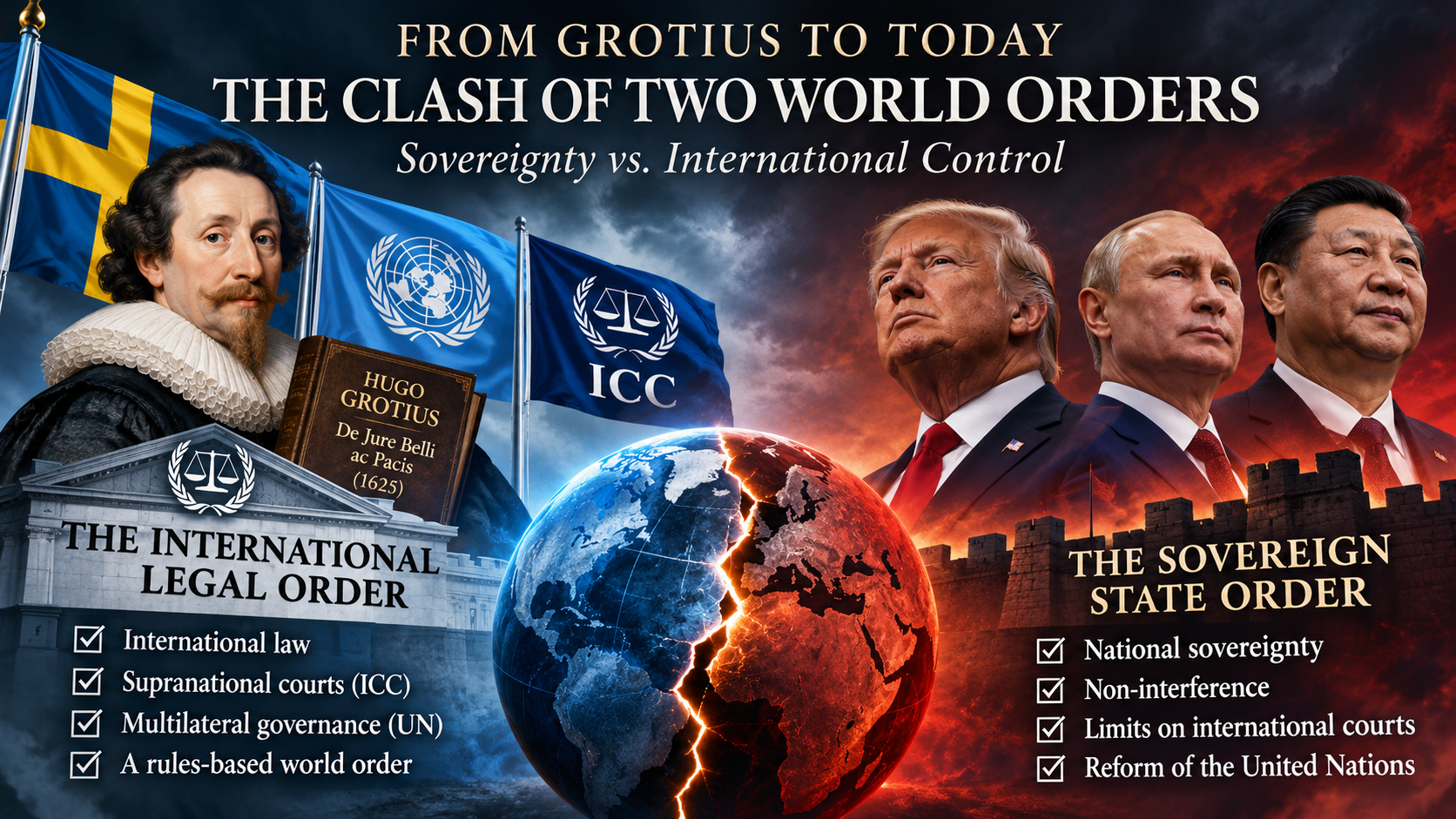
From Grotius to the ICC: Who Gave International Institutions the Authority to Override Sovereign Nations?
The joint declaration issued by Donald Trump, Vladimir Putin, and Xi Jinping on November 19, 2026, addressing United Nations reform, national sovereignty, and the jurisdiction of the International Criminal Court (ICC), raises a fundamental question that is rarely confronted in Sweden’s political debate:
Who gave international institutions the authority to exercise legal power over sovereign nations and their representatives?
The declaration explicitly emphasizes state consent and the immunities of state officials while warning against abuses of jurisdiction by the ICC and similar institutions. It also commits the three countries to pursuing reform of the United Nations. [1]
Sweden and the European Union continue to defend an international legal order in which international courts and institutions exercise significant authority. Yet the legitimacy, limits, and democratic accountability of that authority deserve far greater scrutiny.
At the heart of this confrontation lies a question that has shaped international relations for centuries:
Does sovereignty ultimately belong to independent nations, or can international institutions exercise authority over them without their consent?
From Grotius to the Rise of International Institutions
In the seventeenth century, Hugo Grotius developed influential ideas about the legal principles governing relations between states.His landmark work, De Jure Belli ac Pacis (On the Law of War and Peace), published in 1625, became one of the foundational texts in the intellectual development of modern international law.
Grotius was later recruited into Swedish diplomatic service by Axel Oxenstierna, Sweden’s powerful Lord High Chancellor, and appointed Sweden’s ambassador to France in 1634. [2]
The historical connection is significant. Sweden was not merely an observer of the early development of international legal thought. Through Oxenstierna and Grotius, it was directly connected to the political and diplomatic environment in which these ideas gained influence. Four centuries later, Sweden remains a committed defender of international legal institutions.
But Grotius’s intellectual legacy also raises a fundamental question:
Who should have the ultimate authority to interpret and enforce international legal principles, particularly when those principles conflict with the sovereignty of independent nations?
This question becomes especially important when international institutions claim jurisdiction over citizens of countries that never agreed to their founding treaties.
The ICC’s Contested Claims of Jurisdiction
The United States, Russia, and China have never ratified the Rome Statute, the treaty establishing the International Criminal Court.
Nevertheless, the ICC maintains that it can exercise jurisdiction over nationals of non-member states under certain circumstances, including when alleged crimes are committed on the territory of a state that has accepted the Court’s jurisdiction.
Article 12 of the Rome Statute provides the treaty basis for this form of territorial jurisdiction. [3]
This is where the fundamental dispute begins.
The ICC claims the authority to exercise such jurisdiction. But why should an international court be able to prosecute nationals of a sovereign country that never consented to its founding treaty?
The Court relies on provisions of the Rome Statute, particularly Article 12, which establishes conditions for the exercise of its jurisdiction. Its legal rationale draws on the principle of territorial jurisdiction, under which a state may exercise criminal jurisdiction over acts committed within its territory. But the existence of a legal argument does not eliminate the deeper question of legitimacy.
Can states that have joined an international treaty confer authority on an international institution to prosecute citizens of countries that have not joined that treaty? And where should the limits of such authority be drawn?
These are not merely technical legal questions. They concern sovereignty, consent, democratic accountability, and the boundaries of international institutional power.
The Trump administration has explicitly challenged the ICC’s jurisdiction over American and Israeli personnel.
In Executive Order 14203, signed on February 6, 2025, President Trump argued that the Court’s actions threatened American sovereignty, national security, and foreign policy interests. [4]
The November 2026 declaration demonstrates that Washington, Moscow, and Beijing have now publicly expressed a shared concern about international criminal jurisdiction and the protection of state officials. [1]
Sweden and the EU Defend the Existing Rules-Based International Order
Sweden and the European Union have made the defense of the ICC and the broader international legal order central elements of their foreign policies. In May 2025, Swedish Foreign Minister Maria Malmer Stenergard confirmed Sweden’s commitment to protecting the ICC’s independence and stated that the Swedish government supported the possible activation of the EU Blocking Statute in response to American sanctions. [5]
The United States, meanwhile, has used economic sanctions to challenge what the Trump administration regards as unacceptable assertions of judicial authority. This confrontation exposes two competing approaches to international law. One emphasizes the authority of international institutions to exercise powers established through multilateral treaties.
The other emphasizes national sovereignty, state consent, and the limits that should apply to institutions seeking to exercise authority beyond the states that created them. For Sweden, the conflict carries an additional economic dimension.
Swedish corporations and banks are deeply connected to American markets, technology, and international financial infrastructure.
The United States possesses substantial economic leverage through the dollar, financial sanctions, export controls, and access to its domestic market. According to the Bank for International Settlements, the US dollar was on one side of 89.2 percent of all foreign exchange transactions in April 2025, illustrating its central position in global finance. [6]
This creates a difficult question for Swedish policymakers:
How far are Sweden and the European Union prepared to go to defend the ICC’s contested authority if doing so threatens Swedish economic interests and relations with the United States?
The issue is no longer confined to diplomatic statements or competing legal interpretations. It also concerns the economic consequences of defending an international institution whose jurisdiction is challenged by major powers.
Oxenstierna 2.0: What Kind of International Order Is Sweden Defending?
The renewed use of the expression Oxenstierna 2.0 in Swedish political discussions makes the historical connection to Grotius particularly interesting. In June 2026, Sweden’s Christian Democrats presented a reform initiative under that name, proposing changes to the relationship between government ministries and public authorities, with the stated aim of strengthening the state’s ability to implement political decisions. [7]
Axel Oxenstierna helped build the administrative foundations of the Swedish state. Hugo Grotius helped shape the intellectual foundations of modern international law. Four hundred years later, Swedish politicians invoke Oxenstierna as a symbol of effective state administration while continuing to defend international institutions whose authority is increasingly contested.
The modern expression Oxenstierna 2.0 has primarily been used in discussions about administrative reform, rather than as an explicit reference to Grotius or the ICC. However, Sweden’s Prime Minister, Ulf Kristersson, stated during a press conference that “Oxenstierna still applies today.” What exactly he meant by that remains unclear. Nevertheless, the historical parallel raises an important question.
Should Sweden’s political leadership place greater emphasis on national sovereignty and Swedish interests, or continue defending international institutions whose authority is subject to profound legal and political disagreement?
The question becomes particularly pressing when the defense of those institutions risks bringing Sweden into conflict with the United States, one of its most important economic and security partners.
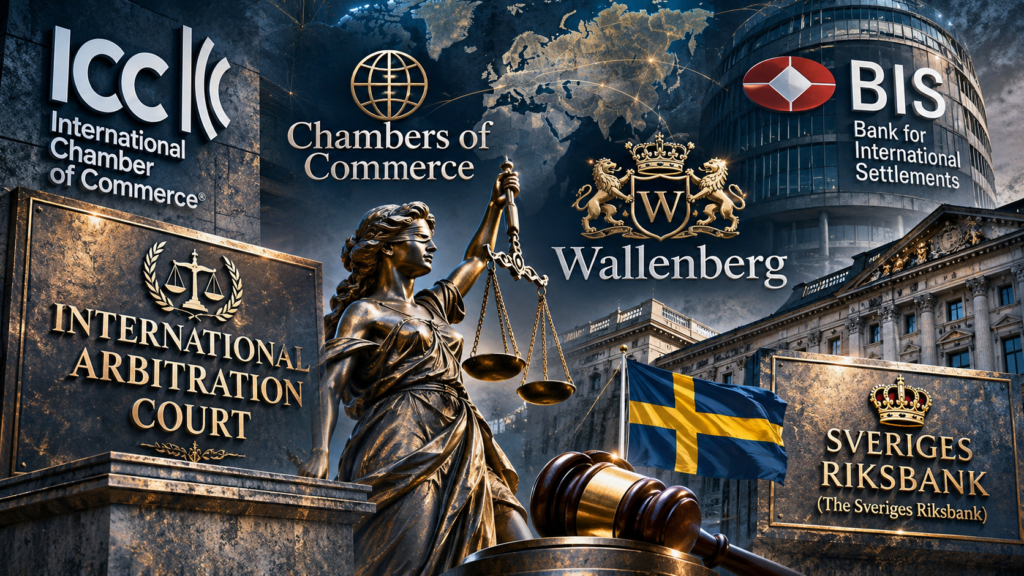
Sweden, Wallenberg, and the Origins of International Financial Arbitration
Sweden has played a significant role in the development of international arbitration and financial governance for more than a century.
In 1917, the Arbitration Institute of the Stockholm Chamber of Commerce, now known as the SCC Arbitration Institute, was established. Stockholm later became an important center for resolving international commercial disputes, including those involving the United States, the Soviet Union, and China. [8]
The Wallenberg family’s involvement is documented in historical records. According to the Federal Reserve Bulletin of June 1932,
Marcus Wallenberg served as chairman of an arbitration committee appointed by the Bank for International Settlements (BIS) to address disputes involving international banking agreements concerning Germany. [9]
The connection continues through the International Chamber of Commerce (ICC), where Marcus Wallenberg is listed as Treasurer of ICC Sweden’s governing board. [10]
Sweden’s central bank, Sveriges Riksbank, became a shareholder in BIS when it was established in 1930 and gained representation on its Board of Directors in 1931. [11]
BIS itself was established through international agreements concluded at The Hague in 1930. These arrangements also created a standing arbitral tribunal whose secretariat is administered by the Permanent Court of Arbitration, founded in 1899. [12]
Together, these historical records reveal Sweden’s longstanding involvement in the institutions connecting international finance, arbitration, and legal governance.
From Hugo Grotius and Axel Oxenstierna to the Riksbank, the Wallenberg family, and BIS, Sweden’s influence on international institutional development extends across several centuries. This history raises a fundamental question:
Who shapes the rules governing international finance and dispute resolution, and where does the authority of sovereign nations end and that of international institutions begin?
Who Gave International Criminal Court ant the International Arbitration Courts Their Authority?
The Stockholm Chamber of Commerce established its arbitration board in 1917, laying the foundations for today’s internationally recognized SCC Arbitration Institute, based in Stockholm.
This raises a fundamental question about the origins of judicial authority. Unlike national courts, arbitration institutions derive their authority primarily from agreements between the parties involved, while national legislation determines the legal framework and enforceability of arbitral awards.
But who ultimately determines the boundaries of that authority, particularly when private institutions become influential in resolving disputes involving multinational corporations, sovereign states, and international financial interests?
The distinction between contractual arbitration and state judicial power is central to understanding how international legal authority has developed beyond traditional national court systems.
Who grants these institutions their authority, who holds them accountable, and whose interests do they ultimately serve?
The confrontation surrounding the ICC ultimately concerns the source and limits of legal authority. International institutions cannot resolve every question of legitimacy, jurisdiction, or democratic accountability simply by invoking their own founding treaties. The fact that a court claims jurisdiction does not mean that every sovereign nation accepts its authority.
Nor does the existence of a treaty automatically settle the broader political and philosophical debate over whether its provisions should apply to nationals of states that never consented to it.
The November 19 declaration brings this debate into sharper focus. Three permanent members of the UN Security Council have jointly emphasized state consent and official immunities while calling for reform of the United Nations. [1]
The central question is therefore not merely what the ICC believes it is entitled to do, but why sovereign nations should accept those claims when they have never agreed to the Court’s founding treaty.
This is the fundamental conflict between national sovereignty and the contested authority of international institutions.
And it is a conflict that Sweden and the European Union can no longer afford to ignore.
Sources and References
[1] The White House, November 19, 2026
U.S.-Russia-China Heads of State Declaration toward Peace.
Official joint declaration addressing UN reform, state consent, immunity of state officials, ICC jurisdiction, energy, and nuclear security.
https://www.whitehouse.gov/briefings-statements/2026/11/u-s-russia-china-heads-of-state-declaration-toward-peace
[2] Encyclopedia.com, Hugo Grotius
Grotius, Hugo (Huigh de Groot; 1583–1645).
Historical account of Grotius’s relationship with Axel Oxenstierna and his appointment as Sweden’s ambassador to France.
https://www.encyclopedia.com/history/encyclopedias-almanacs-transcripts-and-maps/grotius-hugo-huigh-de-groot-1583-1645
[3] International Criminal Court
Rome Statute of the International Criminal Court, particularly Articles 12 and 13.
The treaty provisions governing the Court’s jurisdiction, including territorial jurisdiction and referrals by the UN Security Council.
https://www.icc-cpi.int/sites/default/files/2024-05/Rome-Statute-eng.pdf
[4] The White House / Federal Register, February 6, 2025
Executive Order 14203: Imposing Sanctions on the International Criminal Court.
President Trump’s official explanation of the American government’s objections to ICC jurisdiction and the national security rationale for sanctions.
https://ofac.treasury.gov/system/files/2025-02/eo14203.pdf
[5] Swedish Parliament, May 7, 2025
Sweden’s Actions in Defense of the International Criminal Court.
Written response by Foreign Minister Maria Malmer Stenergard concerning Sweden’s support for the ICC and the possible activation of the EU Blocking Statute.
https://www.riksdagen.se/sv/dokument-och-lagar/dokument/svar-pa-skriftlig-fraga/sveriges-agerande-till-forsvar-for-internationella_hc121103
[6] Bank for International Settlements, September 2025
Triennial Central Bank Survey: OTC Foreign Exchange Turnover in April 2025.
Official statistics documenting the US dollar’s dominant role in global foreign exchange markets. https://www.bis.org/statistics/rpfx25_fx.pdf
[7] Swedish Parliamentary Debate and Public Reporting, 2026
Oxenstierna 2.0: Proposals to Reform Sweden’s Administrative Model.
https://www.publikt.se/nyhet/sa-vill-partierna-forandra-staten-27996
[8] SCC Arbitration Institute: Our History
[9] Federal Reserve Bulletin, June 1932
[10] ICC Sweden: Organization and Governing Board
[11] Sveriges Riksbank: Economic Review, 2022
[12] Permanent Court of Arbitration: BIS Arbitral Tribunal
Additional primary source: Ministry of Foreign Affairs of China, November 19, 2026
China-Russia-U.S. Heads of State Declaration toward Peace.
China’s official publication of the joint declaration.
https://www.fmprc.gov.cn/eng./xw/zyxw/202611/t20261119_12063224.html
Additional Source: SCC Arbitration Institute, Official History
Editorial note: This article presents a critical analysis of international institutional authority from the perspective of national sovereignty. Its legal and historical claims are supported by the sources above, while questions concerning legitimacy, democratic accountability, and the proper limits of international jurisdiction reflect the article’s analytical perspective.