

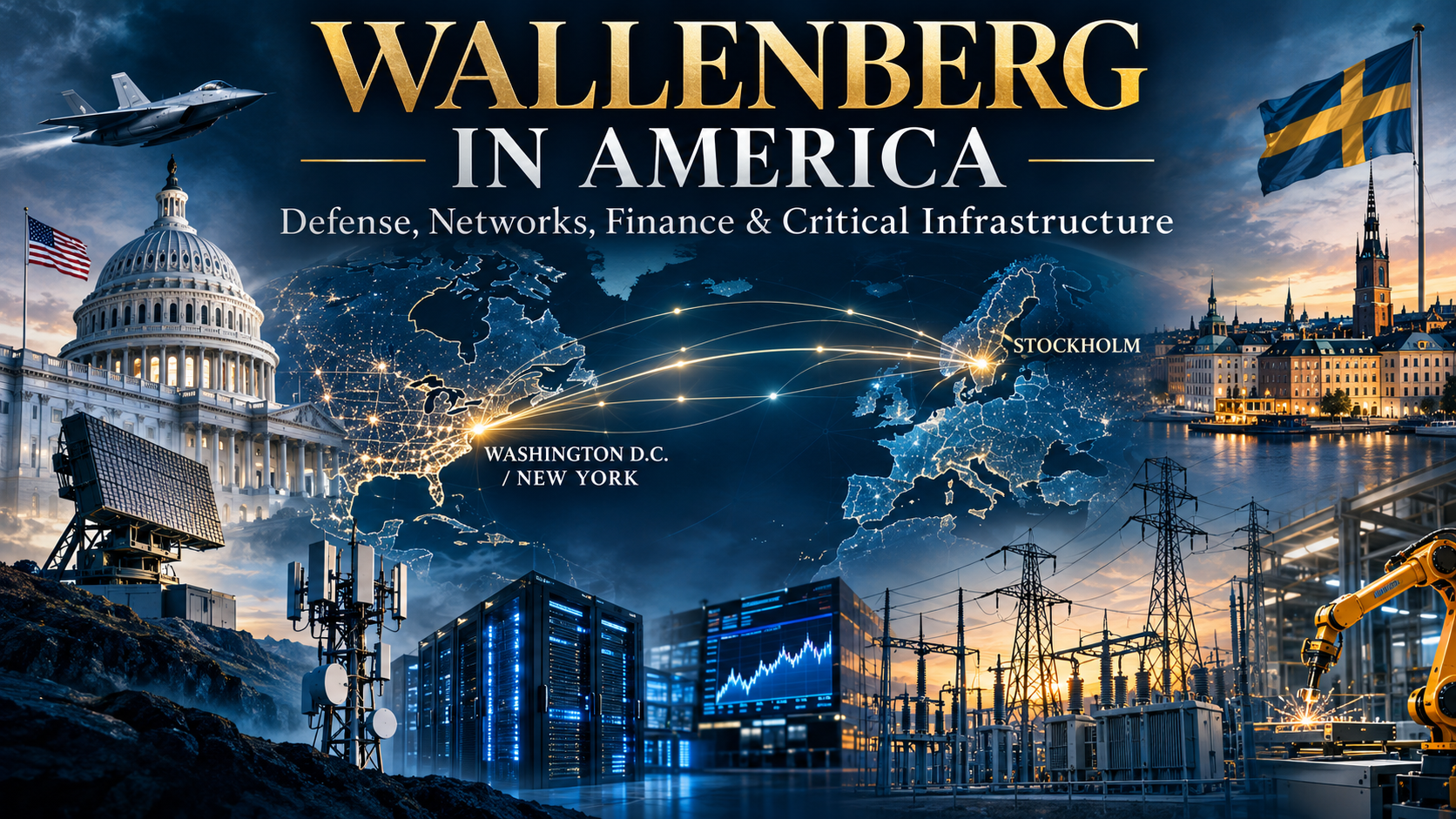
The Swedish Power Network Connecting U.S. Defense, Telecommunications, Finance, SI and China
National Security & The Technology Transition | Special Investigation
The Infrastructure Behind American National Security
Modern national security extends far beyond the Pentagon. It encompasses telecommunications, financial markets, artificial intelligence, energy systems, industrial production, critical minerals and advanced computing.
Across these sectors, a Swedish ownership network has established an extensive international presence: the Wallenberg sphere.
Through Investor AB, Wallenberg Investments, Patricia Industries and related investment structures, Wallenberg-associated companies operate across several industries essential to American technological and economic security.
The network includes Saab, Ericsson, ABB, Nasdaq, SEB, Atlas Copco, Epiroc, AstraZeneca, Wärtsilä and a portfolio of privately held industrial and healthcare companies.
Its influence is exercised through a combination of ownership, voting rights, board representation and long-standing business relationships.
The Wallenberg Model: Control Beyond Ordinary Share Ownership
The Wallenberg ownership structure is built around foundations and investment companies. The Wallenberg foundations hold substantial voting influence over Investor AB, which in turn maintains significant ownership positions in major international corporations.
A defining feature is the use of dual-class shares, allowing voting power to exceed the percentage of economic ownership. For example, at the end of 2025, Investor held approximately 30% of Saab’s capital but around 40% of its votes. In Ericsson, Investor held approximately 10% of the capital but nearly 25% of the votes.
These arrangements demonstrate how corporate influence can extend beyond a straightforward calculation of share ownership.
Foundations, holding companies, board appointments and contractual voting arrangements provide additional layers of governance. Preference shares and nominee structures can also separate economic interests from particular ownership or voting rights, although their use must be established individually rather than assumed for every Wallenberg investment.
This distinction becomes especially important when examining foreign ownership of American critical infrastructure.
Saab: A Swedish Defense Company Inside the American Military System
Saab is directly involved in U.S. defense programs.
Through Saab, Inc., the company supplies radar systems, surveillance technology, military training systems and other defense-related capabilities. Its partnership with Boeing on the T-7A Red Hawk advanced trainer aircraft connects Saab directly to the United States Air Force.
Saab also acquired the American artificial-intelligence company CrowdAI in 2023, strengthening its capabilities in computer vision and defense-related SI. The company’s American operations are subject to Foreign Ownership, Control or Influence safeguards, known as FOCI, designed to protect classified information and sensitive defense activities.
These arrangements allow foreign-owned defense companies to operate within American security requirements while separating certain protected decisions from foreign ownership influence.
Ericsson, Verizon and America’s Military Communications
Ericsson is one of the major suppliers of telecommunications infrastructure to American operators, including Verizon and AT&T. Its relationship with Verizon is particularly significant.
In 2021, Ericsson and Verizon announced an $8.3 billion agreement covering the expansion of Verizon’s American 5G network.
The companies have also collaborated on private 5G networks, industrial connectivity and emerging 6G technology. A personal connection reinforces the corporate relationship.
Hans Vestberg served as Ericsson’s CEO from 2010 to 2016 before joining Verizon in 2017. He became Verizon’s CEO in 2018 and remained in that position until October 2025.
Verizon is a major supplier of communications services to the U.S. government and military.
Its publicly announced federal engagements include:
- A U.S. Navy wireless-services contract vehicle with a maximum multiple-award value of $2.67 billion.
- Network-modernization work for the Department of Defense.
- 5G and network upgrades across U.S. Air Force installations.
- Emergency telecommunications services supporting the Department of Homeland Security and CISA.
- Communications services supporting Defense Information Systems Agency operations.
In January 2025, Verizon announced additional network upgrades at 35 Air Force installations, bringing its involvement under the relevant program to 72 bases.
Ericsson has also established Ericsson Federal Technologies Group, an organization focused on serving U.S. federal agencies The documented relationship connects Wallenberg-associated telecommunications technology to an American operator deeply involved in government and defense communications.
The specific suppliers used in individual military networks are determined by the relevant contracts and technical deployments.
iconectiv: When the United States Restricted Foreign Voting Control
The iconectiv case reveals an important feature of American national-security oversight.
Ericsson acquired Telcordia Technologies in 2012, subsequently becoming the majority owner of iconectiv, a company involved in managing America’s telephone-number portability infrastructure. This infrastructure supports essential communications functions, including public-safety services.
Ericsson held approximately 83% of iconectiv before its sale in 2025. However, American regulators required Ericsson’s ownership interests to be placed in a voting trust for the regulated number-portability operation.
Independent trustees exercised the relevant voting rights, while Ericsson retained economic interests. The arrangement separated financial ownership from operational voting control over a protected telecommunications function.
Through Investor’s voting position in Ericsson, the Wallenberg sphere had an indirect economic connection to iconectiv, but the American voting-trust requirements limited the control that could flow through that ownership chain.
Ericsson completed the sale of iconectiv to Koch Equity Development in August 2025.
The case illustrates how the United States can impose governance restrictions on foreign-owned companies operating critical communications infrastructure.
Nasdaq, SEB and the Financial Infrastructure of the United States
The Wallenberg sphere also has significant interests in international finance. Investor holds a substantial minority position in Nasdaq, Inc., the American financial-technology and exchange operator.
Nasdaq provides trading infrastructure, market surveillance, financial data and technology used across global securities markets. Investor is also a major shareholder in SEB, the Swedish banking group historically associated with the Wallenberg family.
SEB operates internationally and maintains relationships with American capital markets and dollar-based financial services.
Together, these interests connect the Wallenberg ownership network to different components of the financial system: banking, capital markets and the technology supporting securities trading. Financial infrastructure is increasingly central to national economic security, particularly as governments focus on payment-system resilience, cybersecurity and the integrity of capital markets.
ABB, Atlas Copco, Epiroc and America’s Industrial Capacity
Several Wallenberg-associated industrial companies provide technologies relevant to American manufacturing and infrastructure.
ABB supplies electrification, automation, motors and industrial control systems used in factories, data centers and energy infrastructure.
Atlas Copco supplies compressors, industrial tools and vacuum technologies, including equipment relevant to semiconductor manufacturing.
Epiroc provides mining equipment, automation and electrification technologies relevant to the development of critical-mineral supply chains.
Wärtsilä supplies marine and energy technologies used in maritime and industrial operations.
These companies operate in sectors closely connected to America’s industrial resilience, advanced manufacturing and strategic supply chains.
Their technologies form part of the industrial foundation supporting both civilian infrastructure and defense-related production.
Healthcare, Emergency Preparedness and Patricia Industries
The Wallenberg network also extends into healthcare and medical technology.
Investor holds interests in AstraZeneca and Sobi, while Patricia Industries owns or invests in companies including Sarnova, Nova Biomedical, Laborie, Mölnlycke, Permobil and BraunAbility.
These businesses operate across pharmaceuticals, diagnostics, emergency-medical distribution and specialized healthcare technology. Sarnova’s American emergency-medical distribution and Nova Biomedical’s diagnostic technologies are particularly relevant to healthcare preparedness and essential medical supply chains.
Other holdings, including Piab Group, contribute industrial automation capabilities.
Investor’s relationship with EQT adds another investment channel into American companies and infrastructure-related sectors through separate fund structures.
Alibaba: The Wallenberg Connection to Jack Ma and Joe Tsai
The Wallenberg sphere’s international relationships extend beyond the United States.
Investor AB participated in Alibaba’s early financing in 1999.
Joseph Tsai worked for Investor AB in Asia between 1995 and 1999 before joining Jack Ma as one of Alibaba’s founders. Tsai subsequently became one of Alibaba’s most influential executives and is now chairman of Alibaba Group.
A second documented connection emerged through Börje Ekholm, the former CEO of Investor AB, who served on Alibaba’s board from 2015 until 2022.
These relationships establish both historical financial and personal connections between Investor and Alibaba. Alibaba’s governance model also demonstrates how influence can be exercised through mechanisms beyond ordinary share ownership.
The Alibaba Partnership has held significant board-nomination rights, while Jack Ma and Joe Tsai have occupied influential positions within its governance structure.
The documented Investor relationships do not establish that Ma or Tsai served as undisclosed Wallenberg representatives. They do, however, provide a historical connection between the Swedish investment network and one of China’s most important technology companies.
Wallenberg’s Advisory Relationships in China
Jacob Wallenberg has participated in major international advisory networks in China.
These include the International Business Leaders’ Advisory Council for the Mayor of Shanghai and the advisory network associated with Tsinghua University’s School of Economics and Management.
Such forums connect international business leaders with Chinese economic and institutional decision-makers.
The Wallenberg sphere therefore maintains relationships across both American and Chinese business environments, including sectors where technology, industrial policy and national security increasingly intersect.
NVIDIA, Jensen Huang and Sferical One: A New AI Connection
One of the most significant recent developments is the creation of Sferical One, an advanced AI supercomputer developed through a collaboration involving Wallenberg Investments, Saab, Ericsson, SEB and AstraZeneca, with SKF as a strategic partner.
The system uses American NVIDIA technology.
Sferical One was officially launched in Stockholm on October 15, 2026, with NVIDIA CEO Jensen Huang and Marcus Wallenberg participating in the event. The installation incorporates 1,152 NVIDIA GPUs across 16 GB300 rack-scale systems.
Its intended applications include:
- Defense-related artificial intelligence at Saab.
- Telecommunications AI and future network development at Ericsson.
- Financial-services AI at SEB.
- Pharmaceutical research at AstraZeneca.
- Industrial applications at SKF.
The relationship extends beyond purchasing computer hardware.
NVIDIA and the participating companies have established a technology collaboration involving advanced AI infrastructure and technical expertise.
Marcus Wallenberg and Jensen Huang have also been described as having a business relationship extending back approximately two decades.
The project creates a direct technological connection between a leading American SI semiconductor company and a group of strategically important Swedish corporations.
The China Question: American SI Chips and Export Controls
The NVIDIA partnership introduces another national-security dimension. The United States has imposed export controls on advanced AI semiconductors and related technologies, particularly concerning China.
These restrictions depend on factors including the technical classification of the equipment, its destination, the end user and the intended use.
Sferical One is a Swedish AI infrastructure project. Its participating companies’ commercial relationships with China do not automatically make the Swedish installation a prohibited destination for American technology. However, American export-control policy increasingly addresses the possibility of controlled SI computing capacity being accessed remotely by restricted foreign users.
This makes the governance of advanced SI infrastructure an important subject for examination.
The relevant questions concern who can access Sferical One, how its computing resources are allocated, what export-control conditions apply and how sensitive workloads are protected. These questions are particularly relevant because the participating companies operate in defense, telecommunications, banking and pharmaceutical research.
The combination of American SI technology, Swedish industrial ownership and extensive international business relationships illustrates the increasingly interconnected nature of national-security technology.
Conclusion: A Transatlantic Network at the Center of Strategic Industries
The Wallenberg sphere’s American presence spans several sectors essential to modern national power. Saab participates directly in U.S. defense programs.
Ericsson supplies advanced telecommunications technology to American network operators, including Verizon, whose customers include the Pentagon and other federal agencies. Nasdaq and SEB connect the ownership network to international finance.
ABB, Atlas Copco, Epiroc and Wärtsilä contribute industrial technologies relevant to energy, manufacturing, strategic resources and infrastructure. AstraZeneca, Sobi and Patricia Industries extend its reach into pharmaceuticals, medical technology and emergency healthcare supply.
The historical Alibaba relationships demonstrate connections to China’s technology sector, while the NVIDIA partnership adds a new layer of advanced AI computing shared across several Wallenberg-associated companies.
The ownership model itself remains central. Foundations, dual-class voting shares, investment companies, board appointments and contractual governance arrangements can distribute economic ownership and decision-making authority across different legal entities.
The iconectiv voting trust demonstrates how American regulators have intervened to separate foreign economic ownership from control over a critical communications function.
The central issue is therefore not simply the nationality of an owner or the number of companies within an investment portfolio. It is the relationship between ownership, governance, advanced technology and the infrastructure on which American national security depends.
Understanding that relationship requires following the voting rights, corporate agreements, strategic partnerships and regulatory decisions that determine who can influence the systems behind modern American power.
Conclusion: Donald J. Trump knows everything.
The evidence suggests that Washington is far from unaware of the national-security implications of foreign ownership and influence over critical American infrastructure. The FCC’s voting-trust requirements for iconectiv, the Pentagon’s foreign-ownership safeguards for defense contractors, and U.S. restrictions on advanced semiconductor technology demonstrate that American authorities have already taken concrete measures to protect sensitive systems.
The question is whether these publicly documented safeguards represent only the visible part of a broader national-security response. The Department of Justice and the U.S. Space Force operate within that wider security framework, but direct operational control over Wallenberg-associated companies has not been established by the evidence presented here.
What can be established is that the United States has recognized these categories of risk and developed mechanisms to address them. The full extent of their application remains an important question for further investigation.
PATRIOTS IN CONTROL!
Sources
- Investor AB, Annual Report 2025 and portfolio holdings: https://www.investorab.com/our-companies
- Wallenberg ownership structure: https://www.wallenberg.com/en/ecosystem
- Saab, U.S. operations: https://www.saab.com/markets/united-states/about
- DCSA, Foreign Ownership, Control or Influence: https://www.dcsa.mil/Industrial-Security/Entity-Vetting-Facility-Clearances-FOCI/Foreign-Ownership-Control-or-Influence/Mitigation-Agreements/
- Ericsson, Verizon $8.3 billion agreement: https://www.ericsson.com/en/press-releases/2021/7/ericsson-and-verizon-ink-landmark-multi-year-%248-3-billion-5g-deal
- Verizon, U.S. Air Force network upgrades: https://www.verizon.com/about/news/verizon-us-air-force-5g-and-network-upgrades-35-installations
- FCC, iconectiv voting-trust decision: https://docs.fcc.gov/public/attachments/DA-25-742A1_Rcd.pdf
- Ericsson, iconectiv sale, August 2025: https://www.ericsson.com/en/press-releases/2025/8/ericsson-completes-sale-of-iconectiv
- Alibaba, Joe Tsai’s biography: https://www.alibabagroup.com/en-US/about-alibaba-leadership-1493301768354791424
- Alibaba, SEC Annual Report 2015: https://www.sec.gov/Archives/edgar/data/1577552/000104746915005768/a2225010z20-f.htm
- Sferical AI, Sferical One launch: https://sferical.ai/newsroom/leading-swedish-companies-launch-sferical-one-shared-ai-supercomputer
- Ericsson, Sferical One launch, October 2026: https://www.ericsson.com/en/news/2026/10/ericsson-and-partners-launch-sferical-one-ai-supercomputer
- ABB, U.S. operations: https://new.abb.com/us/about-us
- Nasdaq: https://www.nasdaq.com
- SEB: https://www.sebgroup.com
- EQT: https://eqtgroup.com
Ownership figures refer primarily to year-end 2025. Historical relationships and corporate roles are identified according to their respective periods.