
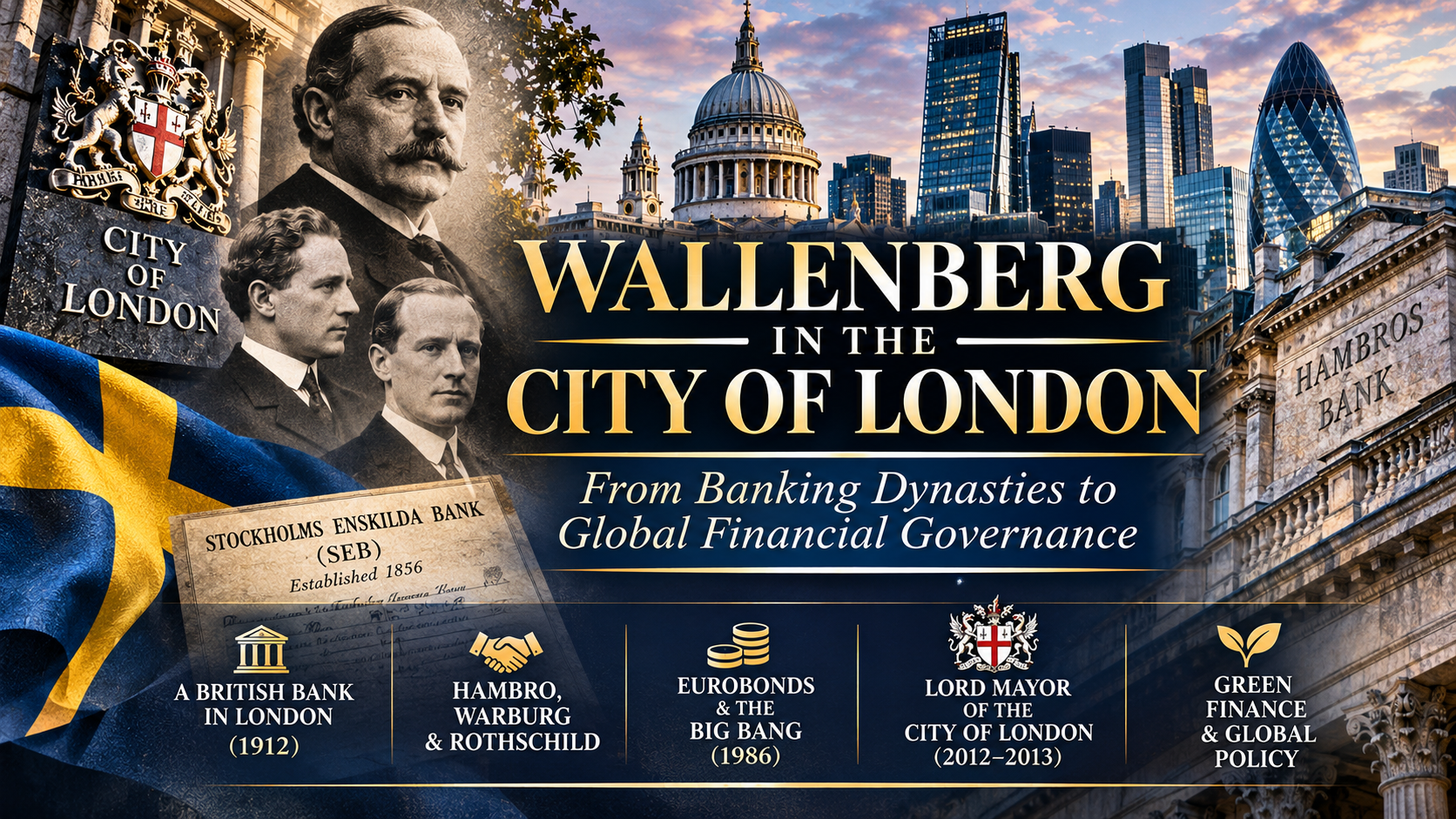
From Banking Dynasties and British Intelligence to Global Financial Governance
The Wallenberg family’s international influence extends far beyond Swedish industry. For more than a century, the family and its associated financial institutions have maintained significant relationships with the City of London, one of the world’s most important centres for banking, international capital markets and financial services.
These connections encompass the British banking houses of Hambro and Warburg, the development of international bond markets, Britain’s financial deregulation and even the office of Lord Mayor of the City of London.
The historical record reveals how a Swedish banking dynasty became deeply integrated into British financial and institutional networks.
1. The British Origins of the Wallenberg Banking Model
In 1856, André Oscar Wallenberg founded Stockholms Enskilda Bank, the predecessor of today’s SEB.
According to the Wallenberg family’s own historical account, the bank was established using a Scottish banking model. It introduced new methods of directing savings and private capital towards industrial development in Sweden.
During the following decades, the bank developed international relationships with European financial institutions involved in sovereign debt, railway construction and industrial financing.
Among the prominent foreign banking houses active in the Swedish capital market were Hambro, Rothschild and Warburg.
By the beginning of the twentieth century, the Wallenberg family’s ambitions extended beyond international banking partnerships. It sought an institutional presence within the British financial system itself.
2. Establishing a Bank in London
In 1911, Knut Agathon Wallenberg expressed his ambition to establish:
an English bank à nous
In other words, a British bank of their own.
In 1912, the Wallenbergs participated in the establishment of the British Bank of Northern Commerce in London.
The bank subsequently merged with C.J. Hambro & Son in 1920, becoming Hambros Bank in 1921.
Historical research published in the Scandinavian Economic History Review confirms that the Wallenberg family maintained representation on the bank’s board.
In correspondence with Harald Bendixson, who became a senior figure in the bank, K.A. Wallenberg emphasised the importance of Scandinavian influence:
The majority lies on this side of the North Sea.
This correspondence demonstrates that the family’s objective was not merely access to British capital markets, but participation in the ownership and governance of a British banking institution.
Hambros operated from the heart of the City of London and became an important financial intermediary between Britain, Scandinavia and international markets.
3. Hambro and Wallenberg: Banking, Family and British Intelligence
The relationship between Hambro and Wallenberg extended beyond banking.
In 1936, the British banker Sir Charles Jocelyn Hambro married Dorothy Helen Mackay, the former wife of Marcus Wallenberg (1899–1982), thereby establishing a direct family connection between the two banking dynasties.
Charles Hambro subsequently became head of Britain’s Special Operations Executive (SOE), the wartime organisation responsible for supporting resistance movements and conducting covert operations in occupied Europe.
During the Second World War, Jacob and Marcus Wallenberg maintained contacts with British officials and acted as intermediaries in communications involving members of the German resistance.
Historical correspondence and academic research document relationships connecting the Wallenberg brothers, Hambro and the British wartime establishment.
These relationships illustrate how international banking networks could overlap with diplomacy, government and intelligence during a period of global conflict.
4. Rothschild, Warburg and the International Banking Network
The Swedish government’s official investigation, Sweden and Jewish Assets (SOU 1999:20), documents further connections between the Wallenberg family and two prominent European banking dynasties.
In 1937, Jacob Wallenberg entered negotiations with Max Warburg concerning possible Swedish participation in the ownership of M.M. Warburg & Co. in Hamburg.
Max Warburg was the brother of Paul Warburg, one of the principal architects of the American Federal Reserve System.
During 1938 and 1939, the Wallenbergs also participated in negotiations concerning the Rothschild family’s Witkowitz industrial assets in Czechoslovakia.
The proposed arrangements involved Swiss Bank Corporation, a predecessor of today’s UBS, alongside other European financial interests.
Neither proposed transaction was completed. Both must be understood within the historical context of Nazi persecution and the forced transfer of Jewish-owned businesses.
Nevertheless, the documentary record establishes direct business negotiations between the Wallenberg, Warburg and Rothschild networks.
5. From the City of London to Wall Street and the BIS
The Wallenberg family’s international banking relationships also extended into the United States and the emerging system of central bank cooperation.
In June 1932, the Federal Reserve Bulletin recorded the appointment of Marcus Wallenberg Sr as chairman of an arbitration committee established by the Bank for International Settlements (BIS).
The committee dealt with disputes arising from international German credit agreements.
Among its members was Thomas H. McKittrick, who subsequently became president of the BIS during the Second World War.
A letter dated 8 February 1934, preserved in the Wallenberg historical archives, provides further evidence of the family’s American relationships.
Marcus Wallenberg Jr identified James Paul Warburg, son of Federal Reserve architect Paul Warburg, and Robert A. Lovett of Brown Brothers Harriman as close personal friends.
The letter also identifies the Bank of the Manhattan Company, a predecessor of JPMorgan Chase, as one of Stockholms Enskilda Bank’s correspondent banks.
Robert Lovett later became United States Secretary of Defense.
These historical documents connect the Wallenberg banking network with prominent American financial institutions and individuals who subsequently occupied senior government positions.
They do not establish Wallenberg participation in drafting the Federal Reserve Act of 1913, but they document the family’s involvement in the international financial architecture that developed during the following decades.
6. Warburg, Eurobonds and London’s International Capital Markets
After the Second World War, London developed into a major centre for international securities and offshore currency markets.
In 1963, S.G. Warburg led the landmark Autostrade bond issue, widely recognised as the beginning of the modern Eurobond market.
In a recorded interview conducted in April 2019, British banker Sir Roger Gifford also identified SEB banker Rolf Hallberg as an early contributor to the development of this market.
The Eurobond market became an important mechanism for raising capital internationally, including in US dollars outside the domestic American financial market.
The modern Wallenberg family maintained professional connections with S.G. Warburg. Marcus Wallenberg, the present-day Swedish banker, worked at the institution during his international banking career.
Gifford himself joined S.G. Warburg in 1978 after being interviewed by its founder, Siegmund Warburg.
These professional relationships continued through the development of SEB’s investment banking operations in London.
7. Enskilda Securities and the Big Bang of 1986
Sir Roger Gifford’s 2019 oral history interview provides a particularly valuable account of the Wallenberg banking network’s expansion in London.
Gifford recalled how a group of bankers from Hambros approached Marcus Wallenberg about establishing a new financial business, which developed into Enskilda Securities.
Supported by SEB, the operation built capabilities in securities, corporate finance and international capital markets.
Gifford described the business as having adopted an organisational structure anticipating the liberalisation of London’s financial markets.
On 27 October 1986, the British government implemented the financial reforms known as the Big Bang.
These reforms transformed the London Stock Exchange and accelerated the internationalisation of British investment banking.
The Wallenberg-associated operation was already positioned within this increasingly competitive financial environment.
8. An SEB Banker Becomes Lord Mayor of the City of London
Perhaps the clearest institutional connection between the Wallenberg sphere and the City of London Corporation is the career of Sir Roger Gifford.
After working at S.G. Warburg, Gifford joined Enskilda Securities and developed a long career within SEB.
He subsequently held several senior civic and financial positions:
- Head of SEB’s UK operations, 2000–2017.
- Alderman of the City of London, first elected in 2004.
- Sheriff of the City of London, 2008–2009.
- Lord Mayor of the City of London, 2012–2013.
- Chairman of the Green Finance Initiative, launched in 2016.
- Chairman of the UK Government’s Green Finance Taskforce.
- Chairman of the Green Finance Institute.
The City of London Corporation officially confirmed these institutional connections in its tribute to Gifford following his death in 2021.
The Lord Mayor of the City of London is distinct from the Mayor of Greater London. The office plays an important representative role in promoting Britain’s financial and professional services internationally.
Gifford’s career therefore provides a direct documented link between the Wallenberg-associated bank and the civic leadership of the Square Mile.
9. The City of London’s Corporate Electoral System
The City of London Corporation operates under an unusual system of local government.
Unlike most British municipalities, eligible businesses and organisations can appoint individuals to vote in local elections. The number of appointments is determined by the size of the organisation’s workforce.
This gives qualifying financial institutions and other employers a formal avenue for participation in the City’s municipal democratic process.
SEB maintains an established banking presence within the Square Mile.
Although SEB’s specific electoral representation has not been established in this investigation, Gifford’s documented career demonstrates how senior financial professionals can simultaneously participate in the City’s civic institutions.
10. Green Finance: From the City of London to Global Policy
On 14 January 2016, the City of London Corporation launched its Green Finance Initiative.
Among the announced speakers were:
- Sir Roger Gifford, senior SEB banker and former Lord Mayor.
- Ma Jun, Chief Economist of the People’s Bank of China.
- Achim Steiner, Executive Director of the United Nations Environment Programme.
- Nick Robins, Co-director of the UNEP inquiry into sustainable financial systems.
- Lord Mountevans, the serving Lord Mayor of the City of London.
The initiative sought to expand green investment, develop financial standards and increase the role of capital markets in environmental policy.
Gifford subsequently chaired the British government’s Green Finance Taskforce, whose recommendations contributed to the development of the UK’s Green Finance Strategy.
This represents a documented example of cooperation between private banking, municipal institutions, national government, the United Nations and Chinese financial policymakers.
11. HSBC and the Wallenberg Banking Network
The relationship between SEB and the British financial establishment extends beyond Gifford.
In 2022, former HSBC Group Chief Executive John Flint joined the board of SEB under the chairmanship of Marcus Wallenberg.
Flint had previously been appointed by the British government to lead the UK Infrastructure Bank, which subsequently became part of the UK’s National Wealth Fund initiative.
His professional history connects international commercial banking, strategic British infrastructure investment and the governance of SEB.
It represents a contemporary example of the continuing relationships between the Wallenberg sphere and Britain’s financial establishment.
Conclusion: More Than a Banking Relationship
From the establishment of Stockholms Enskilda Bank in 1856 to the creation of a British banking institution in 1912, the Wallenberg family developed an international financial network that extended well beyond Sweden.
Its documented historical relationships include Hambro, Warburg, Rothschild, American correspondent banks and the Bank for International Settlements.
In the modern era, these relationships evolved into investment banking, international capital markets, financial policy development and participation in the civic institutions of the City of London.
The career of Sir Roger Gifford provides perhaps the clearest illustration of this institutional overlap: a senior banker within the Wallenberg-associated financial sphere who also became Lord Mayor of the City of London and subsequently helped shape British green finance policy.
The Wallenberg family’s traditional motto, Esse non Videri, commonly expressed in Swedish as Att verka utan att synas, provides an interesting historical contrast to the importance of transparency in modern financial governance.
The documented relationships do not establish a single structure of ownership or command over these institutions. They do, however, reveal the depth and longevity of the networks connecting Swedish private capital with the British and international financial establishment.
Understanding these relationships is essential to understanding how financial influence can develop through ownership, professional appointments, institutional participation and personal networks across generations.
Sources and Further Reading
- Wallenberg – Five Generations in the Service of Enterprise
- SEB – Corporate History
- Scandinavian Economic History Review – Swedish Capital and Entrepreneurial Strategies in Greece During the Interwar Period
- The London Archives – Hambros Bank Historical Records
- British Intelligence and the July Bomb Plot of 1944: A Reappraisal
- Swedish Government Investigation – Sweden and Jewish Assets, SOU 1999:20
- Federal Reserve History – Paul M. Warburg
- Federal Reserve Bulletin – June 1932
- Wallenberg Historical Archives – Banking & Enterprise
- International Capital Market Association – History of the Eurobond Market
- Worshipful Company of International Bankers – Oral History Interview with Sir Roger Gifford, 26 April 2019
- City of London Corporation – Tribute to Sir Roger Gifford
- City of London Corporation – Business Vote Registration
- City of London Corporation – Launch of the Green Finance Initiative
- UK Government – Green Finance Taskforce Report
- HM Treasury – Appointment of John Flint as Chief Executive of the UK Infrastructure Bank