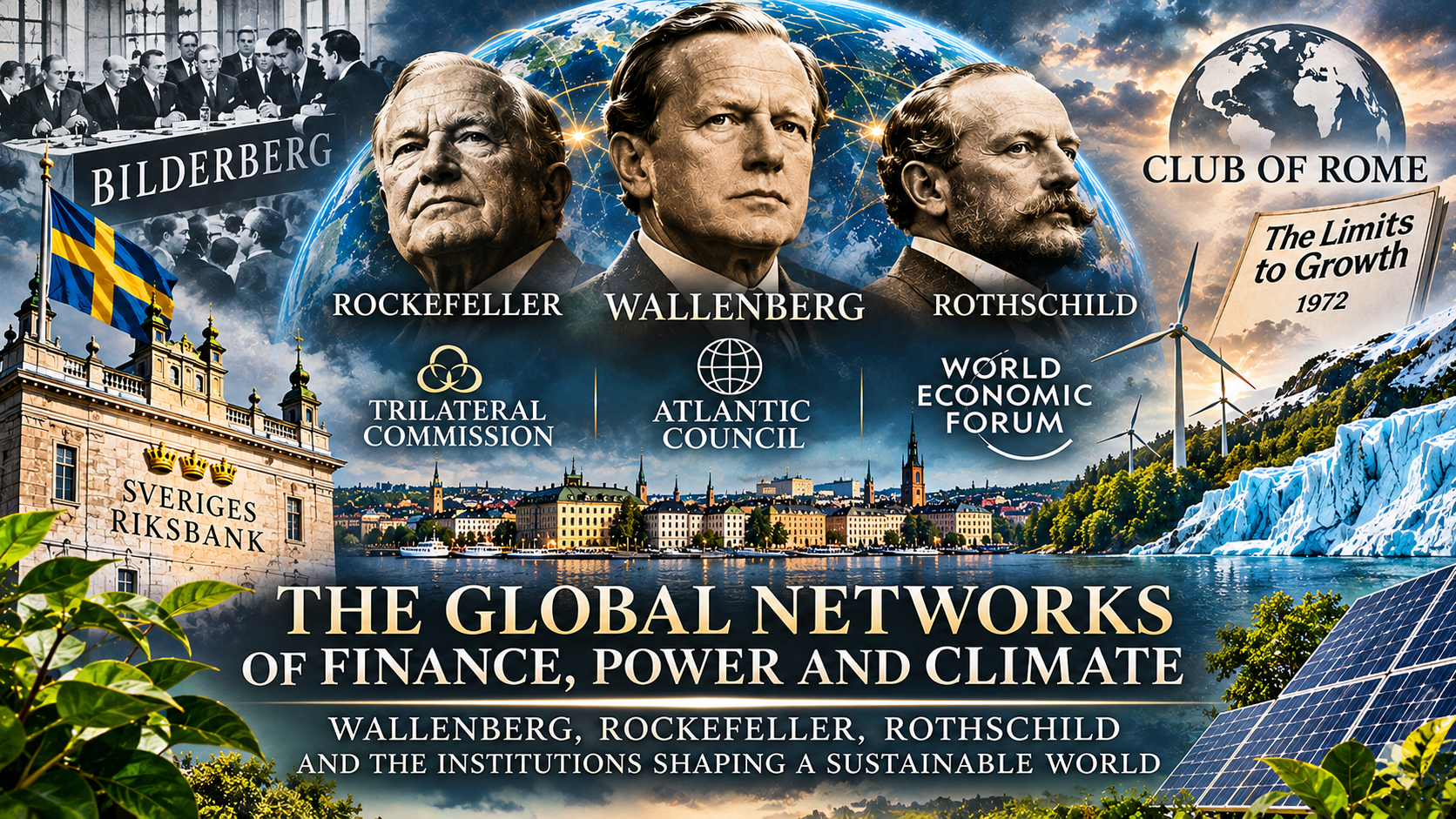
From Bilderberg, Rockefeller and Rothschild to the Club of Rome, Climate Governance and the Transformation of the Global Economy
Estimated reading time: 10 minutes
Behind the development of international economic, environmental and security policy lies a series of interconnected institutions that have brought together political leaders, industrialists, bankers, scientists and international policymakers for more than half a century.
Among these institutions are the Bilderberg Group, the Club of Rome, the Trilateral Commission, the Atlantic Council and the World Economic Forum. Their activities span international finance, geopolitical cooperation, environmental research, technological development and economic transformation.
One family appears repeatedly throughout this institutional landscape: the Swedish Wallenberg family. Historical conference records, World Bank archives, academic research and the family’s own publications reveal connections involving the Rockefeller and Rothschild families, Swedish political leaders and institutions that have contributed to the development of international environmental and economic policy.
1. Bilderberg: The Historical Meeting Place
Established in 1954, the Bilderberg Group brought together influential individuals from Western Europe and North America. Its conferences became meeting places for senior political figures, financial executives, industrial leaders, academics and representatives of international institutions.
Over the following decades, members of the Wallenberg, Rockefeller and Rothschild families participated in these conferences. Bilderberg’s official historical records identify David Rockefeller, Edmond de Rothschild, Giovanni Agnelli, Henry Kissinger and Klaus Schwab among its former Steering Committee members.
The Swedish connection extends beyond attendance. The organisation’s historical leadership records include Swedish industrial figures, while Marcus Wallenberg, chairman of SEB, is listed on its modern Steering Committee alongside representatives of international banking, technology, investment and security institutions.
These conferences provide a historical record of the contacts established between European and American political and economic establishments. They also reveal connections between the individuals who subsequently became involved in global environmental initiatives.
2. Wallenberg, Rockefeller, Rothschild and the Club of Rome
One significant example is the Bilderberg conference held in Bad Ragaz, Switzerland, on 17–19 April 1970.
The participant list includes Marcus Wallenberg, David Rockefeller, Edmond de Rothschild, Giovanni Agnelli and Alexander King, the co-founder of the Club of Rome. John D. Rockefeller IV and Swedish Social Democratic politician Sven Moberg also attended.
The meeting took place two years after the establishment of the Club of Rome and two years before the publication of its internationally influential report The Limits to Growth.
This brings together representatives of three prominent banking families, the Italian industrial establishment and one of the founders of an organisation that would become a major advocate of long-term environmental and economic planning.
The significance of this connection becomes clearer when examining the origins of the Club of Rome itself and the scientific institutions that emerged around its founders.
3. The Origins of the Club of Rome
The Club of Rome was founded in 1968 by Italian industrialist Aurelio Peccei and Scottish scientist Alexander King, who held a senior scientific position at the OECD.
Their project emerged from discussions about population growth, industrialisation, technological change, natural resources and the capacity of governments to address interconnected international problems.
In 1972, a research team at the Massachusetts Institute of Technology produced The Limits to Growth, commissioned by the Club of Rome. Its authors, Donella Meadows, Dennis Meadows, Jørgen Randers and William Behrens, used computer modelling to investigate possible long-term interactions between economic activity, population, industrial output, pollution and finite resources.
The report challenged prevailing assumptions about unlimited material expansion. Its findings were conditional scenarios rather than fixed predictions, but the publication established an influential framework for subsequent debates concerning sustainability, resource consumption and economic policy.
During the same period, Sweden became an important institutional centre for international environmental research.
4. Sweden, Olof Palme and Alva Myrdal
The Club of Rome’s early activities intersected with Swedish political discussions about long-term planning and the future of industrial society.
Research by historian Jenny Andersson, published by Cambridge University Press, documents these contacts through correspondence preserved in Alva Myrdal’s archive.
Aurelio Peccei was invited to Stockholm and visited the Swedish Research Advisory Board in 1971. The visit generated considerable controversy among Swedish environmentalists and researchers.
Hans Palmstierna, a prominent Swedish environmental figure, expressed serious reservations about Peccei’s ideas in correspondence with economist and Nobel laureate Gunnar Myrdal. In a letter dated 5 March 1972, Palmstierna expressed his belief that the Club of Rome was influencing Prime Minister Olof Palme.
Palme’s own position was more complex. When appointing a Swedish futures studies group under Alva Myrdal in May 1971, he emphasised democratic participation and warned against the concentration of future-oriented research in the hands of powerful private interests.
These archival exchanges demonstrate that the Club of Rome had already entered Swedish governmental and intellectual discussions before the publication of The Limits to Growth. They also reveal a contemporary debate about who should shape society’s long-term priorities.
5. Stockholm 1972 and the Emergence of Environmental Governance
In June 1972, Stockholm hosted the United Nations Conference on the Human Environment, a landmark event in the development of international environmental cooperation.
The conference helped establish environmental issues as a permanent component of international diplomacy and contributed to the creation of the United Nations Environment Programme, UNEP.
Another important institutional development took place in Sweden that same year: the establishment of the International Federation of Institutes for Advanced Study, known as IFIAS.
Academic research published in Stockholm and the Rise of Global Environmental Governance traces the organisation’s origins to discussions initiated by Swedish Nobel laureate Arne Tiselius in 1969.
The Swedish central bank, the Nobel Foundation and the Rockefeller Foundation supported its establishment. The Swedish king provided premises for its secretariat at Ulriksdal Palace.
IFIAS brought together scientific institutions to investigate complex international problems. Its intellectual and organisational relationship with the Club of Rome was particularly close.
Swedish nuclear physicist Sam Nilsson, the Club of Rome’s first Swedish member, became the founding director of IFIAS. Both Aurelio Peccei and Alexander King served as trustees, with King becoming its chairman in 1974.
The two founders of the Club of Rome therefore held formal positions within an international scientific organisation based in Sweden.
6. The World Bank Archives: Wallenberg Financing in 1973
A particularly revealing document is preserved in the World Bank’s historical archives.
On 9 April 1973, IFIAS chairman Nils Ståhle and managing director Sam Nilsson met with World Bank president Robert McNamara to discuss their organisation, its research programme and its financing.
When McNamara asked about the sources of its financial support, the official memorandum recorded the following response:
The sources were mainly the Wallenberg Foundation and Mr. Robert Anderson (U.S.).
The memorandum describes annual secretariat funding of $30,000 for three years, together with $50,000 for project preparation and workshops. Individual research projects were to receive separate financing.
The planned areas of research included water resources, human settlements, energy, biotechnology and climatic changes.
This document establishes a direct financial relationship between the Wallenberg Foundation and IFIAS, an organisation whose trustees included both founders of the Club of Rome.
Robert O. Anderson was a leading American oil industry executive associated with Atlantic Richfield Company, ARCO.
The archival record is especially significant because it identifies private financial support for international environmental and climate-related research during the early 1970s, at a time when the institutional framework of global environmental governance was still developing.
7. Bilderberg Returns to Sweden: Saltsjöbaden 1973
Approximately one month after the documented IFIAS meeting at the World Bank, another international gathering took place in Sweden.
On 11–13 May 1973, Bilderberg held its conference at the Grand Hotel Saltsjöbaden under the chairmanship of Prince Bernhard of the Netherlands.
The historical conference records identify participants including Marcus Wallenberg, Edmond de Rothschild, Giovanni Agnelli, Robert O. Anderson and Zbigniew Brzezinski. Swedish political participants included Prime Minister Olof Palme, Finance Minister Gunnar Sträng and Foreign Minister Krister Wickman.
The conference report identifies two principal subjects: European energy policy and its implications for relations with North America, and differing expectations concerning European security cooperation.
The juxtaposition of these subjects is historically notable. Energy security, industrial development, international capital and geopolitical cooperation were becoming increasingly interdependent concerns.
Later that year, the international oil crisis would expose the vulnerability of Western industrial economies to disruptions in energy supply.
The Saltsjöbaden records provide a concrete example of Swedish political leaders meeting international bankers, industrialists and geopolitical strategists to discuss these questions.
8. Rockefeller and the Trilateral Commission
In 1973, David Rockefeller established the Trilateral Commission with the involvement of political scientist Zbigniew Brzezinski.
Its purpose was to strengthen cooperation between North America, Western Europe and Japan. Its geographical scope subsequently expanded to include other parts of Asia.
The commission brought together individuals from business, government, academia and international affairs to discuss economic cooperation, political developments and long-term international challenges.
The involvement of Rockefeller and Brzezinski illustrates the historical overlap between Bilderberg’s transatlantic discussions and the development of a broader international policy network.
Today, Jacob Wallenberg is identified as a member of the Trilateral Commission in the organisation’s own biographical records.
His professional responsibilities have included leadership positions within Investor AB and SEB, board responsibilities in major international companies and involvement with the Knut and Alice Wallenberg Foundation.
His international affiliations also extend to China through Tsinghua University and Shanghai’s International Business Leaders’ Advisory Council.
9. The Wallenberg Family’s Own Network Strategy
The Wallenberg organisation published a particularly informative description of its international engagements in 2017.
The publication explains that the Wallenberg Office develops the family’s relationships through systematic and coordinated networking. It also describes activities intended to prepare future generations to maintain and develop those relationships.
The publication identifies Marcus Wallenberg’s involvement with Bilderberg, Brookings, the International Institute for Strategic Studies, the International Chamber of Commerce and the Asia Business Council.
Jacob Wallenberg’s listed affiliations include the Atlantic Council, the Trilateral Commission, the World Economic Forum, the European Round Table of Industrialists, the China Development Forum and Shanghai’s International Business Leaders’ Advisory Council.
Peter Wallenberg Jr is associated with the German Marshall Fund.
This is an institutional record published by the Wallenberg organisation itself. It demonstrates that international networking forms an explicitly recognised component of the family’s long-term strategy.
Taken together, these affiliations span international security, diplomatic relations, industrial policy, financial cooperation and economic development across Europe, North America and Asia.
10. The Atlantic Council and Carl Bildt
The Atlantic Council, established in 1961 and based in Washington, D.C., focuses on international affairs, transatlantic cooperation, security and economic policy.
Its International Advisory Board includes both Jacob Wallenberg and former Swedish Prime Minister and Foreign Minister Carl Bildt.
Other individuals listed on this advisory body include former US Director of National Intelligence James Clapper, former Chairman of the Joint Chiefs of Staff Joseph Dunford, former NATO Secretary General George Robertson, former US Treasury Secretary Lawrence Summers and former World Bank president Robert Zoellick.
Carl Bildt provides a further connection between Swedish political leadership and the Wallenberg family’s international institutional relationships.
His published biography at the Stockholm Resilience Centre identifies him as a senior adviser to the Wallenberg Foundations, a trustee of the RAND Corporation and a former Prime Minister and Foreign Minister of Sweden.
These appointments demonstrate how international security-policy institutions, Swedish political experience and private-sector advisory networks can intersect through the same individuals.
11. From the Limits to Growth to the Planetary Boundaries
The establishment of the Stockholm Resilience Centre in 2007 marked another important stage in Sweden’s international environmental research.
The centre became associated with research into planetary boundaries, exploring the environmental conditions within which human societies can develop while maintaining the stability of major Earth-system processes.
In 2012, Swedish environmental researcher Johan Rockström and former Swedish and European parliamentarian Anders Wijkman published Bankrupting Nature as a report to the Club of Rome.
The publication called for changes in economic priorities, resource consumption and business models. It questioned the use of GDP growth as the principal measure of societal progress and advocated greater emphasis on welfare and resource efficiency.
The relationship between Rockström’s environmental research and Wijkman’s involvement with the Club of Rome represents a continuation of discussions that had begun with the organisation’s earlier work on industrialisation and resource constraints.
The Swedish connections, however, extend beyond the academic world.
12. Anders Wijkman and Sweden’s Climate Policy
Anders Wijkman served as co-president of the Club of Rome during the period 2012–2018.
His professional background includes membership of the Swedish Parliament, service in the European Parliament and senior positions within international and environmental organisations.
While involved in the leadership of the Club of Rome, Wijkman also chaired Sweden’s parliamentary Environmental Objectives Committee, Miljömålsberedningen.
Its proposals contributed to the climate policy framework adopted by the Swedish Parliament in 2017.
The framework established a national Climate Act, an independent Climate Policy Council and the objective of achieving net-zero greenhouse gas emissions by 2045.
Wijkman’s overlapping responsibilities provide a documented example of an individual occupying leadership roles in both an international sustainability organisation and an important Swedish parliamentary policy-development process.
13. Jacob Wallenberg and Earth4All
The institutional relationships established during the 1970s have modern counterparts.
The Club of Rome’s Earth4All initiative is a collaboration involving the Stockholm Resilience Centre, the Potsdam Institute for Climate Impact Research and BI Norwegian Business School.
Its main publication, Earth for All: A Survival Guide for Humanity, was launched in 2022 at events that included the New York Stock Exchange.
The initiative examines changes in energy, food systems, poverty, inequality and empowerment, linking environmental sustainability with economic and social policy.
Jacob Wallenberg is listed on the International Advisory Board of the Stockholm Resilience Centre, the same research institution participating in Earth4All.
The centre’s official description of its advisory board also identifies Carl Bildt as a former member.
This creates a contemporary institutional connection between the Club of Rome’s international research programme, Swedish environmental science, Wallenberg’s business network and former Swedish political leadership.
Approximately five decades separate this collaboration from the establishment of IFIAS in 1972.
14. SEB, the City of London and Green Finance
The development of environmental policy has increasingly intersected with international capital markets.
One particularly relevant figure was Sir Roger Gifford, a senior SEB banker and Lord Mayor of the City of London in 2012–2013.
In 2016, Gifford became chairman of the City of London’s Green Finance Initiative, which aimed to expand the financial sector’s contribution to international climate objectives.
Its work included developing markets for green bonds, encouraging investment in low-carbon infrastructure and improving financial standards.
The initiative’s launch brought together representatives of the financial industry, UNEP and the People’s Bank of China.
In 2017, Gifford was appointed chairman of the British government’s Green Finance Taskforce. He subsequently chaired the Green Finance Institute.
His career illustrates a direct institutional connection between a leading Swedish bank, London’s financial establishment and the development of British and international green finance policy.
The environmental questions explored by the Club of Rome during the 1970s had, by this stage, become important considerations in investment decisions, infrastructure financing and the development of new financial markets.
15. Bilderberg in Stockholm: Half a Century Later
On 12–15 June 2025, Bilderberg once again held its annual conference in Stockholm.
The official participant list identifies both Marcus and Jacob Wallenberg, alongside Swedish Social Democratic leader Magdalena Andersson.
International participants included NATO Secretary General Mark Rutte, US Indo-Pacific Command commander Samuel Paparo, Microsoft CEO Satya Nadella, investor Peter Thiel and former US Treasury Secretary Lawrence Summers.
Marcus Wallenberg’s involvement also extends to Bilderberg’s Steering Committee, placing him within the organisation’s formal leadership structure.
The 2025 meeting illustrates the continuing intersection of political leadership, international security, advanced technology, industrial development and global finance.
More than half a century after the 1973 gathering in Saltsjöbaden, Sweden was again the setting for discussions involving prominent representatives of these sectors.
Conclusion: The Intersection of Finance, Politics and Environmental Governance
The historical record reveals a series of institutional relationships extending across generations.
Marcus Wallenberg attended Bilderberg conferences alongside David Rockefeller, Edmond de Rothschild and Alexander King. The Wallenberg Foundation subsequently provided financial support to IFIAS, where both founders of the Club of Rome held formal positions.
Swedish political leaders engaged with international discussions about environmental research, energy policy and long-term economic planning. Decades later, Anders Wijkman combined leadership of the Club of Rome with responsibility for developing Swedish environmental policy.
Meanwhile, the Wallenberg family’s international engagements expanded through the Atlantic Council, the Trilateral Commission, the World Economic Forum and other security, economic and industrial institutions.
Jacob Wallenberg’s advisory role at the Stockholm Resilience Centre provides another documented connection to the modern research environment surrounding the Club of Rome, while SEB’s Roger Gifford played a prominent role in the institutional development of green finance.
These relationships represent different forms of participation: financial sponsorship, advisory appointments, scientific collaboration, conference attendance and policy development. Their significance lies in the opportunities they create for exchanging ideas, building relationships and influencing institutional priorities.
The archives establish Sweden as an important meeting point between international financial networks, environmental research and political cooperation.
Understanding how these networks operate, how they are financed and how their proposals enter public policy remains an important subject for democratic scrutiny.
Sources and Historical Documents
Bilderberg
- Bilderberg Meetings, official list of former Steering Committee members, including Edmond de Rothschild and David Rockefeller.
https://www.bilderbergmeetings.org/background/steering-committee/former-steering-committee-members
- Bilderberg Meetings, official Steering Committee.
https://www.bilderbergmeetings.org/background/steering-committee/steering-committee
- Bilderberg conference participant list and agenda, Bad Ragaz, Switzerland, April 1970. Historical reproduction.
https://publicintelligence.net/1970-bilderberg-meeting-participant-list
- Bilderberg Conference Report, Saltsjöbaden, Sweden, 11–13 May 1973. Reproduction of the original confidential conference report.
https://info.publicintelligence.net/bilderberg/BilderbergConferenceReport1973.pdf
- Bilderberg Meetings, official Stockholm participant list, June 2025.
https://www.bilderbergmeetings.org/meetings/meeting-2025/participants-2025
The Club of Rome and Environmental Governance
- Club of Rome, official institutional history.
- Club of Rome, historical timeline, including the publication of The Limits to Growth and the establishment of Earth4All.
- Stockholm and the Rise of Global Environmental Governance, chapter Enter the Earth System. Cambridge University Press. Documents IFIAS, its institutional supporters and the involvement of Peccei, King and Nilsson.
- United Nations, Stockholm Conference on the Human Environment, 1972.
https://www.un.org/en/conferences/environment/stockholm1972
Swedish Political History and World Bank Archives
- Jenny Andersson, Choosing Futures: Alva Myrdal and the Construction of Swedish Futures Studies, 1967–1972. International Review of Social History, Cambridge University Press, 2006.
https://doi.org/10.1017/S0020859006002458
- World Bank Group Archives, Memorandum for the Record: Visit of Messrs. Stahle and Nilsson, of IFIAS, April 9, 1973. Documents Wallenberg Foundation financing and the planned research programme.
Wallenberg’s International Networks
- Wallenberg, institutional publication, 2017. Networks and Additional Engagements, pages 38–39.
https://www.wallenberg.com/sites/default/files/wallenberg_about_us_english_lowres_0.pdf
- Trilateral Commission, official Jacob Wallenberg biography.
https://www.trilateral.org/people/jacob-wallenberg
- Atlantic Council, International Advisory Board.
- European Round Table for Industry, Jacob Wallenberg biography.
https://ert.eu/members/jacob-wallenberg
Environmental Research and Swedish Climate Policy
- Club of Rome, Bankrupting Nature, Anders Wijkman and Johan Rockström, 2012.
https://www.clubofrome.org/publication/bankrupting-nature-4
- Anders Wijkman, article concerning the proposals of Sweden’s Environmental Objectives Committee, 2016.
https://www.svd.se/a/gPBMA/sverige-kan-och-bor-ga-fore-i-klimatpolitiken
- Government of Sweden, Sweden’s Climate Policy Framework.
https://government.se/articles/2021/03/swedens-climate-policy-framework
- Stockholm Resilience Centre, International Advisory Board, including Jacob Wallenberg and the biography of former member Carl Bildt.
SEB and Green Finance
- City of London Corporation, launch of the Green Finance Initiative, 2016.
- City of London Corporation, Sir Roger Gifford appointed chairman of the UK Government Green Finance Taskforce, 2017.
- City of London Corporation, official tribute to Sir Roger Gifford, 2021.
https://news.cityoflondon.gov.uk/city-of-london-corporation-pays-tribute-to-sir-roger-gifford


