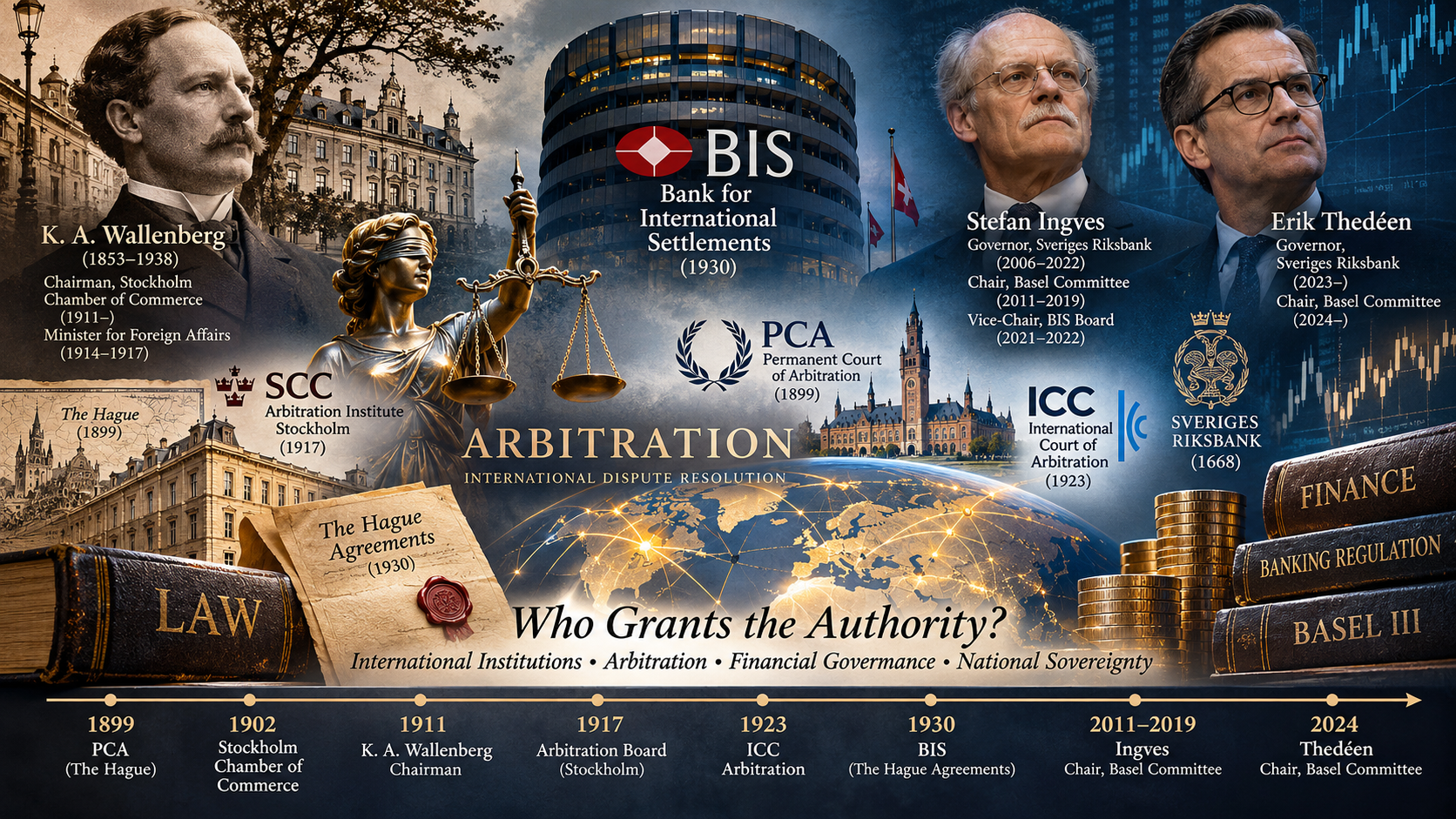
The historical relationship between Sweden, international arbitration, and global financial institutions reveals a remarkable continuity in the country’s involvement in shaping mechanisms for resolving disputes and governing international economic relations.
The story begins long before the establishment of the International Criminal Court.
In 1917, the Arbitration Institute of the Stockholm Chamber of Commerce, today known as the SCC Arbitration Institute, was established in Sweden. It subsequently developed into an internationally recognized institution for resolving commercial and investment disputes.
Sweden’s position became particularly significant during the Cold War. In 1977, an agreement between the American Arbitration Association and the Soviet Chamber of Commerce and Industry established Stockholm as a forum for resolving commercial disputes between American and Soviet parties. In 1984, the SCC also entered into a cooperation agreement with the China Council for the Promotion of International Trade.
Stockholm thus became an important venue for international dispute resolution involving the United States, the Soviet Union, and China. [1]
The Wallenberg Connection to International Arbitration
The Wallenberg family’s involvement in international economic governance is documented in historical financial records. A particularly revealing example appears in the Federal Reserve Bulletin of June 1932.
The publication records that the Bank for International Settlements (BIS) appointed an arbitration committee to address disputes concerning international agreements on short-term banking credits to Germany.
Marcus Wallenberg was appointed chairman of this arbitration committee, alongside T. H. McKittrick Jr. and Franz Urbig. The committee was reappointed in 1932 following the renewal of the international banking agreement. [2]
This places a prominent Swedish banker in a documented leadership position within an international dispute-resolution mechanism established by BIS during one of the most turbulent periods in modern financial history.
The Wallenberg connection also extends to the present-day International Chamber of Commerce (ICC). According to ICC Sweden’s official organizational records, Marcus Wallenberg serves as Treasurer (Kassaförvaltare) on its governing board, the Överstyrelse. [3]
The International Chamber of Commerce is a major international business organization whose activities include commercial arbitration, trade rules, and international business policy.
Sveriges Riksbank and the Creation of BIS
Sweden’s involvement in international financial governance is equally significant.
The Bank for International Settlements was established in 1930 in connection with the international agreements addressing German reparations following the First World War.
Sveriges Riksbank became a BIS shareholder that same year and obtained representation on its Board of Directors in 1931. In its own historical research, the Riksbank emphasizes the importance of this early position for Sweden’s influence in international monetary cooperation. [4]
Today, BIS serves as a central forum for cooperation among central banks and supports the development of international financial standards.
Sweden continues to hold a prominent position within this framework.
Sweden’s Continued Influence over Global Banking Standards
Sweden’s influence within the Bank for International Settlements extends well beyond its early involvement in 1930.
Stefan Ingves, Governor of Sveriges Riksbank from 2006 to 2022, served on the BIS Board of Directors, chaired its Banking and Risk Management Committee, and became Vice-Chairman of the BIS Board in 2021.
Between 2011 and 2019, he also chaired the Basel Committee on Banking Supervision, overseeing the completion of the Basel III post-crisis regulatory reforms. In a speech delivered on November 30, 2016, Ingves explicitly acknowledged that the Basel Committee has no legal enforcement power and relies on participating jurisdictions to implement its standards.
Since June 2024, Riksbank Governor Erik Thedéen has chaired the Basel Committee on Banking Supervision, one of the principal international bodies responsible for developing banking regulatory standards.
From BIS and Sveriges Riksbank to the Leadership of the IMF
Sweden’s influence within international financial institutions dates back to the early years of the Bretton Woods system.
Ivar Rooth, Governor of Sveriges Riksbank from 1929 to 1948, became the IMF’s second Managing Director in 1951, serving until 1956.
He was succeeded by another Swede, Per Jacobsson, who had spent 25 years working as an economic adviser at the Bank for International Settlements (BIS) before leading the IMF from 1956 until 1963.
For twelve consecutive years, two Swedish financial officials led the IMF during a formative period in the development of the post-war international monetary system. Their careers demonstrate a historical continuity between Sveriges Riksbank, BIS and the IMF, extending well beyond Sweden’s formal membership in these institutions.
Related articles: BIS – Bank of International Settlement, Marcus Wallenberg, Per Jacobsson & Kreuger
Sweden’s Current Role in Global Financial Governance
The international influence of Sweden’s central bank governors extends beyond BIS and the Basel Committee to the International Monetary Fund (IMF).
Between 1999 and 2005, Stefan Ingves served as Director of the IMF’s Monetary and Financial Systems Department. Upon becoming Governor of Sveriges Riksbank in 2006, he also became Sweden’s Governor at the IMF, a position he held until the end of 2022, alongside his senior responsibilities within BIS.
His successor, Erik Thedéen, continued this institutional representation in 2023. His international responsibilities include:
- Governor for Sweden on the IMF’s Board of Governors, its highest decision-making body.
- Member of the BIS Board of Directors.
- Chairman of the Basel Committee on Banking Supervision since June 2024.
- Member of the BIS Innovation Hub Advisory Committee.
- Member of the European Central Bank’s General Council.
- Member of the European Systemic Risk Board’s General Board.
These overlapping appointments illustrate Sweden’s longstanding participation in the international institutions responsible for monetary cooperation, financial stability, banking regulation and the development of future financial infrastructure.
Sweden Was the Seventh-Largest Shareholder in BIS
Sveriges Riksbank’s 2022 Annual Report explicitly states:
The Riksbank has been involved since its establishment and is the seventh-largest shareholder.
The report also reveals that:
- Stefan Ingves received SEK 1.5 million in board remuneration from BIS in 2022, offset by a corresponding deduction from his gross salary at Sveriges Riksbank.
- BIS established its Nordic Innovation Centre in Stockholm in 2021.
- Cecilia Skingsley, former First Deputy Governor of Sveriges Riksbank, became global Head of the BIS Innovation Hub in September 2022.
- International cooperation included central bank digital currencies (CBDCs), cryptocurrencies, and the future of the monetary system.
These documented facts highlight another dimension of Sweden’s longstanding role within the international financial system, extending from central bank ownership and global banking regulation to the development of future monetary and financial infrastructure.
This continuity demonstrates Sweden’s prominent role in shaping international banking standards and raises a fundamental question concerning the relationship between international regulatory influence, democratic accountability, and national sovereignty.
The Hague Connection: International Law and Financial Arbitration
The legal architecture surrounding BIS provides another important historical connection.
Under Article XV of the Hague Agreement of January 20, 1930, a standing arbitral tribunal was established to resolve disputes concerning the agreement and the statutes of BIS.
The tribunal’s secretariat is administered by the Permanent Court of Arbitration (PCA), headquartered at the Peace Palace in The Hague.
The PCA itself was established in 1899 as part of the development of institutionalized international dispute resolution. [6]
The Permanent Court of Arbitration (PCA)
Established in 1899 at the First Hague Peace Conference, the Permanent Court of Arbitration (PCA) is one of the world’s oldest international dispute-resolution institutions. Despite its name, it is not a conventional court with permanent judges. Its authority derives from international treaties and arbitration agreements.
Of particular significance is its institutional connection to the Bank for International Settlements (BIS). Under the Hague Agreement of 1930, a standing arbitral tribunal was established to resolve disputes concerning BIS and its statutes, with the PCA serving as its secretariat.
This formal connection illustrates how international arbitration became embedded in the legal architecture of the global financial system, raising important questions about the relationship between financial governance, international legal authority, and national sovereignty.
The Wallenberg Connection: The Establishment of Stockholm’s Arbitration Institution
The Stockholm Chamber of Commerce was founded in 1902 by prominent representatives of Sweden’s banking, commercial, and industrial sectors. In 1911, banker Knut Agathon Wallenberg became its chairman, a position he also held during his tenure as Sweden’s Minister for Foreign Affairs (1914–1917).
On April 18, 1917, under Wallenberg’s chairmanship of the Chamber, the decision was made to establish an arbitration board consisting of 100 members. The Chamber’s executive committee appointed the arbitrators, and Arthur Lindhagen of the Svea Court of Appeal was appointed secretary. Operations commenced on July 1, 1917.
This institution subsequently evolved into today’s internationally recognized SCC Arbitration Institute.
Fifteen years later, in 1932, the Federal Reserve Bulletin documented Marcus Wallenberg’s chairmanship of an arbitration committee appointed by the Bank for International Settlements (BIS).
These historical records establish a longstanding connection between the Wallenberg family, Sweden’s banking establishment, and the development of international arbitration mechanisms.
The question of who grants legal authority to institutions operating outside traditional national court systems becomes particularly relevant when examining the historical relationship between banking, commercial interests, and international dispute resolution.
These arrangements illustrate how international legal mechanisms became embedded in financial agreements and institutions during the twentieth century. The historical development is striking.
Sweden established an international arbitration institution in Stockholm in 1917. Sveriges Riksbank became involved in BIS from its creation in 1930. Marcus Wallenberg chaired a BIS-appointed arbitration committee during the financial crisis of the early 1930s. Decades later, Stockholm became an internationally recognized forum for resolving disputes involving American, Soviet, and Chinese commercial interests.
Sweden’s role in the development of international legal and financial governance has therefore been far more substantial than its size might suggest.
This history adds another dimension to the contemporary debate over national sovereignty, international jurisdiction, and the authority exercised by institutions operating across national borders.
It also raises an enduring question:
Who shapes the rules governing international disputes, finance, and commerce, and how much influence do individual nations retain over the institutions entrusted with enforcing them? They also raise important questions about the relationship between international financial governance, national sovereignty and democratic accountability.
Sources and References
[1] SCC Arbitration Institute, Official History
Our History.
Documents the establishment of the SCC in 1917, the 1977 US-Soviet arbitration agreement, and cooperation with China beginning in 1984.
https://sccarbitrationinstitute.se/en/about-scc/our-history/
[2] Federal Reserve Bulletin, June 1932, p. 373
International Banking and Standstill Agreements.
Original historical record naming Marcus Wallenberg as chairman of the arbitration committee appointed by BIS.
https://fraser.stlouisfed.org/title/federal-reserve-bulletin-62/june-1932-20726/fulltext
[3] ICC Sweden, Official Organization and Governing Board
Om oss.
Lists Marcus Wallenberg as Treasurer (Kassaförvaltare) of ICC Sweden’s governing board.
https://icc.se/om
[4] Sveriges Riksbank, Economic Review, 2022
Sweden’s Role in International Economic Cooperation: Then, Now and Looking Ahead.
Documents the Riksbank’s participation in BIS from 1930 and board representation from 1931.
https://www.riksbank.se/globalassets/media/rapporter/pov/engelska/2022/economic-review-1-2022.pdf
[5] Sveriges Riksbank, Official BIS Overview
Bank for International Settlements (BIS).
Describes Sweden’s continued participation and the chairmanship of the Basel Committee on Banking Supervision.
https://www.riksbank.se/en-gb/about-the-riksbank/the-tasks-of-the-riksbank/international-work/cooperation-at-the-global-level/bis/
[6] Permanent Court of Arbitration
Bank for International Settlements (BIS) Arbitral Tribunal.
Official documentation of the tribunal established under the 1930 Hague Agreement and administered through the PCA.
https://pca.int/en/services/arbitration-services/bis/
Additional sources
- SCC: Stockholm – An International Arbitration Centre, p. 14
- Stockholm Municipal Calendar, 1914
- Swedish State Calendar, 1925
- Federal Reserve Bulletin, June 1932
- BIS – Stefan Ingves appointed Vice-Chairman, 2021
- BIS – Reflections of a Basel Committee Chairman, Stefan Ingves, 2016
- BIS – Basel Committee Organisation and Governance
- Sveriges Riksbank Annual Report 2022 – Swedish Parliament
- Stefan Ingves – Official Curriculum Vitae, Sveriges Riksbank
- Erik Thedéen – Official International Assignments, Sveriges Riksbank
- Sveriges Riksbank – International Monetary Fund
- Permanent Court of Arbitration – BIS Arbitral Tribunal


