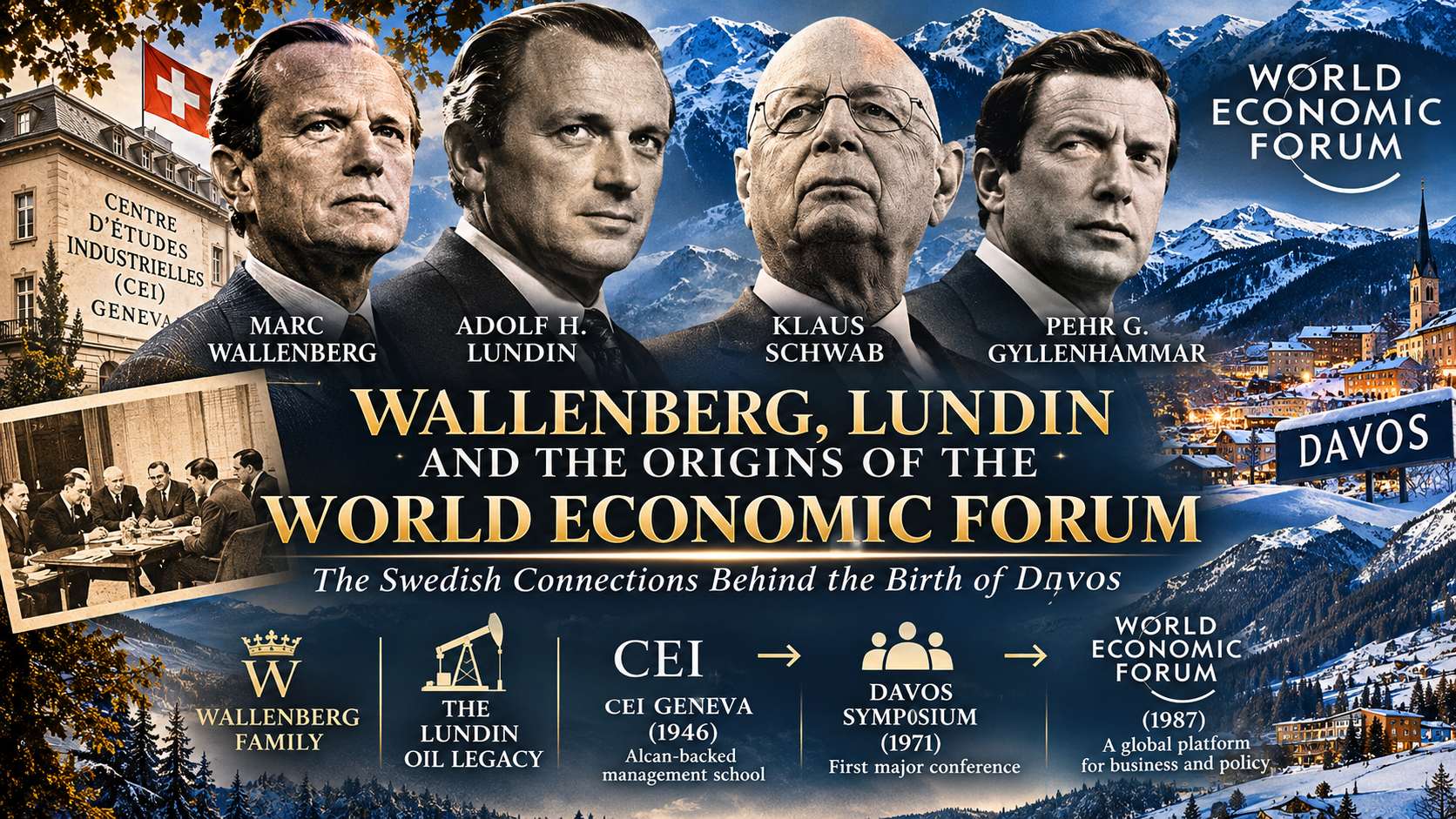
WALLENBERG, LUNDIN AND THE ORIGINS OF THE WORLD ECONOMIC FORUM


The Swedish Family and Industrial Connections Behind the Early History of Davos

Estimated reading time: 10 minutes

The founding of the World Economic Forum in 1971 is generally associated with German economist and engineer Klaus Schwab. Behind the first gathering in Davos, however, lies an institutional history involving international industry, a Swiss management school and members of the Swedish business establishment.

Among the individuals connected to this history was Adolf Henrik Lundin, the Swedish oil and mining entrepreneur whose marriage connected him directly to the Wallenberg family.

A remarkable account by Swedish foreign correspondent Svante Löfgren identifies Lundin and Pehr G. Gyllenhammar as participants in the discussions that gave rise to the original Davos seminar. Combined with independent biographical sources, academic research and the World Economic Forum’s own historical publications, his account reveals a Swedish dimension to the organisation’s origins that deserves considerably more attention.

1. The Journalist Who Knew Adolf Lundin

In his memoir Hemma för gott: Om 80 år med press & radio, Swedish journalist Svante Löfgren devoted an entire chapter to Adolf Lundin under the title Adolf Lundin – Gold, Oil & Gas.

Löfgren had worked as a foreign correspondent for several major Swedish newspapers and maintained personal contacts with Lundin during his years in Geneva. He followed Lundin’s international business activities for Svenska Dagbladet and published an extensive profile of the entrepreneur in Månadsjournalen in 1980.

On pages 390–391 of his memoir, Löfgren discusses Lundin’s involvement in the origins of the World Economic Forum.

He associates Lundin and Pehr G. Gyllenhammar with the decision to hold a management seminar in Davos in connection with an anniversary of the Centre d’Études Industrielles, known as CEI. According to Löfgren, Klaus Schwab subsequently developed the concept into a permanent international institution.

The significance of this account becomes apparent when examining Lundin’s professional position at CEI during the years immediately preceding the first Davos conference.

2. The Wallenberg, Wehtje and Lundin Families

In 1957, Adolf H. Lundin married Eva Wehtje, daughter of Walter Wehtje, former CEO of Investor AB. Eva’s sister, Olga Wehtje, married Marc Wallenberg, son of Marcus Wallenberg Jr.

Through their marriages to the Wehtje sisters, Adolf Lundin and Marc Wallenberg became brothers-in-law. Adolf Lundin was therefore the uncle by marriage of Marcus Wallenberg (born in 1956), the current chairman of SEB.

Jacob Wallenberg and Peter Wallenberg Jr are the sons of Marc’s younger brother, Peter Wallenberg Sr, and first cousins of Marcus Wallenberg.

These family connections illustrate the close relationships between the Lundin, Wehtje and Wallenberg families within the Swedish financial and industrial establishment.

3. From Swedish Industry to Geneva

After graduating as a mining engineer from the Royal Institute of Technology in Stockholm, Lundin entered the international petroleum industry.

His early career took him to Colombia, where he worked for Royal Dutch Shell. He subsequently returned to Europe and completed an MBA at the Centre d’Études Industrielles in Geneva in 1961, with financial assistance from Walter Wehtje.

Through his Swedish business contacts, Lundin obtained a position at Nynäs Petroleum, which belonged to the Axel Johnson industrial group.

In 1966, he returned to CEI, this time in a senior administrative capacity. His responsibilities included fundraising, recruitment and teaching petroleum economics.

Lundin’s position connected him with international industrial executives, management specialists and potential investors.

It was within this professional environment that Klaus Schwab entered the institution three years later.

4. Alcan and the Industrial Origins of CEI

The origins of CEI can be traced to 1946 and the Canadian aluminium company Alcan.

The institution was established to develop international management expertise during the economic reconstruction that followed the Second World War. It connected European business leaders with North American management practices and industrial experience.

CEI subsequently developed into an internationally connected business school. Its activities brought together corporate executives from different countries and sectors, creating opportunities for professional education, international networking and business cooperation.

In 2026, an academic article published in Cambridge University Press’s journal Contemporary European Historyexamined the institutional origins of the World Economic Forum and its relationship with international management education.

The research identifies CEI as the institution from which the WEF emerged in 1971 and confirms the financial involvement of Alcan in the school’s development.

The institutional background of Davos was therefore closely connected to international industrial management, rather than originating solely as an independent initiative by a single individual.

5. Adolf Lundin and Klaus Schwab: Geneva, 1969

The World Economic Forum’s own historical publication, The World Economic Forum: A Partner in Shaping History, confirms that Klaus Schwab joined CEI as a part-time professor in 1969.

At the time, Adolf Lundin had already occupied the position of deputy director for approximately three years.

Their professional activities consequently overlapped during 1969–1970, the period immediately preceding the establishment of the European Management Forum.

The historical chronology is significant because it places Lundin in a senior administrative position at the institution during Schwab’s arrival and the development of the environment from which the first Davos conference emerged.

Academic research into the WEF’s history also places the original conference within preparations for CEI’s 25th anniversary.

According to political scientist Jean-Christophe Graz, Schwab was entrusted with organising the anniversary event and proposed a major international conference as an alternative to a conventional celebration.

This institutional account provides important context for Löfgren’s description of Swedish involvement in the decision to organise the Davos seminar.

6. Marc Wallenberg and CEI’s International Network

Löfgren’s memoir describes another episode connecting the Geneva management school directly to the Wallenberg family.

According to his account, CEI encountered difficulties arranging a study trip for its participants. Adolf Lundin was asked to assist and, together with his brother-in-law Marc Wallenberg, organised an alternative programme in Sweden.

Löfgren describes the extensive access to Swedish business contacts that the two men were able to provide.

This account illustrates how the Lundin and Wallenberg family connection could be translated into practical institutional cooperation. International management education created opportunities for Swedish industrial leaders to establish relationships with executives from other countries.

The episode also helps explain why Lundin’s involvement with CEI extended beyond conventional academic responsibilities.

7. Pehr G. Gyllenhammar and the First Davos Conference

Perhaps the most revealing detail in Löfgren’s memoir is the reference to Pehr G. Gyllenhammar.

Gyllenhammar, who became chief executive of Volvo in 1971, would subsequently become one of Europe’s most prominent industrial leaders and an important advocate of European business cooperation.

Löfgren associates Gyllenhammar and Lundin with the decision to organise the management seminar in Davos, before describing Schwab’s subsequent development of the initiative.

The account identifies a potential Swedish contribution to the formative discussions surrounding the conference.

Although the memoir contains a chronological discrepancy concerning CEI’s anniversary, independent research confirms that the first Davos symposium emerged from preparations for the institution’s 25th anniversary in 1971.

The distinction between the origin of a conference idea and the legal establishment of the organisation is important. Löfgren’s account concerns the development of the seminar concept, while the subsequent foundation became the institution formally led by Schwab.

8. The Formal Establishment of the European Management Forum

The first European Management Symposium took place in Davos in 1971 and brought together approximately 440 participants from the European business community.

Its purpose was to explore management practices, international competitiveness and the challenges facing European companies.

According to the World Economic Forum’s historical records, the European Management Forum was formally established as a foundation on 8 February 1971, with an initial endowment of 25,000 Swiss francs.

Klaus Schwab became its principal executive and developed the symposium into a recurring international gathering.

The organisation progressively expanded its focus from European industrial management to international economics, politics and cooperation between governments and private-sector institutions.

In 1987, the European Management Forum adopted the name World Economic Forum.

1971: The Death of Marc Wallenberg and the Transformation of Swedish Banking

The year of the first Davos symposium was also a dramatic turning point in the history of the Wallenberg family.

Marc Wallenberg, brother-in-law of Adolf H. Lundin and chief executive of Stockholms Enskilda Bank since 1958, died by suicide in November 1971 at the age of 47.

His death occurred during the preparations for the merger between Stockholms Enskilda Bank and Skandinaviska Banken, a process involving considerable disagreements within the Wallenberg family. The merger was completed on 1 January 1972, creating what is today known as SEB.

Marc was the father of Marcus Wallenberg, born in 1956, who subsequently became chairman of SEB and a member of the Bilderberg Steering Committee.

The year 1971 thus marked two separate institutional turning points: the establishment of the European Management Forum in Switzerland and the transformation of the Wallenberg family’s banking interests in Sweden. Their chronological proximity is historically notable, although it does not establish a causal relationship.

9. From Industrial Management to Global Economic Policy

The development of the World Economic Forum was closely connected to the growing importance of international economic competitiveness.

The 2026 Cambridge University Press study traces the origins of the WEF’s competitiveness measurements to 1979, when Schwab initiated an assessment of European national economies.

These measurements developed into a broader international benchmarking system evaluating economic and institutional conditions.

Meanwhile, CEI eventually merged with another Swiss management school, IMEDE, which had been established by Nestlé. The combined institution became the International Institute for Management Development, IMD.

Beginning in 1989, the WEF and IMD jointly published international competitiveness indicators for several years.

This collaboration demonstrates that the institutional relationship between the World Economic Forum and its original management-school environment continued long after the first Davos symposium.

10. Swedish Family Connections Across Generations

The association between Lundin and the Wallenberg family provides a historical connection to Sweden’s international industrial network before WEF’s formal establishment.

Decades later, the Wallenberg organisation’s own publications identify Jacob Wallenberg’s involvement with the World Economic Forum as part of the family’s international network.

The same institutional material identifies engagements involving the Trilateral Commission, the Atlantic Council, Bilderberg and the European Round Table of Industrialists.

The family connection between Adolf Lundin and Marcus Wallenberg links two generations of international industrial and financial networking, from the institutional origins of Davos in the late 1960s to the Wallenberg family’s modern involvement in global economic and political forums.

These connections are particularly relevant when examining the long-term role of private industrial organisations in international economic discussions.

Conclusion: The Swedish Dimension of Davos

The institutional history of the World Economic Forum is more extensive than its familiar association with Klaus Schwab.

Its origins can be traced to a management school established with support from Canadian industry, where a Swedish oil entrepreneur closely connected to the Wallenberg family occupied a senior position during Schwab’s arrival.

Svante Löfgren’s account adds another dimension by identifying Lundin and Gyllenhammar in connection with the original seminar initiative and Marc Wallenberg in the development of CEI’s Swedish business contacts.

Independent biographical and academic sources establish the professional positions, institutional relationships and family connections underlying this account.

The precise contribution made by each individual to the original conference preparations remains a subject for archival research. Nevertheless, the documented connections justify including Adolf Lundin and the Swedish industrial establishment in the broader history of the environment from which the World Economic Forum emerged.

The story of Davos began not only with an individual founder, but within an existing international network of industrial corporations, management institutions and business leaders.


Sources and Historical Documents

1. Svante Löfgren, Hemma för gott: Om 80 år med press & radio.

ISBN 978-91-633-1211-3. Chapter 30, Adolf Lundin – guld, olja & gas, particularly pages 390–391.

https://www.las-en-bok.com/hemma_for_gott.pdf

2. Jonathan Kandell, The Life and Death of Adolf Lundin.

Institutional Investor, 16 November 2006. Based partly on Lundin’s final interview.

https://www.institutionalinvestor.com/article/2btft67cpjzhyizh0pvk0/home/the-life-and-death-of-adolf-lundin

3. World Economic Forum, A Partner in Shaping History: The First 40 Years.

Official institutional history documenting Schwab’s appointment at CEI in 1969.

https://www3.weforum.org/docs/WEF_First40Years_Book_2010.pdf

4. World Economic Forum, A Partner in Shaping History.

Historical account of the formal establishment and initial endowment of the European Management Forum.

https://www3.weforum.org/docs/WEF_A_Partner_in_Shaping_History.pdf

5. Inventing the Global Competitiveness Race: The World Economic Forum, the IMD and the Neoliberal Benchmarking Tool They Created.

Contemporary European History, Cambridge University Press, 2026.

https://www.cambridge.org/core/journals/contemporary-european-history/article/inventing-the-global-competitiveness-race-the-world-economic-forum-the-imd-and-the-neoliberal-benchmarking-tool-they-created/9204A56D9CDD5CB77A35529131CB017F

6. Jean-Christophe Graz, How Powerful Are Transnational Elite Clubs? The Social Myth of the World Economic Forum.

Academic research published in 2003.

https://www.researchgate.net/publication/261668133_How_Powerful_Are_Transnational_Elite_Clubs_The_Social_Myth_of_the_World_Economic_Forum

7. Parag Khanna, The World Economic Forum: An Anatomy of Multi-Stakeholder Global Policy Making.

London School of Economics, doctoral thesis, 2010. Chapter 3: The WEF’s Founding and Early Years.

https://researchonline.lse.ac.uk/id/eprint/133388/1/U615338.pdf

8. World Economic Forum, Klaus Schwab: Official Biography.

https://www.weforum.org/about/klaus-schwab

9. Wallenberg, Networks and Additional Engagements.

Institutional publication, 2017, pages 38–39.

https://www.wallenberg.com/sites/default/files/wallenberg_about_us_english_lowres_0.pdf

Leave a Reply

Your email address will not be published. Required fields are marked *

Related Post

It’s about you!It’s about you!

It’s all about you! Your life, your future, your family and future generations. It’s about us, us together and our society. Do we want a society where we help each other?

Many see the polarization clearly now and want to see peace, tranquility and unity. We all want that and it will only come when enough of us understand what the problem really is. It is not enough to agree just to agree. Agree on what?

What you feel is a power struggle, the end of a war that has been going on all our lives. A war for our freedom, our awareness and knowledge. We have been a commodity and a source of income to be controlled, controlled and manipulated at all costs.

These power structures don’t want you to understand. You should feel that you have no power to change anything for the better. You should feel that this bureaucracy and corrupt machine can never be touched.

Many do not want to believe that people we trust, popular people (persona), celebrities, business leaders, politicians, media, authorities, government, Riksdag, royal house would have different information than you have, a broader understanding and a knowledge that is withheld from you. The reasons can be many but can be summed up in self-interest.

Could our awakening movement be infiltrated? Is it someone we know? Most likely YES. Does it help to make each other suspicious as people NO. Does it help to make suspicious of their fake news, lies, propaganda, defeatism, hopelessness and everything that keeps us behind the scenes or creates hope/trust for this system YES.

The one who has united many around the core issue is Donald Trump. For those of you who only listened to the media but never took the time to actually listen to him, I recommend that you spend 5 minutes listening to what he says here in his speech in 2016. He was the first to expose these people in power that you never elected, hidden power structures, corporate interests that do not want the best of our people.

Many of those who claim to fight for the truth do not know how it all started, they do not know that they are imitating Q’s followers and ironically following what Q asked us to do. They share memes and information about corruption, crime and lies that Q wrote about first and we thank you for that!

Q post 4510, June 24, 2020

You have been chosen to help serve your country.
Never retreat from the battlefield [Twitter, FB, etc.].
Use other platforms as a form of centralized command and control.
Organize and connect [bridge by linking].
Source meme material from battlefield and/or garage [mark and share][drag and drop]
Mission 1: Dispute [reject] propaganda enforce publication of research and facts
Mission 2: The support role of other digital soldiers [one falls another stands (gets up)]
Mission 3: Awaken [awaken] others using facts [DECLAS 1-99 material and other relevant facts] and memes [disengaging MSDNC control of infostream] _ask “counter questions” to initiate “thought” vs repeat [echo] of MSDNC propaganda
Mission 4: Learn the use of camouflage [digital] _primary account suspended, terminated _use of secondary
Task 5: Identify strengths/weaknesses [personal and designated targets] re: Twitter & FB [+other] example re: meme(s) failure to read through use of ALGO [think Tron (MCP_master control program)] _reliance on person-to-person capture [slow response time unidentified users]
Game theory.
Information warfare.
Welcome to the digital battlefield.
Together we win.
Q

Michael Rae Khoury, who wrote The Ericsson Report, writes on Twitter:

“If they can FABRICATE election data even after a president like Donald Trump is elected.

If they are allowed to SPY on a sitting president.

If they can CONTROL a company like Twitter even after the richest man in the world bought it.

What does that say about what else [THEY] can do?”

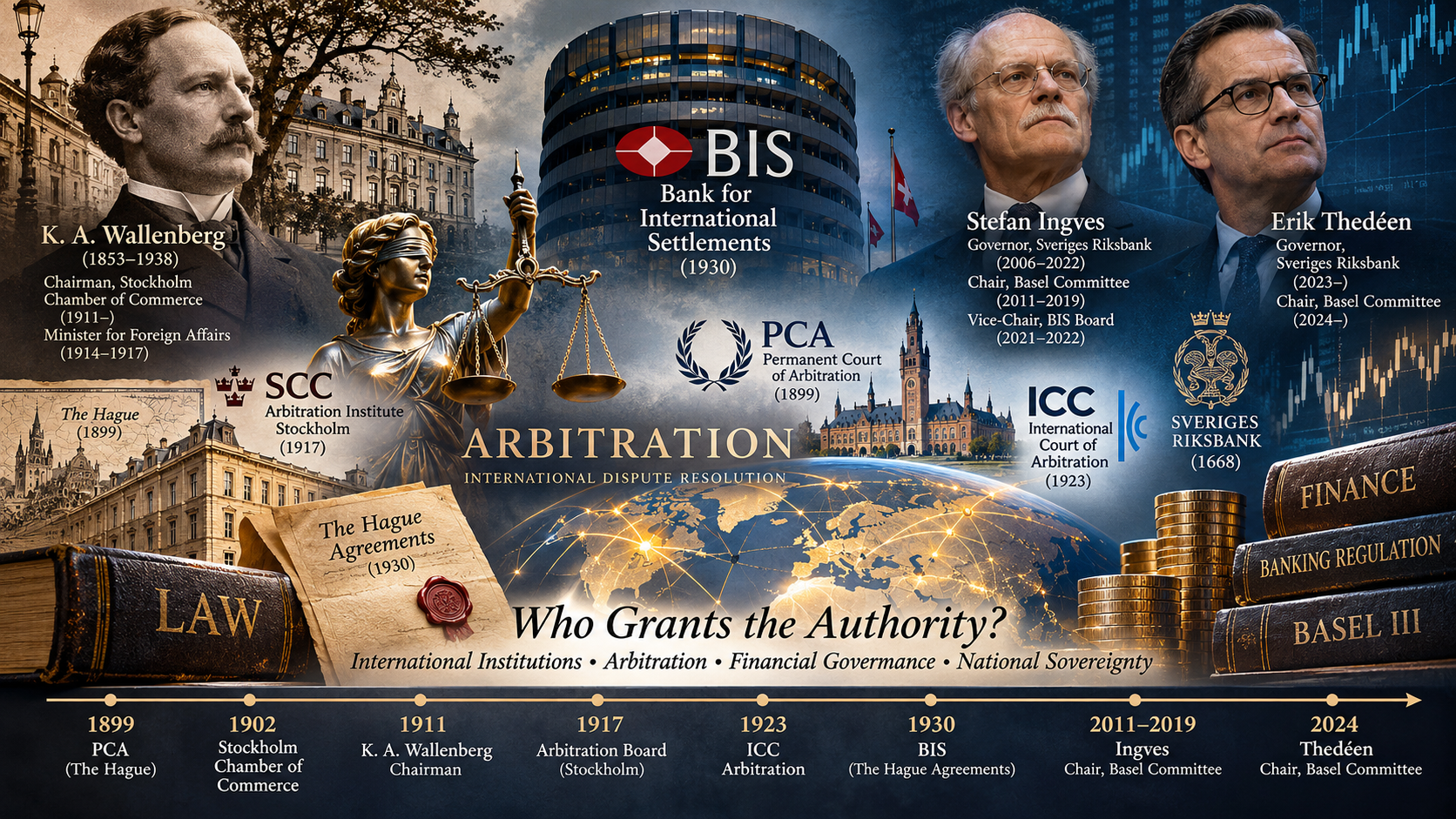
Sweden’s Overlooked Role in International Arbitration and Financial GovernanceSweden’s Overlooked Role in International Arbitration and Financial Governance

The historical relationship between Sweden, international arbitration, and global financial institutions reveals a remarkable continuity in the country’s involvement in shaping mechanisms for resolving disputes and governing international economic relations.

The story begins long before the establishment of the International Criminal Court.

In 1917, the Arbitration Institute of the Stockholm Chamber of Commerce, today known as the SCC Arbitration Institute, was established in Sweden. It subsequently developed into an internationally recognized institution for resolving commercial and investment disputes.

Sweden’s position became particularly significant during the Cold War. In 1977, an agreement between the American Arbitration Association and the Soviet Chamber of Commerce and Industry established Stockholm as a forum for resolving commercial disputes between American and Soviet parties. In 1984, the SCC also entered into a cooperation agreement with the China Council for the Promotion of International Trade.

Stockholm thus became an important venue for international dispute resolution involving the United States, the Soviet Union, and China. [1]

The Wallenberg Connection to International Arbitration

The Wallenberg family’s involvement in international economic governance is documented in historical financial records. A particularly revealing example appears in the Federal Reserve Bulletin of June 1932.

The publication records that the Bank for International Settlements (BIS) appointed an arbitration committee to address disputes concerning international agreements on short-term banking credits to Germany.

Marcus Wallenberg was appointed chairman of this arbitration committee, alongside T. H. McKittrick Jr. and Franz Urbig. The committee was reappointed in 1932 following the renewal of the international banking agreement. [2]

This places a prominent Swedish banker in a documented leadership position within an international dispute-resolution mechanism established by BIS during one of the most turbulent periods in modern financial history.

The Wallenberg connection also extends to the present-day International Chamber of Commerce (ICC). According to ICC Sweden’s official organizational records, Marcus Wallenberg serves as Treasurer (Kassaförvaltare) on its governing board, the Överstyrelse. [3]

The International Chamber of Commerce is a major international business organization whose activities include commercial arbitration, trade rules, and international business policy.

Sveriges Riksbank and the Creation of BIS

Sweden’s involvement in international financial governance is equally significant.

The Bank for International Settlements was established in 1930 in connection with the international agreements addressing German reparations following the First World War.

Sveriges Riksbank became a BIS shareholder that same year and obtained representation on its Board of Directors in 1931. In its own historical research, the Riksbank emphasizes the importance of this early position for Sweden’s influence in international monetary cooperation. [4]

Today, BIS serves as a central forum for cooperation among central banks and supports the development of international financial standards.

Sweden continues to hold a prominent position within this framework.

Sweden’s Continued Influence over Global Banking Standards

Sweden’s influence within the Bank for International Settlements extends well beyond its early involvement in 1930.

Stefan Ingves, Governor of Sveriges Riksbank from 2006 to 2022, served on the BIS Board of Directors, chaired its Banking and Risk Management Committee, and became Vice-Chairman of the BIS Board in 2021.

Between 2011 and 2019, he also chaired the Basel Committee on Banking Supervision, overseeing the completion of the Basel III post-crisis regulatory reforms. In a speech delivered on November 30, 2016, Ingves explicitly acknowledged that the Basel Committee has no legal enforcement power and relies on participating jurisdictions to implement its standards.

Since June 2024, Riksbank Governor Erik Thedéen has chaired the Basel Committee on Banking Supervision, one of the principal international bodies responsible for developing banking regulatory standards.

From BIS and Sveriges Riksbank to the Leadership of the IMF

Sweden’s influence within international financial institutions dates back to the early years of the Bretton Woods system.

Ivar Rooth, Governor of Sveriges Riksbank from 1929 to 1948, became the IMF’s second Managing Director in 1951, serving until 1956.

He was succeeded by another Swede, Per Jacobsson, who had spent 25 years working as an economic adviser at the Bank for International Settlements (BIS) before leading the IMF from 1956 until 1963.

For twelve consecutive years, two Swedish financial officials led the IMF during a formative period in the development of the post-war international monetary system. Their careers demonstrate a historical continuity between Sveriges Riksbank, BIS and the IMF, extending well beyond Sweden’s formal membership in these institutions.

Related articles: BIS – Bank of International Settlement, Marcus Wallenberg, Per Jacobsson & Kreuger

Sweden’s Current Role in Global Financial Governance

The international influence of Sweden’s central bank governors extends beyond BIS and the Basel Committee to the International Monetary Fund (IMF).

Between 1999 and 2005, Stefan Ingves served as Director of the IMF’s Monetary and Financial Systems Department. Upon becoming Governor of Sveriges Riksbank in 2006, he also became Sweden’s Governor at the IMF, a position he held until the end of 2022, alongside his senior responsibilities within BIS.

His successor, Erik Thedéen, continued this institutional representation in 2023. His international responsibilities include:

  • Governor for Sweden on the IMF’s Board of Governors, its highest decision-making body.
  • Member of the BIS Board of Directors.
  • Chairman of the Basel Committee on Banking Supervision since June 2024.
  • Member of the BIS Innovation Hub Advisory Committee.
  • Member of the European Central Bank’s General Council.
  • Member of the European Systemic Risk Board’s General Board.

These overlapping appointments illustrate Sweden’s longstanding participation in the international institutions responsible for monetary cooperation, financial stability, banking regulation and the development of future financial infrastructure.

Sweden Was the Seventh-Largest Shareholder in BIS

Sveriges Riksbank’s 2022 Annual Report explicitly states:

The Riksbank has been involved since its establishment and is the seventh-largest shareholder.

The report also reveals that:

  • Stefan Ingves received SEK 1.5 million in board remuneration from BIS in 2022, offset by a corresponding deduction from his gross salary at Sveriges Riksbank.
  • BIS established its Nordic Innovation Centre in Stockholm in 2021.
  • Cecilia Skingsley, former First Deputy Governor of Sveriges Riksbank, became global Head of the BIS Innovation Hub in September 2022.
  • International cooperation included central bank digital currencies (CBDCs), cryptocurrencies, and the future of the monetary system.

These documented facts highlight another dimension of Sweden’s longstanding role within the international financial system, extending from central bank ownership and global banking regulation to the development of future monetary and financial infrastructure.

This continuity demonstrates Sweden’s prominent role in shaping international banking standards and raises a fundamental question concerning the relationship between international regulatory influence, democratic accountability, and national sovereignty.

The Hague Connection: International Law and Financial Arbitration

The legal architecture surrounding BIS provides another important historical connection.

Under Article XV of the Hague Agreement of January 20, 1930, a standing arbitral tribunal was established to resolve disputes concerning the agreement and the statutes of BIS.

The tribunal’s secretariat is administered by the Permanent Court of Arbitration (PCA), headquartered at the Peace Palace in The Hague.

The PCA itself was established in 1899 as part of the development of institutionalized international dispute resolution. [6]

The Permanent Court of Arbitration (PCA)

Established in 1899 at the First Hague Peace Conference, the Permanent Court of Arbitration (PCA) is one of the world’s oldest international dispute-resolution institutions. Despite its name, it is not a conventional court with permanent judges. Its authority derives from international treaties and arbitration agreements.

Of particular significance is its institutional connection to the Bank for International Settlements (BIS). Under the Hague Agreement of 1930, a standing arbitral tribunal was established to resolve disputes concerning BIS and its statutes, with the PCA serving as its secretariat.

This formal connection illustrates how international arbitration became embedded in the legal architecture of the global financial system, raising important questions about the relationship between financial governance, international legal authority, and national sovereignty.

The Wallenberg Connection: The Establishment of Stockholm’s Arbitration Institution

The Stockholm Chamber of Commerce was founded in 1902 by prominent representatives of Sweden’s banking, commercial, and industrial sectors. In 1911, banker Knut Agathon Wallenberg became its chairman, a position he also held during his tenure as Sweden’s Minister for Foreign Affairs (1914–1917).

On April 18, 1917, under Wallenberg’s chairmanship of the Chamber, the decision was made to establish an arbitration board consisting of 100 members. The Chamber’s executive committee appointed the arbitrators, and Arthur Lindhagen of the Svea Court of Appeal was appointed secretary. Operations commenced on July 1, 1917.

This institution subsequently evolved into today’s internationally recognized SCC Arbitration Institute.

Fifteen years later, in 1932, the Federal Reserve Bulletin documented Marcus Wallenberg’s chairmanship of an arbitration committee appointed by the Bank for International Settlements (BIS).

These historical records establish a longstanding connection between the Wallenberg family, Sweden’s banking establishment, and the development of international arbitration mechanisms.

The question of who grants legal authority to institutions operating outside traditional national court systems becomes particularly relevant when examining the historical relationship between banking, commercial interests, and international dispute resolution.

These arrangements illustrate how international legal mechanisms became embedded in financial agreements and institutions during the twentieth century. The historical development is striking.

Sweden established an international arbitration institution in Stockholm in 1917. Sveriges Riksbank became involved in BIS from its creation in 1930. Marcus Wallenberg chaired a BIS-appointed arbitration committee during the financial crisis of the early 1930s. Decades later, Stockholm became an internationally recognized forum for resolving disputes involving American, Soviet, and Chinese commercial interests.

Sweden’s role in the development of international legal and financial governance has therefore been far more substantial than its size might suggest.

This history adds another dimension to the contemporary debate over national sovereignty, international jurisdiction, and the authority exercised by institutions operating across national borders.

It also raises an enduring question:

Who shapes the rules governing international disputes, finance, and commerce, and how much influence do individual nations retain over the institutions entrusted with enforcing them? They also raise important questions about the relationship between international financial governance, national sovereignty and democratic accountability.


Sources and References

[1] SCC Arbitration Institute, Official History
Our History.
Documents the establishment of the SCC in 1917, the 1977 US-Soviet arbitration agreement, and cooperation with China beginning in 1984.
https://sccarbitrationinstitute.se/en/about-scc/our-history/

[2] Federal Reserve Bulletin, June 1932, p. 373
International Banking and Standstill Agreements.
Original historical record naming Marcus Wallenberg as chairman of the arbitration committee appointed by BIS.
https://fraser.stlouisfed.org/title/federal-reserve-bulletin-62/june-1932-20726/fulltext

[3] ICC Sweden, Official Organization and Governing Board
Om oss.
Lists Marcus Wallenberg as Treasurer (Kassaförvaltare) of ICC Sweden’s governing board.
https://icc.se/om

[4] Sveriges Riksbank, Economic Review, 2022
Sweden’s Role in International Economic Cooperation: Then, Now and Looking Ahead.
Documents the Riksbank’s participation in BIS from 1930 and board representation from 1931.
https://www.riksbank.se/globalassets/media/rapporter/pov/engelska/2022/economic-review-1-2022.pdf

[5] Sveriges Riksbank, Official BIS Overview
Bank for International Settlements (BIS).
Describes Sweden’s continued participation and the chairmanship of the Basel Committee on Banking Supervision.
https://www.riksbank.se/en-gb/about-the-riksbank/the-tasks-of-the-riksbank/international-work/cooperation-at-the-global-level/bis/

[6] Permanent Court of Arbitration
Bank for International Settlements (BIS) Arbitral Tribunal.
Official documentation of the tribunal established under the 1930 Hague Agreement and administered through the PCA.
https://pca.int/en/services/arbitration-services/bis/

Additional sources

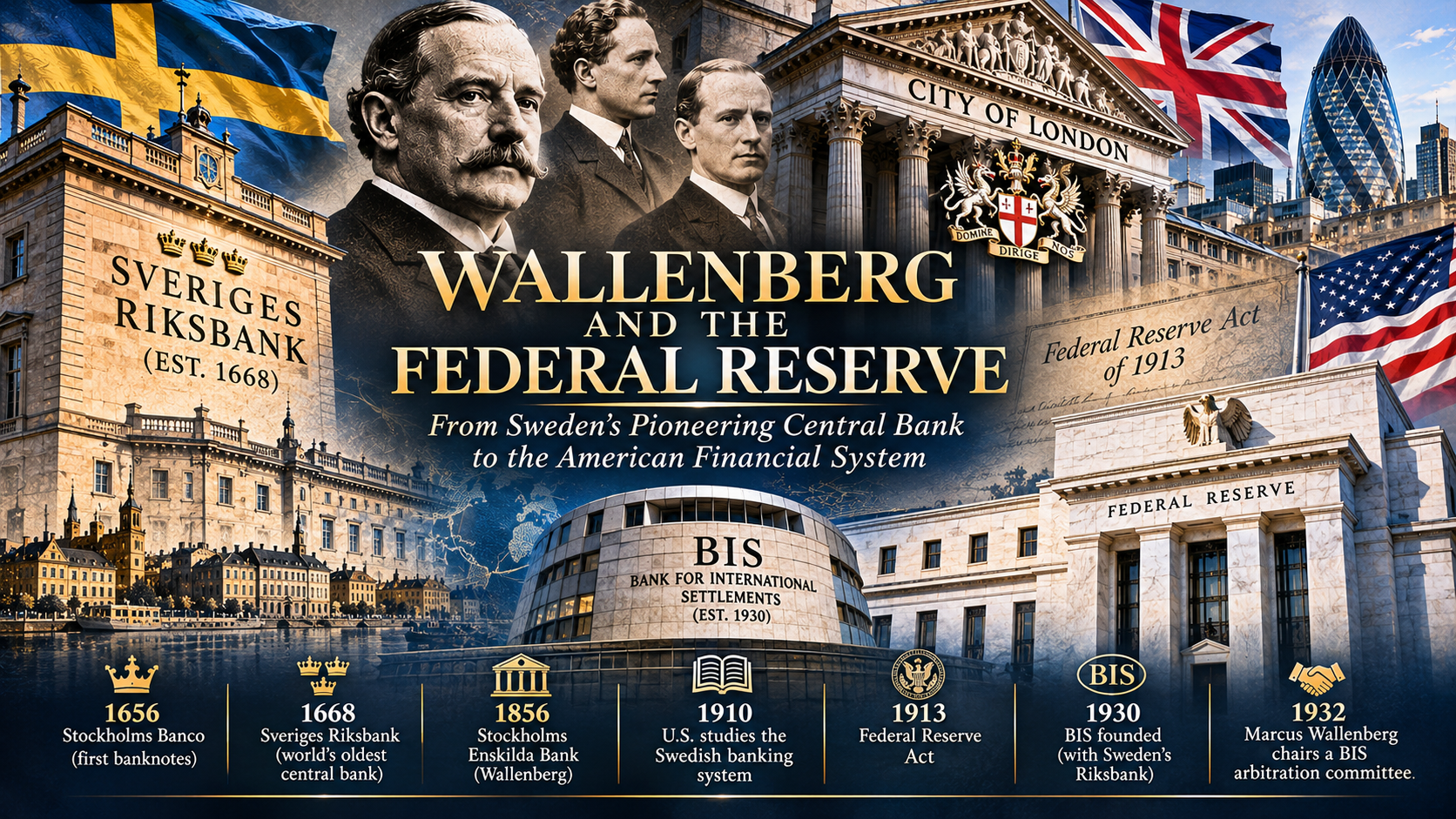
WALLENBERG AND THE FEDERAL RESERVEWALLENBERG AND THE FEDERAL RESERVE

From the World’s Oldest Central Bank to the Architecture of International Finance

The history of the American Federal Reserve is generally told through the financial crisis of 1907, the secret meeting at Jekyll Island in 1910 and the Federal Reserve Act of 1913.

However, the origins of modern central banking extend much further back, geographically as well as historically.

More than two centuries before the Federal Reserve was established, Sweden had already created the institution recognised today as the world’s oldest central bank.

By the time American policymakers began designing their own central banking system, Sweden had accumulated extensive experience in monetary policy, private banknote issuance, commercial banking and the centralisation of monetary authority.

At the centre of Sweden’s commercial banking establishment stood the Wallenberg family.

By examining the historical connections between Stockholm, the City of London, Hamburg, Wall Street and Basel, a broader picture emerges of the financial networks surrounding the development of modern central banking.

1. Sweden: The Birthplace of Modern Central Banking

In 1656, Johan Palmstruch established Stockholms Banco, Sweden’s first bank.

In 1661, the bank introduced Europe’s first generally recognised banknotes, replacing cumbersome copper currency with paper instruments that could circulate more efficiently.

The expansion of banknote issuance eventually resulted in a financial crisis and the collapse of Stockholms Banco.

In 1668, the Swedish parliament established Riksens Ständers Bank, which later became Sveriges Riksbank.

It remains the world’s oldest central bank.

The Bank of England was established in 1694, the Banque de France in 1800 and the Federal Reserve in 1913.

Sweden therefore possessed 245 years of central banking history when the United States established its Federal Reserve System.

The Swedish experience included precisely the questions that would later confront American policymakers: monetary stability, currency issuance, credit expansion, liquidity and the relationship between private banking and public monetary authority.

Source: Sveriges Riksbank – The Foundation of the World’s Oldest Central Bank.

2. Wallenberg and the Development of the Swedish Banking System

In 1856, André Oscar Wallenberg founded Stockholms Enskilda Bank, the predecessor of today’s SEB.

The institution became an important force in the development of Swedish commercial and industrial banking, directing private capital towards industrial enterprises and infrastructure.

At the time, Swedish commercial banks possessed the right to issue their own banknotes. Stockholms Enskilda Bank was among the institutions operating within this system.

André Oscar Wallenberg was also politically active and participated in parliamentary debates concerning Swedish banking.

One particularly interesting historical detail is documented by the Riksbank itself.

When Sweden transformed its parliamentary system in 1866, the central bank required a new name. André Oscar Wallenberg proposed that it should be called Sveriges Bank, or the Bank of Sweden.

Following parliamentary debate, the name Sveriges Riksbank was adopted in 1867.

This episode illustrates Wallenberg’s direct participation in discussions concerning the institutional development of Sweden’s central bank.

Through subsequent generations, the family’s commercial banking operations expanded alongside Sweden’s evolving monetary system.

Source: Sveriges Riksbank – The Riksbank Is Renamed, 1867.

3. Sweden Centralised Its Monetary System Before the United States

During the nineteenth century, Sweden operated a banking system in which private commercial banks could issue currency alongside the central bank.

The banking reforms initiated in 1897 gradually transferred the exclusive right of banknote issuance to Sveriges Riksbank.

By 1904, this transition had been completed.

Sweden had therefore recently completed a major monetary transformation when the United States experienced the financial panic of 1907.

The Swedish experience offered American policymakers a contemporary European example of how a country could move from decentralised private currency issuance towards a centralised monetary institution while retaining an extensive commercial banking sector.

Stockholms Enskilda Bank had operated under both arrangements.

The Wallenberg banking establishment consequently possessed practical experience of precisely the type of monetary transition that American reformers were investigating.

4. The United States Congress Studied the Swedish Banking System

In response to the financial panic of 1907, the United States Congress established the National Monetary Commission in 1908 under Senator Nelson W. Aldrich.

Its purpose was to investigate the weaknesses of the American financial system and examine potential reforms.

The commission studied European banking institutions, monetary arrangements and central banks.

Among its official publications was a substantial examination of Sweden.

Published in 1910, the report was entitled The Swedish Banking System, written by A. W. Flux and issued as Senate Document No. 576.

The report examined:

  • The historical development of Swedish banking.
  • The operation of Sveriges Riksbank.
  • Private commercial banking institutions.
  • The issuance of banknotes.
  • Monetary reserves and gold convertibility.
  • The transfer of currency issuance to the central bank.
  • The relationship between central and commercial banking.

The National Monetary Commission’s own publication catalogue confirms that the study was prepared for the commission in Sweden.

This establishes that Swedish banking experience formed part of the official research undertaken by the United States before the creation of the Federal Reserve.

The Swedish monetary model was not merely a historical parallel. It was a documented subject of American institutional research during the legislative development of a new central banking system.

Primary sources:

United States National Monetary Commission – The Swedish Banking System, 1910.

Publications of the National Monetary Commission, September 1911.

5. Wallenberg Was Expanding Internationally at the Same Time

While American authorities were studying European banking systems, Knut Agathon Wallenberg was expanding the family’s international financial operations.

In 1912, just one year before the Federal Reserve Act, Wallenberg participated in the establishment of the British Bank of Northern Commerce in London.

The institution subsequently merged with the British banking house Hambro, becoming part of Hambros Bank.

Wallenberg was simultaneously active in Swedish parliamentary politics and banking reform.

In 1914, he became Sweden’s Minister for Foreign Affairs, illustrating the overlap between his commercial banking activities and public responsibilities.

The family’s financial network was already operating across several European capital markets, including London, Paris and Hamburg.

These were also among the European financial centres whose banking practices were being examined by American monetary reformers.

London was particularly important because American international trade depended extensively on European financial houses before the establishment of the Federal Reserve.

The creation of an American central banking system was therefore taking place within a financial environment in which the Wallenberg sphere was already an established participant.

Source: Uppsala University – The Internationalisation of Swedish Banks.

6. Paul Warburg and the European Origins of the Federal Reserve

One of the most important figures behind the establishment of the Federal Reserve was Paul Moritz Warburg.

Born into the German banking family behind M.M. Warburg & Co. in Hamburg, Paul Warburg developed extensive knowledge of European banking practices before becoming a partner in the New York investment bank Kuhn, Loeb & Co.

He became an influential advocate of American monetary reform.

Federal Reserve historical records confirm that Warburg served as an unofficial adviser to the National Monetary Commission and participated in the confidential meeting at Jekyll Island in 1910.

The six participants were:

  • Nelson Aldrich, United States senator.
  • Paul Warburg, Kuhn, Loeb & Co.
  • Henry P. Davison, J.P. Morgan & Co.
  • Frank A. Vanderlip, National City Bank.
  • A. Piatt Andrew, United States Treasury official.
  • Arthur Shelton, Aldrich’s private secretary.

The meeting produced the foundations of the Aldrich Plan, which subsequently influenced the technical provisions of the Federal Reserve Act.

Warburg also advised policymakers involved in developing the final legislation.

President Woodrow Wilson signed the Federal Reserve Act into law on 23 December 1913.

In 1914, Warburg was appointed to the Federal Reserve’s first governing board.

The establishment of the Federal Reserve therefore involved the transfer of European banking expertise into the developing American monetary system.

Sources:

Federal Reserve History – Paul M. Warburg.

Federal Reserve History – The Meeting at Jekyll Island.

7. Wallenberg and the Warburg Banking Dynasty

The historical connections between the Wallenberg and Warburg families are particularly significant in this context.

The Swedish government’s official investigation, SOU 1999:20, documents negotiations between Jacob Wallenberg and Max Warburg, Paul Warburg’s brother, beginning in January 1937.

The negotiations concerned potential Swedish participation in the ownership of M.M. Warburg & Co. in Hamburg.

The discussions involved representatives of the Warburg family, Stockholms Enskilda Bank, Swiss Bank Corporation and German banking authorities.

The proposed transaction was never completed and took place against the background of Nazi persecution and the forced transfer of Jewish-owned businesses.

However, one detail in the correspondence is especially relevant.

In a letter dated 22 August 1938, Max Warburg’s son Erich referred to the longstanding friendly relations between Stockholms Enskilda Bank and the Warburg banking house.

The correspondence therefore describes an established institutional relationship rather than a newly formed commercial contact.

This raises an important historical question concerning the earlier development of these banking relationships and the exchange of financial expertise between Stockholm, Hamburg and New York.

Source: Swedish Government Investigation – Sweden and Jewish Assets, SOU 1999:20.

8. The Warburg Connection Extended Directly into American Banking

An original letter preserved in the Wallenberg historical archives reveals another significant connection.

Writing to Raoul Wallenberg in the United States on 8 February 1934, Marcus Wallenberg Jr provided letters of introduction to two of his close American friends.

One was Robert A. Lovett, a partner in Brown Brothers Harriman & Co.

The other was James Paul Warburg, the son of Federal Reserve architect Paul Warburg.

Marcus Wallenberg described James as:

also a very good friend of mine

The letter identifies James Warburg as vice chairman of the Bank of the Manhattan Company, which was one of Stockholms Enskilda Bank’s correspondent banks.

James Warburg had also served as a financial adviser to President Franklin D. Roosevelt and as a financial expert to the American delegation at the London Economic Conference of 1933.

The letter furthermore describes longstanding business relations between Stockholms Enskilda Bank and Brown Brothers Harriman.

Robert Lovett subsequently became United States Secretary of Defense.

The Bank of the Manhattan Company later merged with Chase National Bank in 1955, forming Chase Manhattan Bank, which eventually became part of JPMorgan Chase.

These relationships demonstrate how Wallenberg’s international banking operations were integrated into established American financial networks, including the immediate family of one of the Federal Reserve’s principal architects.

Primary source: Wallenberg Historical Archives – Banking & Enterprise, Letter of 8 February 1934, page 31.

9. The Rothschild, Hambro and London Connections

The development of central banking must also be understood within the broader context of nineteenth-century international finance.

Economic-historical research published by Sveriges Riksbank identifies several prominent European banking houses involved in the Swedish bond market, including Rothschild, Hambro and Warburg.

These institutions operated across the sovereign debt and international capital markets from which Sweden obtained financing.

Wallenberg’s relationships with Hambro developed into shared banking operations in London, while documented negotiations with the Rothschild network concerned industrial assets during 1938 and 1939.

The proposed Rothschild transaction involved the Witkowitz industrial enterprise in Czechoslovakia and additional European banking institutions.

These dealings illustrate the interconnected nature of European commercial banking across Stockholm, London, Hamburg, Paris and Switzerland.

Paul Warburg’s transfer of European financial expertise to the United States took place within this wider international banking environment.

Commercial banking, sovereign debt markets and monetary reform were overlapping fields in which these institutions accumulated experience and maintained professional relationships.

Sources:

Sveriges Riksbank – Banking, Bonds, National Wealth and Stockholm House Prices.

Swedish Government Investigation – SOU 1999:20.

10. From National Central Banks to the Bank for International Settlements

The next major development in international monetary cooperation occurred in 1930 with the establishment of the Bank for International Settlements, or BIS, in Basel, Switzerland.

Initially created in connection with the administration of German reparation payments following the First World War, the BIS developed into an institution facilitating international central bank cooperation.

According to the BIS’s official historical records, its original governing board included the central bank governors of Belgium, France, Germany, Italy and the United Kingdom.

The governors of Switzerland, the Netherlands and Sweden were also elected to the board at its inception.

Sweden’s central bank was therefore represented in the institutional leadership of the BIS from the very beginning.

The Swedish governor at the time was Ivar Rooth, who led Sveriges Riksbank between 1929 and 1948.

Rooth subsequently became Managing Director of the International Monetary Fund in Washington, D.C., serving from 1951 to 1956.

The United States Federal Reserve initially declined direct participation in the BIS, while American private banking interests participated in its original capital structure.

This is an important distinction. The establishment of the BIS involved both central banking authorities and, initially, private banking interests.

Its development created a new institutional framework connecting national monetary systems with international financial cooperation.

Sources:

BIS – Historical Timeline.

BIS – The Story of the Bank for International Settlements.

Sveriges Riksbank – Ivar Rooth and the International Financial Crisis.

11. Wallenberg Was Appointed Chairman of a BIS Arbitration Committee

Only two years after the BIS opened its doors, the Wallenberg name appeared in the official publications of the American Federal Reserve.

The June 1932 edition of the Federal Reserve Bulletin records the appointment of Marcus Wallenberg as chairman of an international arbitration committee established by the BIS.

The other members were Thomas H. McKittrick Jr and Franz Urbig.

The committee was responsible for resolving disputes concerning international credit arrangements with German banks.

The Federal Reserve Bulletin states:

The Bank for International Settlements appointed as an arbitration committee Messrs. Marcus Wallenberg (chairman), T. H. McKittrick, jr., and Franz Urbig.

When the credit agreement was renewed in 1932, the committee was reappointed.

Thomas H. McKittrick subsequently became president of the BIS, serving between 1940 and 1946.

Marcus Wallenberg’s appointment is especially significant because it demonstrates a formal role for a private Swedish banker within an international financial mechanism established by the BIS.

Sweden was thus represented at two different institutional levels during the early development of international central bank cooperation.

Through Sveriges Riksbank, it participated in the governance of the BIS itself.

Through Marcus Wallenberg, Swedish private banking expertise participated in international financial arbitration under a BIS mandate.

Primary source: Federal Reserve Bulletin, June 1932, page 373.

12. Behind the Scenes: The Question of Informal Influence

The development of financial institutions cannot be understood exclusively through legislation, official appointments and organisational charts.

Financial expertise also circulates through correspondence, international conferences, correspondent banking arrangements, professional relationships and commercial partnerships.

The creation of the Federal Reserve provides a documented historical example of this process.

The confidential discussions at Jekyll Island preceded the public legislative process, while Paul Warburg continued to advise American policymakers as the legislation evolved.

Against this background, the Swedish dimension deserves particular attention.

The United States formally commissioned research into Sweden’s recently centralised monetary system. At the same time, the Wallenberg banking establishment possessed practical experience of that transformation and extensive relationships within European finance.

Its subsequent documented connections with the Warburg family, American correspondent banks and international central banking institutions provide further evidence of its integration into transatlantic financial networks.

A plausible historical hypothesis is that Swedish commercial banking experience, including experience accumulated by institutions such as Stockholms Enskilda Bank, contributed indirectly to the wider body of European financial knowledge available to American reformers.

Such influence could have operated through published research, professional exchanges and ordinary international banking relationships rather than formal participation in American legislative institutions.

The later Wallenberg-Warburg correspondence makes this a worthwhile subject for further historical investigation, although its chronology does not by itself establish a direct Wallenberg role in drafting the 1913 legislation.

The distinction between formal authority and informal influence is essential. The former can often be established through appointments and legal documents, while the latter requires examining the movement of ideas, expertise and relationships across institutional boundaries.

13. From the Federal Reserve to Modern Financial Infrastructure

The international relationship between Swedish commercial banking and American monetary authorities continues through contemporary financial infrastructure.

SEB participates in international foreign exchange settlement through CLS, an institution operating within a framework of multinational central bank oversight coordinated by the Federal Reserve.

Unlike the historical correspondent banking relationships of the early twentieth century, today’s arrangements operate through formal regulatory structures and financial market infrastructures.

The institutional mechanisms have changed considerably, but the importance of international banking cooperation remains.

Swedish commercial banks, the Riksbank, the Bank of England, the Federal Reserve and other monetary authorities continue to interact within an interconnected financial system.

Further reading: Federal Reserve – Financial Market Utilities.

A Historical Timeline

  • 1656: Stockholms Banco is established.
  • 1661: Sweden introduces Europe’s first generally recognised banknotes.
  • 1668: Sveriges Riksbank is founded.
  • 1694: The Bank of England is established.
  • 1856: André Oscar Wallenberg establishes Stockholms Enskilda Bank.
  • 1867: The Swedish central bank is renamed following parliamentary debate in which Wallenberg participates.
  • 1897–1904: Sweden centralises banknote issuance.
  • 1907: The American financial panic accelerates demands for monetary reform.
  • 1908: The United States establishes the National Monetary Commission.
  • 1910: The commission publishes its extensive investigation of Swedish banking.
  • 1910: Paul Warburg participates in the Jekyll Island conference.
  • 1912: K.A. Wallenberg participates in the establishment of the British Bank of Northern Commerce.
  • 1913: The Federal Reserve Act becomes law.
  • 1914: Paul Warburg joins the Federal Reserve Board.
  • 1930: Sveriges Riksbank is represented on the inaugural board of the BIS.
  • 1932: Marcus Wallenberg chairs an international arbitration committee appointed by the BIS.
  • 1934: Marcus Wallenberg documents his friendship with James Paul Warburg and Robert Lovett.
  • 1937–1938: Wallenberg and Warburg negotiate potential banking ownership arrangements.
  • 1938–1939: Wallenberg participates in negotiations concerning Rothschild industrial assets.
  • 1951: Former Riksbank governor Ivar Rooth becomes Managing Director of the IMF.

Conclusion: The Swedish Dimension of Global Financial History

The establishment of the Federal Reserve in 1913 was an American legislative achievement informed by extensive research into European banking.

Among the countries studied was Sweden, home to the world’s oldest central bank and an advanced commercial banking sector that had recently undergone a significant monetary transformation.

The Wallenberg family had participated in this Swedish banking environment for generations and had established relationships across major European financial centres by the time the American reforms were being developed.

In subsequent decades, those relationships are documented through personal friendships with the Warburg family, American correspondent banking arrangements, international credit negotiations and formal arbitration responsibilities under the BIS.

The historical record therefore supports an examination of Wallenberg not merely as a Swedish industrial dynasty, but as an established participant in the international financial environment surrounding the development of modern central banking.

The possibility of indirect influence through banking expertise and professional networks deserves serious historical investigation.

The most important insight is that financial institutions are shaped not only when legislation is signed, but also during the years in which knowledge is accumulated, banking relationships are established and institutional models are exchanged.

To understand the origins of the modern international financial system, it is therefore necessary to look beyond Washington and Wall Street.

The history also leads through London, Hamburg, Basel and Stockholm, where the world’s oldest central bank was established and where the Wallenberg banking dynasty developed its international financial network.


This article forms part of a wider investigation into the historical and institutional relationships connecting the Wallenberg sphere with international finance, national security and global financial governance.

Related investigations: Wallenberg in America and Wallenberg in the City of London. and BIS – Bank of International Settlement, Marcus Wallenberg, Per Jacobsson & Kreuger

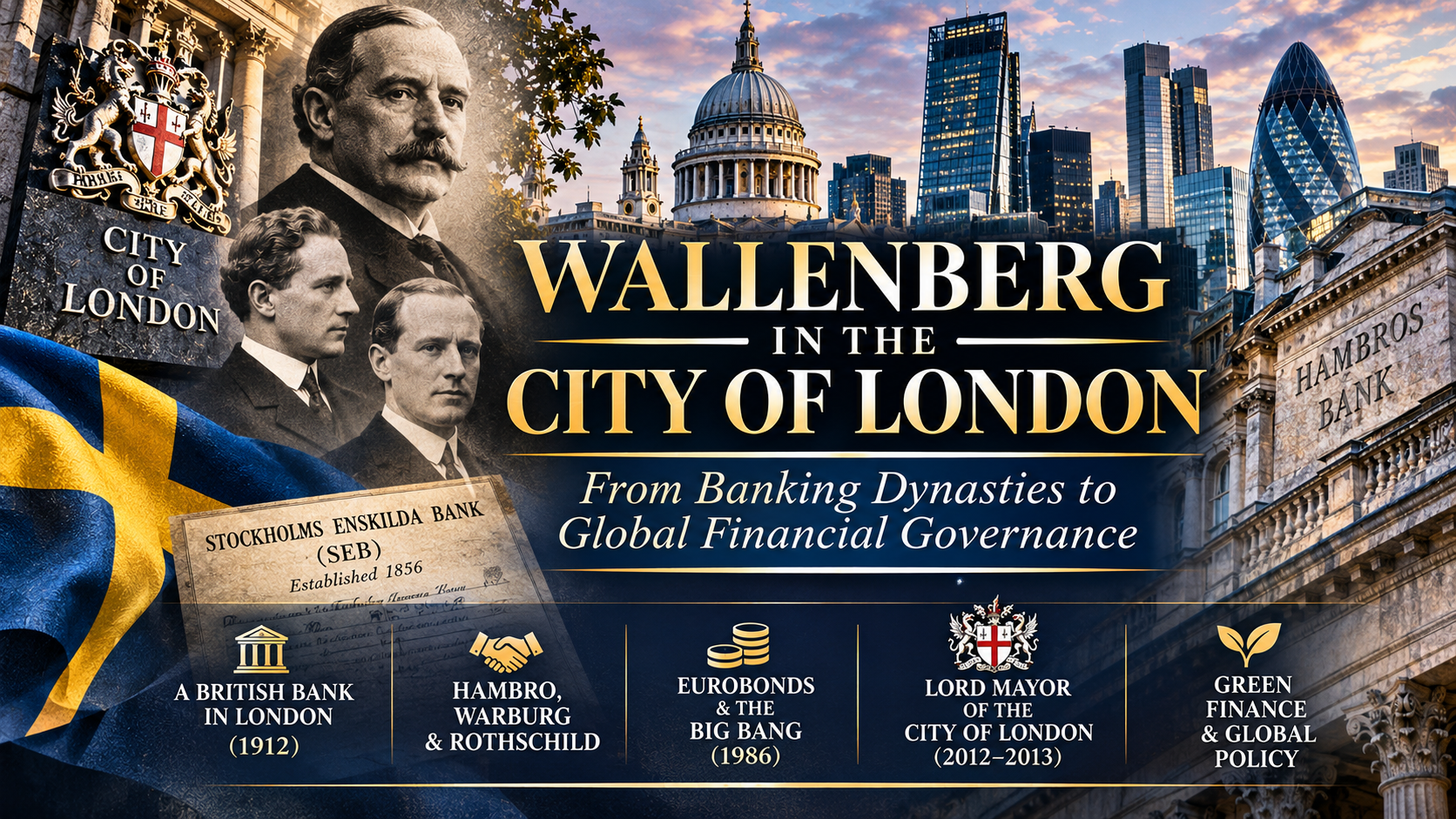
WALLENBERG IN THE CITY OF LONDONWALLENBERG IN THE CITY OF LONDON

From Banking Dynasties and British Intelligence to Global Financial Governance

The Wallenberg family’s international influence extends far beyond Swedish industry. For more than a century, the family and its associated financial institutions have maintained significant relationships with the City of London, one of the world’s most important centres for banking, international capital markets and financial services.

These connections encompass the British banking houses of Hambro and Warburg, the development of international bond markets, Britain’s financial deregulation and even the office of Lord Mayor of the City of London.

The historical record reveals how a Swedish banking dynasty became deeply integrated into British financial and institutional networks.

1. The British Origins of the Wallenberg Banking Model

In 1856, André Oscar Wallenberg founded Stockholms Enskilda Bank, the predecessor of today’s SEB.

According to the Wallenberg family’s own historical account, the bank was established using a Scottish banking model. It introduced new methods of directing savings and private capital towards industrial development in Sweden.

During the following decades, the bank developed international relationships with European financial institutions involved in sovereign debt, railway construction and industrial financing.

Among the prominent foreign banking houses active in the Swedish capital market were Hambro, Rothschild and Warburg.

By the beginning of the twentieth century, the Wallenberg family’s ambitions extended beyond international banking partnerships. It sought an institutional presence within the British financial system itself.

2. Establishing a Bank in London

In 1911, Knut Agathon Wallenberg expressed his ambition to establish:

an English bank à nous

In other words, a British bank of their own.

In 1912, the Wallenbergs participated in the establishment of the British Bank of Northern Commerce in London.

The bank subsequently merged with C.J. Hambro & Son in 1920, becoming Hambros Bank in 1921.

Historical research published in the Scandinavian Economic History Review confirms that the Wallenberg family maintained representation on the bank’s board.

In correspondence with Harald Bendixson, who became a senior figure in the bank, K.A. Wallenberg emphasised the importance of Scandinavian influence:

The majority lies on this side of the North Sea.

This correspondence demonstrates that the family’s objective was not merely access to British capital markets, but participation in the ownership and governance of a British banking institution.

Hambros operated from the heart of the City of London and became an important financial intermediary between Britain, Scandinavia and international markets.

3. Hambro and Wallenberg: Banking, Family and British Intelligence

The relationship between Hambro and Wallenberg extended beyond banking.

In 1936, the British banker Sir Charles Jocelyn Hambro married Dorothy Helen Mackay, the former wife of Marcus Wallenberg (1899–1982), thereby establishing a direct family connection between the two banking dynasties.

Charles Hambro subsequently became head of Britain’s Special Operations Executive (SOE), the wartime organisation responsible for supporting resistance movements and conducting covert operations in occupied Europe.

During the Second World War, Jacob and Marcus Wallenberg maintained contacts with British officials and acted as intermediaries in communications involving members of the German resistance.

Historical correspondence and academic research document relationships connecting the Wallenberg brothers, Hambro and the British wartime establishment.

These relationships illustrate how international banking networks could overlap with diplomacy, government and intelligence during a period of global conflict.

4. Rothschild, Warburg and the International Banking Network

The Swedish government’s official investigation, Sweden and Jewish Assets (SOU 1999:20), documents further connections between the Wallenberg family and two prominent European banking dynasties.

In 1937, Jacob Wallenberg entered negotiations with Max Warburg concerning possible Swedish participation in the ownership of M.M. Warburg & Co. in Hamburg.

Max Warburg was the brother of Paul Warburg, one of the principal architects of the American Federal Reserve System.

During 1938 and 1939, the Wallenbergs also participated in negotiations concerning the Rothschild family’s Witkowitz industrial assets in Czechoslovakia.

The proposed arrangements involved Swiss Bank Corporation, a predecessor of today’s UBS, alongside other European financial interests.

Neither proposed transaction was completed. Both must be understood within the historical context of Nazi persecution and the forced transfer of Jewish-owned businesses.

Nevertheless, the documentary record establishes direct business negotiations between the Wallenberg, Warburg and Rothschild networks.

5. From the City of London to Wall Street and the BIS

The Wallenberg family’s international banking relationships also extended into the United States and the emerging system of central bank cooperation.

In June 1932, the Federal Reserve Bulletin recorded the appointment of Marcus Wallenberg Sr as chairman of an arbitration committee established by the Bank for International Settlements (BIS).

The committee dealt with disputes arising from international German credit agreements.

Among its members was Thomas H. McKittrick, who subsequently became president of the BIS during the Second World War.

A letter dated 8 February 1934, preserved in the Wallenberg historical archives, provides further evidence of the family’s American relationships.

Marcus Wallenberg Jr identified James Paul Warburg, son of Federal Reserve architect Paul Warburg, and Robert A. Lovett of Brown Brothers Harriman as close personal friends.

The letter also identifies the Bank of the Manhattan Company, a predecessor of JPMorgan Chase, as one of Stockholms Enskilda Bank’s correspondent banks.

Robert Lovett later became United States Secretary of Defense.

These historical documents connect the Wallenberg banking network with prominent American financial institutions and individuals who subsequently occupied senior government positions.

They do not establish Wallenberg participation in drafting the Federal Reserve Act of 1913, but they document the family’s involvement in the international financial architecture that developed during the following decades.

6. Warburg, Eurobonds and London’s International Capital Markets

After the Second World War, London developed into a major centre for international securities and offshore currency markets.

In 1963, S.G. Warburg led the landmark Autostrade bond issue, widely recognised as the beginning of the modern Eurobond market.

In a recorded interview conducted in April 2019, British banker Sir Roger Gifford also identified SEB banker Rolf Hallberg as an early contributor to the development of this market.

The Eurobond market became an important mechanism for raising capital internationally, including in US dollars outside the domestic American financial market.

The modern Wallenberg family maintained professional connections with S.G. Warburg. Marcus Wallenberg, the present-day Swedish banker, worked at the institution during his international banking career.

Gifford himself joined S.G. Warburg in 1978 after being interviewed by its founder, Siegmund Warburg.

These professional relationships continued through the development of SEB’s investment banking operations in London.

7. Enskilda Securities and the Big Bang of 1986

Sir Roger Gifford’s 2019 oral history interview provides a particularly valuable account of the Wallenberg banking network’s expansion in London.

Gifford recalled how a group of bankers from Hambros approached Marcus Wallenberg about establishing a new financial business, which developed into Enskilda Securities.

Supported by SEB, the operation built capabilities in securities, corporate finance and international capital markets.

Gifford described the business as having adopted an organisational structure anticipating the liberalisation of London’s financial markets.

On 27 October 1986, the British government implemented the financial reforms known as the Big Bang.

These reforms transformed the London Stock Exchange and accelerated the internationalisation of British investment banking.

The Wallenberg-associated operation was already positioned within this increasingly competitive financial environment.

8. An SEB Banker Becomes Lord Mayor of the City of London

Perhaps the clearest institutional connection between the Wallenberg sphere and the City of London Corporation is the career of Sir Roger Gifford.

After working at S.G. Warburg, Gifford joined Enskilda Securities and developed a long career within SEB.

He subsequently held several senior civic and financial positions:

  • Head of SEB’s UK operations, 2000–2017.
  • Alderman of the City of London, first elected in 2004.
  • Sheriff of the City of London, 2008–2009.
  • Lord Mayor of the City of London, 2012–2013.
  • Chairman of the Green Finance Initiative, launched in 2016.
  • Chairman of the UK Government’s Green Finance Taskforce.
  • Chairman of the Green Finance Institute.

The City of London Corporation officially confirmed these institutional connections in its tribute to Gifford following his death in 2021.

The Lord Mayor of the City of London is distinct from the Mayor of Greater London. The office plays an important representative role in promoting Britain’s financial and professional services internationally.

Gifford’s career therefore provides a direct documented link between the Wallenberg-associated bank and the civic leadership of the Square Mile.

9. The City of London’s Corporate Electoral System

The City of London Corporation operates under an unusual system of local government.

Unlike most British municipalities, eligible businesses and organisations can appoint individuals to vote in local elections. The number of appointments is determined by the size of the organisation’s workforce.

This gives qualifying financial institutions and other employers a formal avenue for participation in the City’s municipal democratic process.

SEB maintains an established banking presence within the Square Mile.

Although SEB’s specific electoral representation has not been established in this investigation, Gifford’s documented career demonstrates how senior financial professionals can simultaneously participate in the City’s civic institutions.

10. Green Finance: From the City of London to Global Policy

On 14 January 2016, the City of London Corporation launched its Green Finance Initiative.

Among the announced speakers were:

  • Sir Roger Gifford, senior SEB banker and former Lord Mayor.
  • Ma Jun, Chief Economist of the People’s Bank of China.
  • Achim Steiner, Executive Director of the United Nations Environment Programme.
  • Nick Robins, Co-director of the UNEP inquiry into sustainable financial systems.
  • Lord Mountevans, the serving Lord Mayor of the City of London.

The initiative sought to expand green investment, develop financial standards and increase the role of capital markets in environmental policy.

Gifford subsequently chaired the British government’s Green Finance Taskforce, whose recommendations contributed to the development of the UK’s Green Finance Strategy.

This represents a documented example of cooperation between private banking, municipal institutions, national government, the United Nations and Chinese financial policymakers.

11. HSBC and the Wallenberg Banking Network

The relationship between SEB and the British financial establishment extends beyond Gifford.

In 2022, former HSBC Group Chief Executive John Flint joined the board of SEB under the chairmanship of Marcus Wallenberg.

Flint had previously been appointed by the British government to lead the UK Infrastructure Bank, which subsequently became part of the UK’s National Wealth Fund initiative.

His professional history connects international commercial banking, strategic British infrastructure investment and the governance of SEB.

It represents a contemporary example of the continuing relationships between the Wallenberg sphere and Britain’s financial establishment.

Conclusion: More Than a Banking Relationship

From the establishment of Stockholms Enskilda Bank in 1856 to the creation of a British banking institution in 1912, the Wallenberg family developed an international financial network that extended well beyond Sweden.

Its documented historical relationships include Hambro, Warburg, Rothschild, American correspondent banks and the Bank for International Settlements.

In the modern era, these relationships evolved into investment banking, international capital markets, financial policy development and participation in the civic institutions of the City of London.

The career of Sir Roger Gifford provides perhaps the clearest illustration of this institutional overlap: a senior banker within the Wallenberg-associated financial sphere who also became Lord Mayor of the City of London and subsequently helped shape British green finance policy.

The Wallenberg family’s traditional motto, Esse non Videri, commonly expressed in Swedish as Att verka utan att synas, provides an interesting historical contrast to the importance of transparency in modern financial governance.

The documented relationships do not establish a single structure of ownership or command over these institutions. They do, however, reveal the depth and longevity of the networks connecting Swedish private capital with the British and international financial establishment.

Understanding these relationships is essential to understanding how financial influence can develop through ownership, professional appointments, institutional participation and personal networks across generations.


Sources and Further Reading

  1. Wallenberg – Five Generations in the Service of Enterprise
  2. SEB – Corporate History
  3. Scandinavian Economic History Review – Swedish Capital and Entrepreneurial Strategies in Greece During the Interwar Period
  4. The London Archives – Hambros Bank Historical Records
  5. British Intelligence and the July Bomb Plot of 1944: A Reappraisal
  6. Swedish Government Investigation – Sweden and Jewish Assets, SOU 1999:20
  7. Federal Reserve History – Paul M. Warburg
  8. Federal Reserve Bulletin – June 1932
  9. Wallenberg Historical Archives – Banking & Enterprise
  10. International Capital Market Association – History of the Eurobond Market
  11. Worshipful Company of International Bankers – Oral History Interview with Sir Roger Gifford, 26 April 2019
  12. City of London Corporation – Tribute to Sir Roger Gifford
  13. City of London Corporation – Business Vote Registration
  14. City of London Corporation – Launch of the Green Finance Initiative
  15. UK Government – Green Finance Taskforce Report
  16. HM Treasury – Appointment of John Flint as Chief Executive of the UK Infrastructure Bank