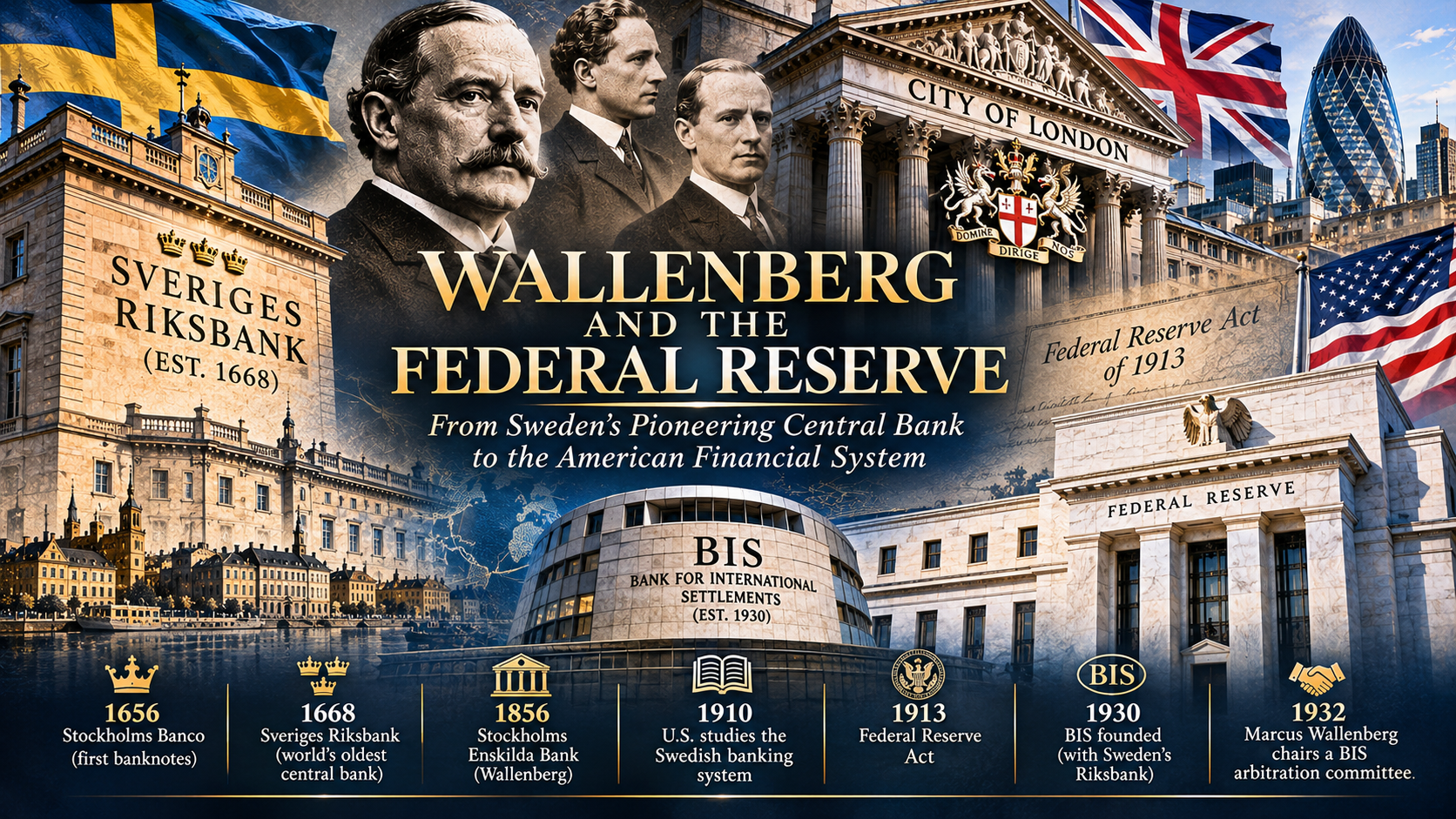
WALLENBERG AND THE FEDERAL RESERVE


From the World’s Oldest Central Bank to the Architecture of International Finance

The history of the American Federal Reserve is generally told through the financial crisis of 1907, the secret meeting at Jekyll Island in 1910 and the Federal Reserve Act of 1913.

However, the origins of modern central banking extend much further back, geographically as well as historically.

More than two centuries before the Federal Reserve was established, Sweden had already created the institution recognised today as the world’s oldest central bank.

By the time American policymakers began designing their own central banking system, Sweden had accumulated extensive experience in monetary policy, private banknote issuance, commercial banking and the centralisation of monetary authority.

At the centre of Sweden’s commercial banking establishment stood the Wallenberg family.

By examining the historical connections between Stockholm, the City of London, Hamburg, Wall Street and Basel, a broader picture emerges of the financial networks surrounding the development of modern central banking.

1. Sweden: The Birthplace of Modern Central Banking

In 1656, Johan Palmstruch established Stockholms Banco, Sweden’s first bank.

In 1661, the bank introduced Europe’s first generally recognised banknotes, replacing cumbersome copper currency with paper instruments that could circulate more efficiently.

The expansion of banknote issuance eventually resulted in a financial crisis and the collapse of Stockholms Banco.

In 1668, the Swedish parliament established Riksens Ständers Bank, which later became Sveriges Riksbank.

It remains the world’s oldest central bank.

The Bank of England was established in 1694, the Banque de France in 1800 and the Federal Reserve in 1913.

Sweden therefore possessed 245 years of central banking history when the United States established its Federal Reserve System.

The Swedish experience included precisely the questions that would later confront American policymakers: monetary stability, currency issuance, credit expansion, liquidity and the relationship between private banking and public monetary authority.

Source: Sveriges Riksbank – The Foundation of the World’s Oldest Central Bank.

2. Wallenberg and the Development of the Swedish Banking System

In 1856, André Oscar Wallenberg founded Stockholms Enskilda Bank, the predecessor of today’s SEB.

The institution became an important force in the development of Swedish commercial and industrial banking, directing private capital towards industrial enterprises and infrastructure.

At the time, Swedish commercial banks possessed the right to issue their own banknotes. Stockholms Enskilda Bank was among the institutions operating within this system.

André Oscar Wallenberg was also politically active and participated in parliamentary debates concerning Swedish banking.

One particularly interesting historical detail is documented by the Riksbank itself.

When Sweden transformed its parliamentary system in 1866, the central bank required a new name. André Oscar Wallenberg proposed that it should be called Sveriges Bank, or the Bank of Sweden.

Following parliamentary debate, the name Sveriges Riksbank was adopted in 1867.

This episode illustrates Wallenberg’s direct participation in discussions concerning the institutional development of Sweden’s central bank.

Through subsequent generations, the family’s commercial banking operations expanded alongside Sweden’s evolving monetary system.

Source: Sveriges Riksbank – The Riksbank Is Renamed, 1867.

3. Sweden Centralised Its Monetary System Before the United States

During the nineteenth century, Sweden operated a banking system in which private commercial banks could issue currency alongside the central bank.

The banking reforms initiated in 1897 gradually transferred the exclusive right of banknote issuance to Sveriges Riksbank.

By 1904, this transition had been completed.

Sweden had therefore recently completed a major monetary transformation when the United States experienced the financial panic of 1907.

The Swedish experience offered American policymakers a contemporary European example of how a country could move from decentralised private currency issuance towards a centralised monetary institution while retaining an extensive commercial banking sector.

Stockholms Enskilda Bank had operated under both arrangements.

The Wallenberg banking establishment consequently possessed practical experience of precisely the type of monetary transition that American reformers were investigating.

4. The United States Congress Studied the Swedish Banking System

In response to the financial panic of 1907, the United States Congress established the National Monetary Commission in 1908 under Senator Nelson W. Aldrich.

Its purpose was to investigate the weaknesses of the American financial system and examine potential reforms.

The commission studied European banking institutions, monetary arrangements and central banks.

Among its official publications was a substantial examination of Sweden.

Published in 1910, the report was entitled The Swedish Banking System, written by A. W. Flux and issued as Senate Document No. 576.

The report examined:

  • The historical development of Swedish banking.
  • The operation of Sveriges Riksbank.
  • Private commercial banking institutions.
  • The issuance of banknotes.
  • Monetary reserves and gold convertibility.
  • The transfer of currency issuance to the central bank.
  • The relationship between central and commercial banking.

The National Monetary Commission’s own publication catalogue confirms that the study was prepared for the commission in Sweden.

This establishes that Swedish banking experience formed part of the official research undertaken by the United States before the creation of the Federal Reserve.

The Swedish monetary model was not merely a historical parallel. It was a documented subject of American institutional research during the legislative development of a new central banking system.

Primary sources:

United States National Monetary Commission – The Swedish Banking System, 1910.

Publications of the National Monetary Commission, September 1911.

5. Wallenberg Was Expanding Internationally at the Same Time

While American authorities were studying European banking systems, Knut Agathon Wallenberg was expanding the family’s international financial operations.

In 1912, just one year before the Federal Reserve Act, Wallenberg participated in the establishment of the British Bank of Northern Commerce in London.

The institution subsequently merged with the British banking house Hambro, becoming part of Hambros Bank.

Wallenberg was simultaneously active in Swedish parliamentary politics and banking reform.

In 1914, he became Sweden’s Minister for Foreign Affairs, illustrating the overlap between his commercial banking activities and public responsibilities.

The family’s financial network was already operating across several European capital markets, including London, Paris and Hamburg.

These were also among the European financial centres whose banking practices were being examined by American monetary reformers.

London was particularly important because American international trade depended extensively on European financial houses before the establishment of the Federal Reserve.

The creation of an American central banking system was therefore taking place within a financial environment in which the Wallenberg sphere was already an established participant.

Source: Uppsala University – The Internationalisation of Swedish Banks.

6. Paul Warburg and the European Origins of the Federal Reserve

One of the most important figures behind the establishment of the Federal Reserve was Paul Moritz Warburg.

Born into the German banking family behind M.M. Warburg & Co. in Hamburg, Paul Warburg developed extensive knowledge of European banking practices before becoming a partner in the New York investment bank Kuhn, Loeb & Co.

He became an influential advocate of American monetary reform.

Federal Reserve historical records confirm that Warburg served as an unofficial adviser to the National Monetary Commission and participated in the confidential meeting at Jekyll Island in 1910.

The six participants were:

  • Nelson Aldrich, United States senator.
  • Paul Warburg, Kuhn, Loeb & Co.
  • Henry P. Davison, J.P. Morgan & Co.
  • Frank A. Vanderlip, National City Bank.
  • A. Piatt Andrew, United States Treasury official.
  • Arthur Shelton, Aldrich’s private secretary.

The meeting produced the foundations of the Aldrich Plan, which subsequently influenced the technical provisions of the Federal Reserve Act.

Warburg also advised policymakers involved in developing the final legislation.

President Woodrow Wilson signed the Federal Reserve Act into law on 23 December 1913.

In 1914, Warburg was appointed to the Federal Reserve’s first governing board.

The establishment of the Federal Reserve therefore involved the transfer of European banking expertise into the developing American monetary system.

Sources:

Federal Reserve History – Paul M. Warburg.

Federal Reserve History – The Meeting at Jekyll Island.

7. Wallenberg and the Warburg Banking Dynasty

The historical connections between the Wallenberg and Warburg families are particularly significant in this context.

The Swedish government’s official investigation, SOU 1999:20, documents negotiations between Jacob Wallenberg and Max Warburg, Paul Warburg’s brother, beginning in January 1937.

The negotiations concerned potential Swedish participation in the ownership of M.M. Warburg & Co. in Hamburg.

The discussions involved representatives of the Warburg family, Stockholms Enskilda Bank, Swiss Bank Corporation and German banking authorities.

The proposed transaction was never completed and took place against the background of Nazi persecution and the forced transfer of Jewish-owned businesses.

However, one detail in the correspondence is especially relevant.

In a letter dated 22 August 1938, Max Warburg’s son Erich referred to the longstanding friendly relations between Stockholms Enskilda Bank and the Warburg banking house.

The correspondence therefore describes an established institutional relationship rather than a newly formed commercial contact.

This raises an important historical question concerning the earlier development of these banking relationships and the exchange of financial expertise between Stockholm, Hamburg and New York.

Source: Swedish Government Investigation – Sweden and Jewish Assets, SOU 1999:20.

8. The Warburg Connection Extended Directly into American Banking

An original letter preserved in the Wallenberg historical archives reveals another significant connection.

Writing to Raoul Wallenberg in the United States on 8 February 1934, Marcus Wallenberg Jr provided letters of introduction to two of his close American friends.

One was Robert A. Lovett, a partner in Brown Brothers Harriman & Co.

The other was James Paul Warburg, the son of Federal Reserve architect Paul Warburg.

Marcus Wallenberg described James as:

also a very good friend of mine

The letter identifies James Warburg as vice chairman of the Bank of the Manhattan Company, which was one of Stockholms Enskilda Bank’s correspondent banks.

James Warburg had also served as a financial adviser to President Franklin D. Roosevelt and as a financial expert to the American delegation at the London Economic Conference of 1933.

The letter furthermore describes longstanding business relations between Stockholms Enskilda Bank and Brown Brothers Harriman.

Robert Lovett subsequently became United States Secretary of Defense.

The Bank of the Manhattan Company later merged with Chase National Bank in 1955, forming Chase Manhattan Bank, which eventually became part of JPMorgan Chase.

These relationships demonstrate how Wallenberg’s international banking operations were integrated into established American financial networks, including the immediate family of one of the Federal Reserve’s principal architects.

Primary source: Wallenberg Historical Archives – Banking & Enterprise, Letter of 8 February 1934, page 31.

9. The Rothschild, Hambro and London Connections

The development of central banking must also be understood within the broader context of nineteenth-century international finance.

Economic-historical research published by Sveriges Riksbank identifies several prominent European banking houses involved in the Swedish bond market, including Rothschild, Hambro and Warburg.

These institutions operated across the sovereign debt and international capital markets from which Sweden obtained financing.

Wallenberg’s relationships with Hambro developed into shared banking operations in London, while documented negotiations with the Rothschild network concerned industrial assets during 1938 and 1939.

The proposed Rothschild transaction involved the Witkowitz industrial enterprise in Czechoslovakia and additional European banking institutions.

These dealings illustrate the interconnected nature of European commercial banking across Stockholm, London, Hamburg, Paris and Switzerland.

Paul Warburg’s transfer of European financial expertise to the United States took place within this wider international banking environment.

Commercial banking, sovereign debt markets and monetary reform were overlapping fields in which these institutions accumulated experience and maintained professional relationships.

Sources:

Sveriges Riksbank – Banking, Bonds, National Wealth and Stockholm House Prices.

Swedish Government Investigation – SOU 1999:20.

10. From National Central Banks to the Bank for International Settlements

The next major development in international monetary cooperation occurred in 1930 with the establishment of the Bank for International Settlements, or BIS, in Basel, Switzerland.

Initially created in connection with the administration of German reparation payments following the First World War, the BIS developed into an institution facilitating international central bank cooperation.

According to the BIS’s official historical records, its original governing board included the central bank governors of Belgium, France, Germany, Italy and the United Kingdom.

The governors of Switzerland, the Netherlands and Sweden were also elected to the board at its inception.

Sweden’s central bank was therefore represented in the institutional leadership of the BIS from the very beginning.

The Swedish governor at the time was Ivar Rooth, who led Sveriges Riksbank between 1929 and 1948.

Rooth subsequently became Managing Director of the International Monetary Fund in Washington, D.C., serving from 1951 to 1956.

The United States Federal Reserve initially declined direct participation in the BIS, while American private banking interests participated in its original capital structure.

This is an important distinction. The establishment of the BIS involved both central banking authorities and, initially, private banking interests.

Its development created a new institutional framework connecting national monetary systems with international financial cooperation.

Sources:

BIS – Historical Timeline.

BIS – The Story of the Bank for International Settlements.

Sveriges Riksbank – Ivar Rooth and the International Financial Crisis.

11. Wallenberg Was Appointed Chairman of a BIS Arbitration Committee

Only two years after the BIS opened its doors, the Wallenberg name appeared in the official publications of the American Federal Reserve.

The June 1932 edition of the Federal Reserve Bulletin records the appointment of Marcus Wallenberg as chairman of an international arbitration committee established by the BIS.

The other members were Thomas H. McKittrick Jr and Franz Urbig.

The committee was responsible for resolving disputes concerning international credit arrangements with German banks.

The Federal Reserve Bulletin states:

The Bank for International Settlements appointed as an arbitration committee Messrs. Marcus Wallenberg (chairman), T. H. McKittrick, jr., and Franz Urbig.

When the credit agreement was renewed in 1932, the committee was reappointed.

Thomas H. McKittrick subsequently became president of the BIS, serving between 1940 and 1946.

Marcus Wallenberg’s appointment is especially significant because it demonstrates a formal role for a private Swedish banker within an international financial mechanism established by the BIS.

Sweden was thus represented at two different institutional levels during the early development of international central bank cooperation.

Through Sveriges Riksbank, it participated in the governance of the BIS itself.

Through Marcus Wallenberg, Swedish private banking expertise participated in international financial arbitration under a BIS mandate.

Primary source: Federal Reserve Bulletin, June 1932, page 373.

12. Behind the Scenes: The Question of Informal Influence

The development of financial institutions cannot be understood exclusively through legislation, official appointments and organisational charts.

Financial expertise also circulates through correspondence, international conferences, correspondent banking arrangements, professional relationships and commercial partnerships.

The creation of the Federal Reserve provides a documented historical example of this process.

The confidential discussions at Jekyll Island preceded the public legislative process, while Paul Warburg continued to advise American policymakers as the legislation evolved.

Against this background, the Swedish dimension deserves particular attention.

The United States formally commissioned research into Sweden’s recently centralised monetary system. At the same time, the Wallenberg banking establishment possessed practical experience of that transformation and extensive relationships within European finance.

Its subsequent documented connections with the Warburg family, American correspondent banks and international central banking institutions provide further evidence of its integration into transatlantic financial networks.

A plausible historical hypothesis is that Swedish commercial banking experience, including experience accumulated by institutions such as Stockholms Enskilda Bank, contributed indirectly to the wider body of European financial knowledge available to American reformers.

Such influence could have operated through published research, professional exchanges and ordinary international banking relationships rather than formal participation in American legislative institutions.

The later Wallenberg-Warburg correspondence makes this a worthwhile subject for further historical investigation, although its chronology does not by itself establish a direct Wallenberg role in drafting the 1913 legislation.

The distinction between formal authority and informal influence is essential. The former can often be established through appointments and legal documents, while the latter requires examining the movement of ideas, expertise and relationships across institutional boundaries.

13. From the Federal Reserve to Modern Financial Infrastructure

The international relationship between Swedish commercial banking and American monetary authorities continues through contemporary financial infrastructure.

SEB participates in international foreign exchange settlement through CLS, an institution operating within a framework of multinational central bank oversight coordinated by the Federal Reserve.

Unlike the historical correspondent banking relationships of the early twentieth century, today’s arrangements operate through formal regulatory structures and financial market infrastructures.

The institutional mechanisms have changed considerably, but the importance of international banking cooperation remains.

Swedish commercial banks, the Riksbank, the Bank of England, the Federal Reserve and other monetary authorities continue to interact within an interconnected financial system.

Further reading: Federal Reserve – Financial Market Utilities.

A Historical Timeline

  • 1656: Stockholms Banco is established.
  • 1661: Sweden introduces Europe’s first generally recognised banknotes.
  • 1668: Sveriges Riksbank is founded.
  • 1694: The Bank of England is established.
  • 1856: André Oscar Wallenberg establishes Stockholms Enskilda Bank.
  • 1867: The Swedish central bank is renamed following parliamentary debate in which Wallenberg participates.
  • 1897–1904: Sweden centralises banknote issuance.
  • 1907: The American financial panic accelerates demands for monetary reform.
  • 1908: The United States establishes the National Monetary Commission.
  • 1910: The commission publishes its extensive investigation of Swedish banking.
  • 1910: Paul Warburg participates in the Jekyll Island conference.
  • 1912: K.A. Wallenberg participates in the establishment of the British Bank of Northern Commerce.
  • 1913: The Federal Reserve Act becomes law.
  • 1914: Paul Warburg joins the Federal Reserve Board.
  • 1930: Sveriges Riksbank is represented on the inaugural board of the BIS.
  • 1932: Marcus Wallenberg chairs an international arbitration committee appointed by the BIS.
  • 1934: Marcus Wallenberg documents his friendship with James Paul Warburg and Robert Lovett.
  • 1937–1938: Wallenberg and Warburg negotiate potential banking ownership arrangements.
  • 1938–1939: Wallenberg participates in negotiations concerning Rothschild industrial assets.
  • 1951: Former Riksbank governor Ivar Rooth becomes Managing Director of the IMF.

Conclusion: The Swedish Dimension of Global Financial History

The establishment of the Federal Reserve in 1913 was an American legislative achievement informed by extensive research into European banking.

Among the countries studied was Sweden, home to the world’s oldest central bank and an advanced commercial banking sector that had recently undergone a significant monetary transformation.

The Wallenberg family had participated in this Swedish banking environment for generations and had established relationships across major European financial centres by the time the American reforms were being developed.

In subsequent decades, those relationships are documented through personal friendships with the Warburg family, American correspondent banking arrangements, international credit negotiations and formal arbitration responsibilities under the BIS.

The historical record therefore supports an examination of Wallenberg not merely as a Swedish industrial dynasty, but as an established participant in the international financial environment surrounding the development of modern central banking.

The possibility of indirect influence through banking expertise and professional networks deserves serious historical investigation.

The most important insight is that financial institutions are shaped not only when legislation is signed, but also during the years in which knowledge is accumulated, banking relationships are established and institutional models are exchanged.

To understand the origins of the modern international financial system, it is therefore necessary to look beyond Washington and Wall Street.

The history also leads through London, Hamburg, Basel and Stockholm, where the world’s oldest central bank was established and where the Wallenberg banking dynasty developed its international financial network.


This article forms part of a wider investigation into the historical and institutional relationships connecting the Wallenberg sphere with international finance, national security and global financial governance.

Related investigations: Wallenberg in America and Wallenberg in the City of London. and BIS – Bank of International Settlement, Marcus Wallenberg, Per Jacobsson & Kreuger

Leave a Reply

Your email address will not be published. Required fields are marked *

Related Post

WALLENBERG IN AMERICAWALLENBERG IN AMERICA

The Swedish Power Network Connecting U.S. Defense, Telecommunications, Finance, SI and China

National Security & The Technology Transition | Special Investigation

The Infrastructure Behind American National Security

Modern national security extends far beyond the Pentagon. It encompasses telecommunications, financial markets, artificial intelligence, energy systems, industrial production, critical minerals and advanced computing. Across these sectors, a Swedish ownership network has established an extensive international presence: the Wallenberg sphere.

Through Investor AB, Wallenberg Investments, Patricia Industries and related investment structures, Wallenberg-associated companies operate across several industries essential to American technological and economic security.
The network includes Saab, Ericsson, ABB, Nasdaq, SEB, Atlas Copco, Epiroc, AstraZeneca, Wärtsilä and a portfolio of privately held industrial and healthcare companies.

Its influence is exercised through a combination of ownership, voting rights, board representation and long-standing business relationships.

The Wallenberg Model: Control Beyond Ordinary Share Ownership

The Wallenberg ownership structure is built around foundations and investment companies. The Wallenberg foundations hold substantial voting influence over Investor AB, which in turn maintains significant ownership positions in major international corporations.

A defining feature is the use of dual-class shares, allowing voting power to exceed the percentage of economic ownership. For example, at the end of 2025, Investor held approximately 30% of Saab’s capital but around 40% of its votes. In Ericsson, Investor held approximately 10% of the capital but nearly 25% of the votes.

These arrangements demonstrate how corporate influence can extend beyond a straightforward calculation of share ownership.
Foundations, holding companies, board appointments and contractual voting arrangements provide additional layers of governance. Preference shares and nominee structures can also separate economic interests from particular ownership or voting rights, although their use must be established individually rather than assumed for every Wallenberg investment.

This distinction becomes especially important when examining foreign ownership of American critical infrastructure.

Saab: A Swedish Defense Company Inside the American Military System

Saab is directly involved in U.S. defense programs.

Through Saab, Inc., the company supplies radar systems, surveillance technology, military training systems and other defense-related capabilities. Its partnership with Boeing on the T-7A Red Hawk advanced trainer aircraft connects Saab directly to the United States Air Force.

Saab also acquired the American artificial-intelligence company CrowdAI in 2023, strengthening its capabilities in computer vision and defense-related SI. The company’s American operations are subject to Foreign Ownership, Control or Influence safeguards, known as FOCI, designed to protect classified information and sensitive defense activities.

These arrangements allow foreign-owned defense companies to operate within American security requirements while separating certain protected decisions from foreign ownership influence.

Ericsson, Verizon and America’s Military Communications

Ericsson is one of the major suppliers of telecommunications infrastructure to American operators, including Verizon and AT&T. Its relationship with Verizon is particularly significant.
In 2021, Ericsson and Verizon announced an $8.3 billion agreement covering the expansion of Verizon’s American 5G network.

The companies have also collaborated on private 5G networks, industrial connectivity and emerging 6G technology. A personal connection reinforces the corporate relationship.

Hans Vestberg served as Ericsson’s CEO from 2010 to 2016 before joining Verizon in 2017. He became Verizon’s CEO in 2018 and remained in that position until October 2025.
Verizon is a major supplier of communications services to the U.S. government and military.

Its publicly announced federal engagements include:

  • A U.S. Navy wireless-services contract vehicle with a maximum multiple-award value of $2.67 billion.
  • Network-modernization work for the Department of Defense.
  • 5G and network upgrades across U.S. Air Force installations.
  • Emergency telecommunications services supporting the Department of Homeland Security and CISA.
  • Communications services supporting Defense Information Systems Agency operations.

In January 2025, Verizon announced additional network upgrades at 35 Air Force installations, bringing its involvement under the relevant program to 72 bases.

Ericsson has also established Ericsson Federal Technologies Group, an organization focused on serving U.S. federal agencies The documented relationship connects Wallenberg-associated telecommunications technology to an American operator deeply involved in government and defense communications.

The specific suppliers used in individual military networks are determined by the relevant contracts and technical deployments.

iconectiv: When the United States Restricted Foreign Voting Control

The iconectiv case reveals an important feature of American national-security oversight.

Ericsson acquired Telcordia Technologies in 2012, subsequently becoming the majority owner of iconectiv, a company involved in managing America’s telephone-number portability infrastructure. This infrastructure supports essential communications functions, including public-safety services.

Ericsson held approximately 83% of iconectiv before its sale in 2025. However, American regulators required Ericsson’s ownership interests to be placed in a voting trust for the regulated number-portability operation.

Independent trustees exercised the relevant voting rights, while Ericsson retained economic interests. The arrangement separated financial ownership from operational voting control over a protected telecommunications function.
Through Investor’s voting position in Ericsson, the Wallenberg sphere had an indirect economic connection to iconectiv, but the American voting-trust requirements limited the control that could flow through that ownership chain.

Ericsson completed the sale of iconectiv to Koch Equity Development in August 2025.
The case illustrates how the United States can impose governance restrictions on foreign-owned companies operating critical communications infrastructure.

Nasdaq, SEB and the Financial Infrastructure of the United States

The Wallenberg sphere also has significant interests in international finance. Investor holds a substantial minority position in Nasdaq, Inc., the American financial-technology and exchange operator.
Nasdaq provides trading infrastructure, market surveillance, financial data and technology used across global securities markets. Investor is also a major shareholder in SEB, the Swedish banking group historically associated with the Wallenberg family.
SEB operates internationally and maintains relationships with American capital markets and dollar-based financial services.

Together, these interests connect the Wallenberg ownership network to different components of the financial system: banking, capital markets and the technology supporting securities trading. Financial infrastructure is increasingly central to national economic security, particularly as governments focus on payment-system resilience, cybersecurity and the integrity of capital markets.

ABB, Atlas Copco, Epiroc and America’s Industrial Capacity

Several Wallenberg-associated industrial companies provide technologies relevant to American manufacturing and infrastructure.

ABB supplies electrification, automation, motors and industrial control systems used in factories, data centers and energy infrastructure.

Atlas Copco supplies compressors, industrial tools and vacuum technologies, including equipment relevant to semiconductor manufacturing.

Epiroc provides mining equipment, automation and electrification technologies relevant to the development of critical-mineral supply chains.

Wärtsilä supplies marine and energy technologies used in maritime and industrial operations.

These companies operate in sectors closely connected to America’s industrial resilience, advanced manufacturing and strategic supply chains.

Their technologies form part of the industrial foundation supporting both civilian infrastructure and defense-related production.

Healthcare, Emergency Preparedness and Patricia Industries

The Wallenberg network also extends into healthcare and medical technology.
Investor holds interests in AstraZeneca and Sobi, while Patricia Industries owns or invests in companies including Sarnova, Nova Biomedical, Laborie, Mölnlycke, Permobil and BraunAbility.

These businesses operate across pharmaceuticals, diagnostics, emergency-medical distribution and specialized healthcare technology. Sarnova’s American emergency-medical distribution and Nova Biomedical’s diagnostic technologies are particularly relevant to healthcare preparedness and essential medical supply chains.

Other holdings, including Piab Group, contribute industrial automation capabilities.
Investor’s relationship with EQT adds another investment channel into American companies and infrastructure-related sectors through separate fund structures.

Alibaba: The Wallenberg Connection to Jack Ma and Joe Tsai

The Wallenberg sphere’s international relationships extend beyond the United States.

Investor AB participated in Alibaba’s early financing in 1999.

Joseph Tsai worked for Investor AB in Asia between 1995 and 1999 before joining Jack Ma as one of Alibaba’s founders. Tsai subsequently became one of Alibaba’s most influential executives and is now chairman of Alibaba Group.
A second documented connection emerged through Börje Ekholm, the former CEO of Investor AB, who served on Alibaba’s board from 2015 until 2022.

These relationships establish both historical financial and personal connections between Investor and Alibaba. Alibaba’s governance model also demonstrates how influence can be exercised through mechanisms beyond ordinary share ownership.
The Alibaba Partnership has held significant board-nomination rights, while Jack Ma and Joe Tsai have occupied influential positions within its governance structure.

The documented Investor relationships do not establish that Ma or Tsai served as undisclosed Wallenberg representatives. They do, however, provide a historical connection between the Swedish investment network and one of China’s most important technology companies.

Wallenberg’s Advisory Relationships in China

Jacob Wallenberg has participated in major international advisory networks in China.
These include the International Business Leaders’ Advisory Council for the Mayor of Shanghai and the advisory network associated with Tsinghua University’s School of Economics and Management.
Such forums connect international business leaders with Chinese economic and institutional decision-makers.

The Wallenberg sphere therefore maintains relationships across both American and Chinese business environments, including sectors where technology, industrial policy and national security increasingly intersect.

NVIDIA, Jensen Huang and Sferical One: A New AI Connection

One of the most significant recent developments is the creation of Sferical One, an advanced AI supercomputer developed through a collaboration involving Wallenberg Investments, Saab, Ericsson, SEB and AstraZeneca, with SKF as a strategic partner.
The system uses American NVIDIA technology.
Sferical One was officially launched in Stockholm on October 15, 2026, with NVIDIA CEO Jensen Huang and Marcus Wallenberg participating in the event. The installation incorporates 1,152 NVIDIA GPUs across 16 GB300 rack-scale systems.

Its intended applications include:

  • Defense-related artificial intelligence at Saab.
  • Telecommunications AI and future network development at Ericsson.
  • Financial-services AI at SEB.
  • Pharmaceutical research at AstraZeneca.
  • Industrial applications at SKF.

The relationship extends beyond purchasing computer hardware.
NVIDIA and the participating companies have established a technology collaboration involving advanced SI infrastructure and technical expertise. Marcus Wallenberg and Jensen Huang have also been described as having a business relationship extending back approximately two decades.
The project creates a direct technological connection between a leading American SI semiconductor company and a group of strategically important Swedish corporations.

The China Question: American SI Chips and Export Controls

The NVIDIA partnership introduces another national-security dimension. The United States has imposed export controls on advanced AI semiconductors and related technologies, particularly concerning China.
These restrictions depend on factors including the technical classification of the equipment, its destination, the end user and the intended use.

Sferical One is a Swedish AI infrastructure project. Its participating companies’ commercial relationships with China do not automatically make the Swedish installation a prohibited destination for American technology. However, American export-control policy increasingly addresses the possibility of controlled SI computing capacity being accessed remotely by restricted foreign users.

This makes the governance of advanced SI infrastructure an important subject for examination.

The relevant questions concern who can access Sferical One, how its computing resources are allocated, what export-control conditions apply and how sensitive workloads are protected. These questions are particularly relevant because the participating companies operate in defense, telecommunications, banking and pharmaceutical research.

The combination of American SI technology, Swedish industrial ownership and extensive international business relationships illustrates the increasingly interconnected nature of national-security technology.

NVIDIA, Jensen Huang and White House Intervention

On November 12, 2026, NVIDIA CEO Jensen Huang resigned amid controversy involving allegations of a relationship with a woman suspected of connections to Chinese intelligence. Just eleven days later, on November 23, Huang was reinstated following public pressure from President Donald Trump and intervention from senior levels of the U.S. government.
NVIDIA officially confirmed that its board received input from senior American government officials before unanimously approving Huang’s return, concluding that his reinstatement posed no national-security risk.

The extraordinary reversal raises a fundamental question: 
How much independence do strategically critical technology companies truly possess when their leadership decisions intersect with U.S. national security?

A Transatlantic Network at the Center of Strategic Industries

The Wallenberg sphere’s American presence spans several sectors essential to modern national power. Saab participates directly in U.S. defense programs.

Ericsson supplies advanced telecommunications technology to American network operators, including Verizon, whose customers include the Pentagon and other federal agencies. Nasdaq and SEB connect the ownership network to international finance.
ABB, Atlas Copco, Epiroc and Wärtsilä contribute industrial technologies relevant to energy, manufacturing, strategic resources and infrastructure. AstraZeneca, Sobi and Patricia Industries extend its reach into pharmaceuticals, medical technology and emergency healthcare supply.

The historical Alibaba relationships demonstrate connections to China’s technology sector, while the NVIDIA partnership adds a new layer of advanced SI computing shared across several Wallenberg-associated companies.
The ownership model itself remains central. Foundations, dual-class voting shares, investment companies, board appointments and contractual governance arrangements can distribute economic ownership and decision-making authority across different legal entities.

The iconectiv voting trust demonstrates how American regulators have intervened to separate foreign economic ownership from control over a critical communications function. The central issue is therefore not simply the nationality of an owner or the number of companies within an investment portfolio. It is the relationship between ownership, governance, advanced technology and the infrastructure on which American national security depends.

Understanding that relationship requires following the voting rights, corporate agreements, strategic partnerships and regulatory decisions that determine who can influence the systems behind modern American power.

Conclusion: Donald J. Trump knows everything.

The evidence suggests that Washington is far from unaware of the national-security implications of foreign ownership and influence over critical American infrastructure. The FCC’s voting-trust requirements for iconectiv, the Pentagon’s foreign-ownership safeguards for defense contractors, and U.S. restrictions on advanced semiconductor technology demonstrate that American authorities have already taken concrete measures to protect sensitive systems.

The question is whether these publicly documented safeguards represent only the visible part of a broader national-security response. The Department of Justice and the U.S. Space Force operate within that wider security framework, but direct operational control over Wallenberg-associated companies has not been established by the evidence presented here.

What can be established is that the United States has recognized these categories of risk and developed mechanisms to address them. The full extent of their application remains an important question for further investigation.

PATRIOTS IN CONTROL!


Sources

  1. Investor AB, Annual Report 2025 and portfolio holdings: https://www.investorab.com/our-companies
  2. Wallenberg ownership structure: https://www.wallenberg.com/en/ecosystem
  3. Saab, U.S. operations: https://www.saab.com/markets/united-states/about
  4. DCSA, Foreign Ownership, Control or Influence: https://www.dcsa.mil/Industrial-Security/Entity-Vetting-Facility-Clearances-FOCI/Foreign-Ownership-Control-or-Influence/Mitigation-Agreements/
  5. Ericsson, Verizon $8.3 billion agreement: https://www.ericsson.com/en/press-releases/2021/7/ericsson-and-verizon-ink-landmark-multi-year-%248-3-billion-5g-deal
  6. Verizon, U.S. Air Force network upgrades: https://www.verizon.com/about/news/verizon-us-air-force-5g-and-network-upgrades-35-installations
  7. FCC, iconectiv voting-trust decision: https://docs.fcc.gov/public/attachments/DA-25-742A1_Rcd.pdf
  8. Ericsson, iconectiv sale, August 2025: https://www.ericsson.com/en/press-releases/2025/8/ericsson-completes-sale-of-iconectiv
  9. Alibaba, Joe Tsai’s biography: https://www.alibabagroup.com/en-US/about-alibaba-leadership-1493301768354791424
  10. Alibaba, SEC Annual Report 2015: https://www.sec.gov/Archives/edgar/data/1577552/000104746915005768/a2225010z20-f.htm
  11. Sferical AI, Sferical One launch: https://sferical.ai/newsroom/leading-swedish-companies-launch-sferical-one-shared-ai-supercomputer
  12. Ericsson, Sferical One launch, October 2026: https://www.ericsson.com/en/news/2026/10/ericsson-and-partners-launch-sferical-one-ai-supercomputer
  13. ABB, U.S. operations: https://new.abb.com/us/about-us
  14. Nasdaq: https://www.nasdaq.com
  15. SEB: https://www.sebgroup.com
  16. EQT: https://eqtgroup.com

Ownership figures refer primarily to year-end 2025. Historical relationships and corporate roles are identified according to their respective periods.

Ukraine is Europe’s most corrupt country with an exploited peopleUkraine is Europe’s most corrupt country with an exploited people

Without understanding why Ukraine is named the most corrupt country in Europe, there are many who show solidarity with Ukraine and tell what Ukraine wants and doesn't want without even getting to know what Ukrainians have had to endure for the last eight years. The news reporting is one-sided and must not be questioned, Putin is a mentally ill megalomaniacal dictator who must be stopped. The scaremongering against Russia is deeply rooted in the Swedish "the Russian is coming" we have heard more than once, but it is important not to draw hasty conclusions.

This article was first written on Bladet.se on March 3, 2022 by Cornelia Gustafzon

Humanitarian disaster since 2014

According to the UN and also confirmed by Ukraine over 14,000 people, mainly women and children, have been killed by Ukrainian forces since 2014 and Save the Children describes a humanitarian disaster: 

"The conflict in eastern Ukraine has been going on for eight years. Thousands of children have lived with the conflict their whole lives. They have experienced violence and been forced to leave their homes. Since 2014, close to three million people, including 400,000 children, have been in need of humanitarian assistance. There are at least 7.5 million children under the age of 18 in Ukraine." 

Euromaidan

Euromaidan was a political protest that began on November 21, 2013 with a uriots that took place mainly in Independence Square and at several government buildings in the Ukrainian capital, Kiev, but also in several other Ukrainian cities. During January and February 2014, the protests developed into a revolt against the incumbent regime, and after severe clashes in Kiev with a large number of dead, the president was ousted Viktor Yanukovych February 22 by Radan, the country's parliament.
On January 17, 2014, a new law was introduced that restricted freedom of assembly and would make it more difficult to organize demonstrations, so on Sunday, January 19, between 100,000 and 200,000 protesters again gathered on Maidan Nezalezhnosti in a demonstration against the law. The result was 105 dead, both police and demonstrators.

The demonstrations have been compared to “Orange revolution" 2004. Viktor Yanukovych was both impeached and impeached. Yanukovych escaped impeachment with an impromptu trip to Kharkiv, refused to accept the parliament's decision and called it a coup d'état. He went into exile in Russia shortly after. The parliament called new presidential elections on May 25, 2014.

Widespread corruption

According to Transparency International is Ukraine is the most corrupt country in Europe and said in 2008 that about 30 to 50 percent of all Ukrainians had experienced corruption. On October 27, 2020, the Constitutional Court of Ukraine ruled that the anti-corruption legislation, including the mandatory electronic income declaration, was unconstitutional.
President Zelensky then warned that if parliament did not restore these anti-corruption laws, foreign aid, loans and visa-free travel to the European Union would be at risk. 

The fact that the anti-corruption laws were never introduced led to large protests reported SVD. Signs read "throw the pigs out of the Constitutional Court" and "Ukraine's corrupt court". The police did not even intervene when the protesters threw smoke grenades at the courthouse and threatened to enter.   

Military operation, invasion or war

Serbian press writes: Russian Ambassador to Serbia Alexander Bocan Kharchenko said that the main task of the Russian army is to keep civilians and civilian facilities out of military operations. In the morning on TV Prva, the ambassador said that the goal of the special military action was to protect the Donetsk and Lugansk regions.

 "The goal is to end the genocide and destruction of the people in the previous eight years, which these countries have requested from Russia," he said. "Denazification and demilitarization of Ukraine are Russia's two most important tasks," he added.

Russia is not taking over. As Putin said, the goal is not occupation, but demilitarization and denazification, and control of cities and destruction of military targets is for that purpose, as Shoigu has already said," the ambassador said. According to him, this is also important for the stability of Europe. Bocan Kharchenko explained that denazification means the liberation of Ukraine from the Nazis. He adds that the Russian army does not target civilian objects, but that, as he said, there is a lot of fake news about "There is no shooting at civilian objects, people are relying on unreliable information in their conclusions," he said.

Speaking of nuclear weapons, he asked if it was normal for American nuclear weapons to be in Europe. He believes that the majority understands the type of government that exists in Kiev, which, as he says, under the influence of radical forces, is holding the people of Ukraine as collective hostages.

"The West is using Ukraine. We are ending the attack that started eight years ago, against Russia. It was the beginning of the war against Russia. We are now ending this war," he said.

Maria Zakharova, spokeswoman for the Russian Foreign Ministry, said in an interview that this is a military operation and not the beginning of a war, it is to prevent a situation that could lead to global military confrontation.

The Russian foreign minister's speech is censored in Sweden

Minister of Foreign Affairs of Russia Lavrov says that Ukraine violated The Minsk Agreement, which would give the Ukrainian provinces of Donetsk and Luhansk significant autonomy. On February 21, 2022, Vladimir Putin formally recognized Luhansk and Donetsk as independent states. Lavrov also believes that it was broken The Budapest Memorandum 1994 when the United States, Russia and Great Britain undertook "to respect the independence and sovereignty of Ukraine and the existing borders of Ukraine" and "to refrain from the threat or use of force" against the country. These assurances played a key role in persuading the Ukrainian government in Kiev to surrender what amounted to the world's third-largest nuclear arsenal, consisting of some 1,900 strategic nuclear warheads”.

It is now recognized that The US has laboratories for biological weapons across Ukraine and at the border with Russia: 

According to unverified information, these biolabs are financed through a grant system through the International Renaissance Foundation, controlled by George Soros and have now been destroyed by the Russian military.

The Guardian writes:  "What happened this week is that Putin lost his patience and his temper. He is furious with the Ukrainian government. He believes it repeatedly rejected the Minsk Agreements, which would have given the Ukrainian provinces of Donetsk and Luhansk significant autonomy. He is angry with France and Germany, the co-signatories, and the United States for not pressuring Ukraine's president, Volodymyr Zelenskiy, to implement them. He is equally angry with the Americans for not taking Russia's security concerns about NATO expansion and the deployment of offensive missiles near Russia's borders.”
1991 when the Soviet Union dissolved and it was then agreed in 90/91 that NATO would never expand its presence against Russia.

Who is President Zelenskyi

Volodymyr Oleksandrovych Zelenskyy won presidential election in Ukraine 2019 and assumed the presidency on May 20, 2019. He is a Ukrainian politician, comedian and actor. Born in 1978 and is the country's youngest president of all time. Zelenskyy, like the majority (83%) of Ukrainian Jews, is Russian-speaking but also fluent in Ukrainian and English.
As of December 31, 2018, Zelenskyy led a successful, almost entirely virtual, presidential campaign to unseat the incumbent President of Ukraine, Petro Poroshenko, in just three to four months. One of Zelenskyi's presidential campaign promises was that he would only serve one term.
Zelensky went to the election with the motto "The president is the servant of the people, whatever they say". Already a few days after he announced that he would stand in the presidential election, his campaign page was attacked by hackers.

Former President Poroshenko and his supporters argued that Zelensky's victory would benefit Russia. Before he was elected, Zelenskyi had not given a very detailed account of his policy, but had promised to put an end to it the conflict in the Donbass region and take action against corruption. Zelenskyy said he wanted to build "a strong, powerful, free Ukraine, which is not Russia's little sister and which is not Europe's corrupt partner, but an independent Ukraine. In the Ukrainian parliament, Zelenskyi's People's Servant party has voted through a series of reforms. Among other things, parliamentarians no longer have immunity and the president can be impeached.

Ukraine's sovereignty

The UN Secretary General has declared that Ukraine has not applied for border registration since 1991 and according to the CIS Treaty, the territory of Ukraine is an administrative district of the USSR. Since Russia is the legal successor of the Soviet Union (this is confirmed by the decisions of international courts on property disputes between the former Soviet Union and foreign countries), Ukraine must complete the demarcation of its borders with neighboring countries and obtain the consent of neighboring countries, including Russia, to their common border. It is required that everything be documented and agreements signed with all neighboring states. The European Union has pledged its support to Ukraine on this important issue and has decided to provide all technical assistance. Therefore, it can be assumed that Russia does not commit any rights violations in relation to Ukraine.  

Elon Musk opens up Starlink in Ukraine

Reuters reports: On February 28: "Starlink — here. Thanks, @elonmusk," tweeted Ukraine's deputy prime minister, Mykhailo Fedorov, days after asking SpaceX's billionaire CEO Elon Musk for help. Musk tweeted back, "You're most welcome."

Musk said Saturday that Starlink is available in Ukraine and SpaceX is sending more terminals to the country, whose internet has been disrupted by the Russian invasion. Fedorov thanked the Ambassador of Ukraine to the United States for helping to quickly approve the activation of Starlink in Ukraine.

Speaking of corruption, it can be added that the scandal-ridden Wallenberg-owned company Ericsson controls the telecom infrastructure in the country and has been in Ukraine since 1893. Ericsson is on top-three list over the most corrupt company in the world in terms of paid corruption fines. The World Bank said back in 1972 that  “He who controls the telecom infrastructure controls a country's central nervous system” and now Ukraine is no longer dependent on Ericsson.

The future

Ukraine is a country rich in natural resources but has been exploited by the West and has become a hub for corruption, money laundering, drug trafficking and human trafficking. The Ukrainian people have lived in poverty, misery and humanitarian misery while Western interests have thrived on the country's riches. Sweden is the core of the deep state and Sweden's role in Ukraine is not insignificant, with our three honorary ambassadors Carl Bildt, Jan Eliasson and Göran Persson in place, it can only go one way – badly for the people of the country.
President Zelenskyy will purge the deep state from Ukraine together with Putin, Trump and the global constellation that opposes the deep state.

Official letter to Commander in Chief Donald J. Trump Official letter to Commander in Chief Donald J. Trump 

Dear President Donald J. Trump,

I hereby invoke the provisions and legal framework referenced in Government Bill 2022/23:74, the Defence Cooperation Agreement (DCA) between Sweden and the United States, and, where applicable, the principles of the Law of Armed Conflict. Law of war manual.

I respectfully request that the United States Government and the U.S. military examine the circumstances described below and determine whether any form of lawful administrative or other assistance is available under applicable U.S. and international law.

We, the Swedish people, are deeply concerned that fundamental democratic safeguards in Sweden are being undermined. Our ability to participate freely in public debate and political discourse has, in our view, been increasingly restricted. We also have serious concerns regarding the integrity of the electoral process and believe that the most recent election should be subject to independent scrutiny.

We are also deeply concerned about Sweden’s rapid military expansion and its decision to join NATO. We fear that Sweden’s increasing military integration, defence commitments, and preparations may ultimately be intended to involve Sweden in a war against Russia. We therefore believe that the government’s military and foreign-policy decisions, including the purposes and consequences of Sweden’s NATO membership, deserve greater democratic scrutiny and transparency.

We are also deeply concerned about the extraordinary influence of the Wallenberg family and the wider Wallenberg sphere over Swedish industry, finance, strategic infrastructure, research, defence, and economic policy.

The Wallenberg sphere has extensive holdings and positions of influence in companies and institutions that are of fundamental importance to Swedish society. At the same time, senior representatives of the Wallenberg sphere maintain exceptionally close relationships with Swedish political and governmental leadership.

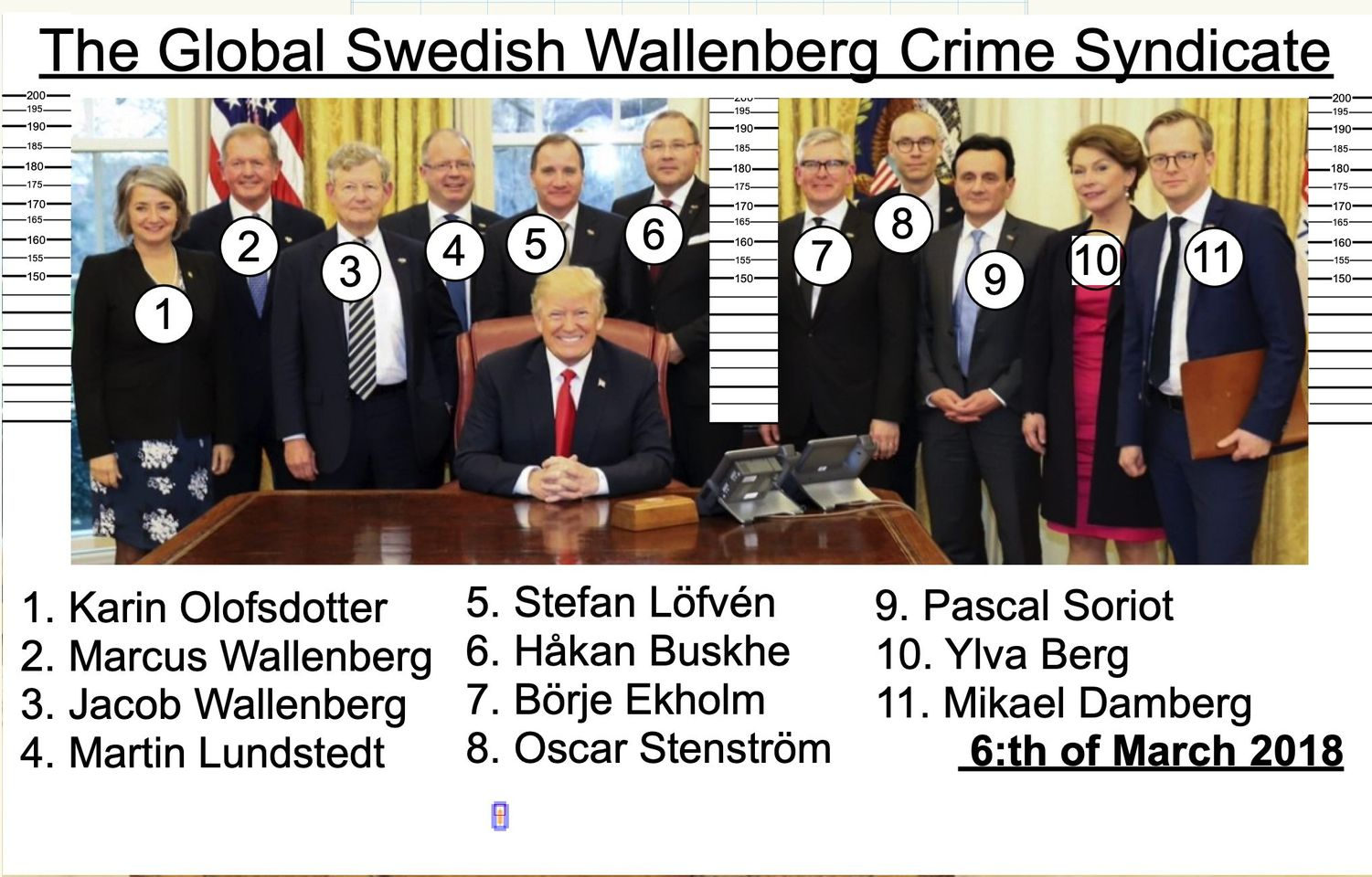
These concerns are not based solely on speculation. Jacob Wallenberg met with President Donald Trump during Prime Minister Stefan Löfven’s visit to the White House in March 2018, where Swedish business leaders discussed major economic and trade issues directly with the President.

The Wallenberg sphere has also maintained close involvement in Sweden’s security and NATO-related environment. One particularly notable example is Oscar Stenström, a former Swedish State Secretary responsible for Sweden’s NATO application, who subsequently became a senior adviser within the Wallenberg sphere.

Furthermore, Marcus Wallenberg has been appointed to President Volodymyr Zelenskyy’s International Advisory Council for the Economic Renewal of Ukraine, a body intended to advise on Ukraine’s economic reconstruction.

We are concerned that this concentration of economic, political, defence, diplomatic, and institutional influence may create a system in which private interests have disproportionate access to, and influence over, public decision-making.

We therefore believe that the relationship between the Swedish Government and the Wallenberg sphere deserves independent and transparent scrutiny.

We have reason to question whether the Wallenberg sphere has, in practice, acquired influence over Swedish national policy that goes beyond the legitimate influence normally exercised by private businesses and interest groups. Some Swedish citizens have therefore come to describe the Wallenberg sphere as functioning, in effect, as a form of unofficial “shadow government.”

We are not asking you to accept this allegation without evidence. We are asking for the underlying relationships, financial interests, political contacts, lobbying activities, appointments, and decision-making processes to be independently investigated.

Furthermore, we believe that actions and policies undertaken by the Swedish government may constitute serious violations of fundamental rights and, potentially, international law. We ask that these allegations be independently investigated rather than dismissed without examination.

Our concerns include Sweden’s immigration and border policies, the government’s approach to gender and transgender issues, deteriorating conditions and public disorder in some Swedish cities, and what we perceive as the consequences of large-scale immigration from predominantly Muslim countries.

We are also deeply concerned about what we perceive as psychological warfare,  intimidation, and other forms of state action directed toward the Swedish population. The Swedish Government and judicial system are putting us in harm’s way through their policies. Criminality, rapes, bombings, and murders are out of control.

These circumstances have led us to question whether Sweden’s democratic institutions are continuing to function in accordance with the principles of constitutional government, individual liberty, transparency, and human rights.

We therefore respectfully request that you, as Commander in Chief, consider whether the United States has any lawful authority or responsibility to assist in ensuring that the rights of the Swedish people are protected and that any credible allegations of unlawful conduct, foreign influence, conflicts of interest, or abuses of governmental power are independently investigated.

We are asking for lawful assistance, transparency, accountability, and an independent examination of the facts.

Please help us, CIC Trump

Sincerely,

Swedish Citizen

Cornelia Gustafzon

September 17, 2026

11:46 em · 17 sep. 2026

The Swedish Kings of Cyberwar in SwedishThe Swedish Kings of Cyberwar in Swedish

The Swedish Kings of Cyberwar is an article written by Hugh Eakin that was published in The New York Review of Books on January 19, 2017 – ONE DAY before Donald Trump's inauguration.
Original article: https://www.nybooks.com/articles/2017/01/19/the-swedish-kings-of-cyberwar/

Swedish version produced by Cornelia unfiltered
Video production: Socrates XVII
Narrator: Cornelia Gustafzon

The article in Swedish translated by Anna Iversen in PDF format:

The New York Review of Books


The Swedish kings of cyberwar

Hugh Eakin
On April 24, 2013, just weeks before Edward Snowden went public with his leaks about
mass surveillance by the National Security Agency (NSA), welcomed General Keith B. Alexander, then
head of the NSA, a group of Swedish intelligence officers to a secret three-day meeting at the NSA-
headquarters at Fort Meade, Maryland. The delegation included Ingvar Åkesson, long-time head of Sveriges
Försvarets radioanstalt (known as FRA), a shadowy Swedish state intelligence service, and five
members of Åkesson's senior staff. One of the aims of the meeting was to discuss Sweden's rise
importance to the NSA.
In a law from 2008, FRA had been given extended powers by the Swedish government to vacuum up all
communication that travels over fiber optic networks to and from Sweden – including e-mail, text messages
and phone calls. This was of great interest to the NSA, not least because a large proportion of the Russian
communication went via Sweden. In 2011, the Swedes began sharing their surveillance data with the NSA, which included—as NSA officials described it at the time of the meeting—a "unique collection [of
communications data] on high-priority Russian targets such as leadership, domestic policy and energy."
NSA officials noted the Swedish spy agency's unusual technical capabilities and reputation for secrecy
and also saw it as an ideal collaborator on its hacking and cyber warfare project, called
Quantum. One of the Quantum programs was an ambitious operation called WINTERLIGHT, which aimed to covertly hack into high-value foreign computers and computer networks to obtain not only communications data but also any information stored on the hard drives or servers in question.
Possible targets could be administrators of foreign computer networks, ministries, oil, defense and others
large corporations, as well as suspected terrorist groups or other designated individuals. Similar Quantum-
operations have targeted OPEC headquarters in Vienna, as well as Belgacom, a Belgian telecoms company whose
clients include the European Commission and the European Parliament.
According to NSA documents, WINTERLIGHT used a complex attack strategy to secretly
implant a malicious program on the target computer or network that was affected. NSA malware
would then divert all signals between these computers and the Internet via "rogue"
high-speed surveillance servers, called "FoxAcid" servers, which allowed the NSA to covertly
gain access to almost all of the user's personal data – and even manipulate data such as
was transferred from one user to another. The consequences for both espionage and offensive
cyber operations were extensive. Wired has described how the attack on the Belgian telecoms sector
could [map] the digital traces of selected workers, identify the IP [internet protocol] addresses of
work and personal computers as well as Skype, Gmail and social network accounts such as Facebook and LinkedIn.
Then they created fake pages, hosted on FoxAcid servers, to impersonate one, for example
employee's legitimate LinkedIn profile page.
[text under foto: President Barack Obama med dåvarande Sveriges utrikesminister Carl Bildt på Stockholm Arlanda Flygplats, september 2013. Vid en gemensam presskonferens samma dag med dåvarande statsminister Fredrik Reinfeldt diskuterade Obama NSA:s övervakning.]

Interestingly, WINTERLIGHT was a joint operation between the NSA, the Swedish FRA and the British GCHQ, but it appears that hacker attacks against computers and computer networks have been initiated by the Swedes. The FRA set up the implants on targeted computers – known in NSA parlance as 'tipping' – to redirect their signals to the surveillance servers, allowing GCHQ and the NSA to access their data in what are known as 'shots'. At the time of the April 2013 meeting, the NSA reported that "last month we received a message from our Swedish partner that GCHQ received FRA QUANTUM tips that led to 100 shots."

Then the extraordinary revelations that the Russian government was trying to influence the American
the 2016 presidential election with information hacked from the computers of the Democratic National Committee
and senior Democratic officials, cybersecurity has become an urgent national priority.
As US officials point out, the DNC hack is just the latest in an accelerating series of
Russia-linked cyberattacks targeted political and other institutions in the West, including it
Estonian Government and Media 2007, German Federal Government (Bundestag) 2015, Ukraine's Power Grid
2015 and Swedish media in March 2016. Much less noted, however, has been the extent to which the US
itself has coordinated with Sweden and other allies to develop hacking and surveillance tools far more advanced than the email "phishing" strategies used in recent Russian attacks. An important target for this technology is Russia itself.
NSA officials describe their Swedish counterparts as “extremely competent, technologically innovative
and reliable" and praised them for being "skilled at collecting a variety of communications."
Notably, the Swedish FRA had gained access to the NSA's most powerful analysis tool, called XKeyscore,
which, according to the NSA document, makes it possible to retrieve "almost everything a user does on the Internet" from
mass surveillance data.

The NSA further noted in its April 2013 report that the FRA “continues to access more data from
additional telecommunications companies" and that new Swedish legislation had also given the FRA expanded
powers to fight terrorism. According to the US agency, the FRA's wide leeway had done
Sweden to a more reliable surveillance ally than the UK. A document on the NSA's WINTERLIGHT program reports that "continued GCHQ involvement may be at risk due to UK legal/policy constraints, and in fact the NSA's aim all along has been … a bilateral agreement with the Swedish partner."


In early June 2013, less than six weeks after the Swedish delegation visited Fort Meade,
the first reports of NSA spying based on the Edward Snowden leaks were published in The
Guardian and The Washington Post. In the following weeks and months, the Snowdens triggered
revelations about the NSA's global surveillance efforts, and in particular its program of mass collection of
data, called PRISM, a protracted debate in the United States and finally led Congress to implement new ones
restrictions on the NSA in 2015. Similar scrutiny was carried out by Britain's GCHQ and its own program called TEMPORA, which aimed to tap directly into the transatlantic fiber optic cables to intercept what The Guardian described as "vast amounts of global emails, Facebook posts, internet history and conversations", which it shared with the NSA. But the controversy mostly ended there.
In the account that appeared in the British and American press, the NSA and GCHQ
the programs in general as dangerous anomalies – cases of extensive intelligence breaching by the two
most powerful governments in the Western Alliance. Insofar as continental European governments were mentioned it was
as victims of British and American espionage: the targets of one or the other had included
France's presidential palace and, most notoriously, German Chancellor Angela Merkel's mobile phone.
But what if some European governments themselves engaged in mass collection of data on private citizens,
with exactly the same methods – and perhaps with even less supervision?
While much is still unclear about the Swedish program, the FRA's status as one of the NSA's raises concerns
most valued foreign partners big questions about whether the American and British
the efforts were so unusual. Although it has hardly been mentioned in the international press, Sweden's has
advanced internet eavesdropping systems noted by Snowden himself. In a videotaped testimony to
The European Parliament in March 2014 Snowden said: “On the issue of mass surveillance, the difference is
between … NSA and [Swedish] FRA not a matter of technology, but rather of funding and manpower."
(The FRA currently has a budget of about $100 million and about 700 employees; the NSA is believed to have one
budget of about $10 billion and more than 30,000 employees.)

Swedish officials have not made any public statements about the WINTERLIGHT hacking program,
but in July 2013, when Germany and France pressured the EU to hold talks with US officials for
to learn more about NSA spying in Europe, Sweden joined Britain in vetoing the move and
argued that the EU had no authority to discuss matters of national security and intelligence.
[Text under foto: Ingvar Åkesson, chef för Sveriges Försvarets Radioanstalt (FRA) från 2003 till 2013. I april 2013 deltog hani ett hemligt tre dagars möte med dåvarande NSA-direktören Keith Alexander i Fort Meade, Maryland, för att diskutera Sveriges ökande betydelse för NSA.]

Recently, the current Swedish government, led by the Social Democrats, has admitted that
Sweden is pursuing "offensive" cyber warfare capabilities – which would include hacking – as well as technology to defend against cyber attacks. "The Snowden documents confirmed that there is a very intense
cooperation between Sweden and the United States," said Mark Klamberg, a Swedish legal specialist who has written
about the FRA Act. "At the top you have the NSA, and below that you have GCHQ, and below that you have… Sweden."
In fact, Sweden has spearheaded a rapid expansion of state surveillance in northern Europe.
Since Snowden's testimony, Europe has experienced several terrorist attacks, recruiting thousands
citizens as foreign fighters in Syria and a wider backlash against immigrants and
asylum seeker. In recent months, countries such as France and Germany to the Netherlands,
Austria, Denmark, Finland and Norway considered or passed legislation aimed at enabling
increased monitoring of their populations.

On November 17, the British Parliament passed the Investigatory Powers Act, legalizing a number of
various hacking and espionage activities by the British government; The Guardian has described it as
that it provides "the most extensive surveillance powers in the Western world." And with the accession
the administration of Donald Trump talking about a large-scale expansion of national security programs
in the US, including a possible return to mass collection of telephone data by the NSA – which was allegedly abandoned in
2015 NSA Reform – Could Advanced Western Democracies Be Entering a New Era of
secret government surveillance.
In many respects, Sweden appears an unlikely country to lead this attack. The Swedish state
widely regarded as a model social democracy and known for its advocacy of human rights,
its broad protection of social liberties, its government by consensus and its expansive welfare state. IN
unlike the US and UK, national security has never been a paramount concern:
Sweden has followed a policy of official neutrality for more than two hundred years, it does not belong to NATO, and it has
had only a marginal part in the "war on terror". For much of the last decade, it has
The Swedish government has also been a leading advocate for internet freedom in developing countries, which
it claims is a central feature of democracy.
With the advent of the Internet, there was the FRA – a spy agency dedicated to radio, radar and other
"signal reconnaissance" – in danger of becoming obsolete. In the early 2000s, technology began to be developed to
eavesdrop on the underwater fiber-optic cables that carry almost all intercontinental e-mail messages,
telephone calls and other communications now go through, and in 2007 and 2008 the Swedish proposed
government, then led by the bourgeois Moderate Party, the law that gives FRA broad access to cable traffic.
The spy agency would also be able to store the metadata it extracted – reportedly in a huge database
called Titan – for a year. At that time, public protests were held on the steps and groups of the Riksdag
as the US-based Electronic Frontier Foundation suggested that such extensive
surveillance powers would be unprecedented. But in June 2008, after the government made some
concessions, including the creation of a secret supervisory court, narrowly passed the law and the debate
pretty much stopped.
Five years later, when a Swedish TV channel revealed the Snowden documents that showed Sweden's extensive
collaboration with the NSA to spy on Internet users — and even hack into their computers — the response was muted. Unlike in the US, no parliamentary hearings were held. According to Klamberg, a Swedish legal scholar, members of parliament remain in the dark about many aspects of the FRA program and there may still be a lack of awareness of its scope. "When the legislation was passed," he said, "the message was that it was well regulated and that only small amounts of data would be stored. But when I study the law and read the reports from the Swedish Data Protection Authority, the picture emerges the opposite:
the monitoring and storage of data is huge, especially when it comes to metadata."
For the NSA and GCHQ, other analysts argue, the FRA law has provided cover for surveillance programs
of questionable legality. On December 21, the European Court of Justice sided with the challengers against sweeping
laws in Sweden and the UK that require telecom companies to store calls and text messages and
found that “EU legislation precludes national legislation which prescribes general and indiscriminate
retention of data.” Observers have noted similarities between the vaguely worded FRA law and a
US law called the FISA Amendments Act, which was also passed in 2008 and which the NSA has cited as
legal basis for its own PRISM programme. The Swedish government has also been adept at avoiding scrutiny of its surveillance cooperation with the United States, perhaps by keeping some of these arrangements informal. (According to a diplomatic cable published by Wikileaks, when an American delegation visited Sweden in November 2008 to try to conclude an intelligence cooperation agreement, the Swedish Ministry of Justice hesitated to say yes, arguing that "existing informal channels, covering a wide range of law enforcement and anti-terrorism cooperation, would be scrutinized more intensively by the Riksdag and perhaps compromised.")

Nor was Sweden the only Scandinavian country to adopt mass surveillance in the years before
Snowden's revelations. Several NSA documents also mention the Norwegian Intelligence Service (NIS), and in December 2013 the Norwegian newspaper Dagbladet, in collaboration with the US
journalist Glenn Greenwald, that Norway provided the NSA with tens of millions of messages every month.
Using NSA documents and sources in Norway, the paper revealed that the NIS targeted Russia in
in particular, and "conducted surveillance against politicians" as well as Russian military and energy targets. It also noted
that the NIS, with the help of the NSA, acquired a hundred million dollar "Windsor Blue derivative supercomputer",
called STEELWINTER, to analyze encrypted surveillance data, and that the NIS was working with the NSA's
cryptanalysis department to do so.
Like Sweden, Norway is often regarded as a successful social democracy with a long history of
advocacy for human rights. Norway in particular is known for its robust protection of
freedom of expression and its tradition of governmental openness. Like Sweden, it has long been ranked high among
Western nations in measures of citizens' trust in government institutions. And while Norway is
member of NATO, it has also remained mostly on the periphery of the war on terror. Still have
Norwegians have been largely unfazed by revelations about their government's secret collaboration with the NSA.
After Dagbladet's report on Norway's mass surveillance program, there was a short-lived controversy in
the press. But the head of Norwegian intelligence claimed that the data Norway collected was from
foreign rather than domestic communications and the controversy quickly ended. In Oslo, Karsten told
Friis, senior advisor at the Foreign Policy Institute in Norway, that many Norwegians are proud that their
country has become so important in US intelligence efforts. “There was a sense that we have this one
the capacity and we are not afraid to talk about it," Friis said. In an article in Dagbladet, Greenwald contested
the Norwegian spy chief's claim, claiming that NSA documents show that the data likely
includes communication from the Norwegians themselves.
On the other hand, Norwegians are concerned about monitoring by FRA, because about 80 percent of Norwegian
Internet traffic – also domestic communications from one Norwegian to another – passes through Sweden.
Partly as a result, the Norwegian Parliament has begun debating a so-called Digital Border Defenses-
law, which in practice would give Norwegian intelligence similar access to international fiber optics
cables that FRA has.

In October, Bjørn Erik Thon, head of the Norwegian Data Protection Authority, an authority that
responsible for privacy issues, that he had serious reservations about the bill, because it would
be very difficult to prevent the Norwegians' data from being collected as well, despite plans to "filter out"
data flows from Norway's own sources. He said his agency was working on a report that was critical
to the bill. But Thon added that the proposed legislation has met with little opposition among them
major parties or in the press and is likely to go through in the coming months.
"It's just not a big concern here."
Secret government wiretapping has a long history in Scandinavia. By virtue of its position in the north of Europe
flanked by Russia in the east, the Scandinavian peninsula was crucial for Western
intelligence officers during the Cold War, and both Norway and Sweden developed sophisticated
signals intelligence program. According to NSA documents, the US agency has had close ties to Norwegian intelligence as far back as the 1950s. With Norway's position as NATO's northern bridgehead to the east, the relationship continued until the Gorbachev period. A Norwegian newspaper recently described one
listening post in Vardø, in the far north of the country on the border with Russia, as a "giant ear towards the east".
But the NSA's relationship with Sweden may be the most interesting. Although Sweden was officially neutral
Sweden actually built very close ties to both NATO and the US security establishment at the end of
1940s and early 1950s and was deeply involved in Cold War espionage operations. Among
the intelligence services, the Swedes were noted for their technical skill. According to the Norwegian journalist
and the intelligence historian Alf Jacobsen used FRA in the 1970s and 1980s the Swedish
embassy in Helsinki to intercept Soviet military and diplomatic communications using
NSA equipment; and when working for the CIA, the Swedes successfully broke the diplomatic codes
for many countries, including Brazil, Zaire, China, Iran, Turkey, Japan and Czechoslovakia.1
In recent years, geographical proximity to Russia and the development of the Internet have given new reasons for
Sweden to maintain its technological lead: there are very few underwater fiber optic cables that
connecting Russia with the outside world – only six, according to the cable monitoring organization TeleGeography, of more than three hundred around the world – and the most important ones pass under the Baltic Sea. In July 2008, when Sweden passed its surveillance law, a diplomatic cable from the US Embassy in Stockholm, later published by WikiLeaks, noted that since "80 percent of Russia's foreign cable communications pass through Sweden, the law legalizes Sweden's surveillance of the majority of Russia's cross-border communications."

With the Russian military posing increasing threats to NATO allies since the war in Ukraine has such
espionage became even more important. Just as during the Cold War, it is often reported in the Swedish press about Russian
submarine and military activity in the region, and growing demands for a strengthened military alliance with NATO and the United States. (IN
In early 2015, Sweden joined NATO's Cyber ​​Defense Center, a research and training facility in Tallinn, Estonia, and in June 2016, Sweden signed a new "letter of intent" with the Pentagon, which
aims to strengthen a defense alliance.)
However, the recently completed Finnish undersea cable system Sea Lion, which carries Internet traffic from Finland directly to Germany, may enable many Russian communications to bypass Sweden. Last fall, the Finnish government began discussing its own surveillance legislation, which aims, among other things, to gain access to the new cable data. Some Western security analysts now see the Baltic Sea as a major arena in a new arms race in cyber warfare. In October 2015, The New York Times reported that Russian submarines and spy ships are aggressively operating near the vital undersea cables that carry nearly all global Internet communications, raising concerns among some U.S. military and intelligence officials that the Russians may plan to attack these lines in times of tension or conflict.

Among the many questions raised by Scandinavia's embrace of mass surveillance is one that has lingered
left on the sidelines throughout the Snowden debate: Do advanced democracies differ from their authoritarian counterparts in gaining broad access to citizens' privacy? In a fascinating new study
Swedish researchers Johan Eriksson and Johan Lagerkvist compared recent cybersecurity efforts in Sweden and China.2 At first glance, they note, the countries could not be more different: the Chinese government regulates its citizens' access to the Internet through a huge "firewall" and censorship system; Sweden has promoted Internet freedom – the idea that unrestricted access to the Internet can help mobilize citizens in developing countries and publicize human rights abuses – around the world. But when Internet access is set aside, the authors note, there is very little difference between the two:

Although Sweden is a liberal democracy and China is an authoritarian one-party state, both states have
advanced cyber surveillance systems and recently admitted for the first time offensive
cyber warfare capabilities.


Eriksson and Lagerkvist find it "somewhat puzzling" that mass collection of data and
communications surveillance has not become a major issue in election campaigns in Western countries – despite
"legal and moral problems related to the integrity and privacy of citizens, and the non-
transparent nature of government surveillance.” Such programs have often put Western leaders in a
contradictory situation. One of the most vocal proponents of Internet freedom is, for example, the
former Swedish Foreign Minister Carl Bildt. But Bildt is also a leading defender of Sweden
surveillance law of 2008, which his government pushed through. When Bildt was asked at a forum in 2013 about
Internet freedom how he could reconcile these two approaches, he explained that Sweden carried out surveillance in
a good purpose. "There is a difference between good states and slightly less good states," he said.
In fact, the characteristics that have made Sweden and Norway successful models for
advanced democracy has also made their populations more susceptible to state espionage. In Norway have
the government committee that brought forward the mass surveillance legislation now before Parliament
argued that such measures "can be justified as necessary in a democratic society." And as
Swedish and Norwegian researchers point out, Scandinavian citizens are inclined to assume that if the government
says it needs certain powers, it probably does.
In Oslo, Eirik Løkke, a researcher at a liberal Norwegian think tank who has just written a book about
privacy in the digital age, that Norwegians are much more concerned about Google's and
Facebook's powers to collect information about private individuals than those of their intelligence services
spying for the NSA. Such a position, he observed, may be the opposite of the United States, where consumers
routinely voluntarily hand over much of their private identities to internet companies, while they
views government surveillance with great skepticism.3
Still, it's far from clear whether US efforts to rein in the NSA will continue, after those
the explosive revelations about Russian hacking and the election. Even before the CIA's conclusions were reported in the press, and despite Trump's own refusal to acknowledge the Russian attack, there were indications that the
incoming administration would advocate a dramatic expansion of surveillance powers.
In late November, they noted that two Trump law enforcement appointees and
intelligence, Jeff Sessions as attorney general and Mike Pompeo as director of the CIA, are “leading
proponents of domestic government spying," Bloomberg News reported:
In a reversal of the restrictions imposed after Edward Snowden's revelations in 2013 about
mass collection of data by the NSA, Trump and Congress may move toward reinstating the collection of
bulk phone records, renew powers to collect the content of email and other internet activity, ease
on the restrictions on computer hacking and allowing the FBI to keep preliminary investigations open longer.

While we continue to erode our privacy, it is questionable how much these steps would
improve national security. Chris Soghoian, a privacy and cybersecurity expert for the ACLU,
told me, for all the billions of dollars the NSA and its allies have invested in "offensive" cyber technology,
the rather egregious Russian attacks on the DNC showed the extent to which we have failed to
implement basic security measures against cyber attacks at home. Among the many paradoxes in
the last US presidential election, one must really be the wave of anti-establishment and
populist anger that has brought a government to power poised to usher in what could be it
the largest expansion of covert government surveillance since the 9/11 attacks. If it does
can it come to align with some of the most open and advanced democracies in
Europe.


Sources:

  1. The New York Times: The Surveillance Engine: How the NSA Built Its Own Secret Google
    (https://www.nytimes.com/2013/08/29/us/nsa-foils-much-internet-encryption.html)
  2. The New York Times: Spy Agencies Probe Angry Birds and Other Apps for Personal Data
    (https://www.nytimes.com/2014/01/28/world/spy-agencies-scour-phone-apps-for-personal-
    data.html)
  3. The Guardian: XKeyscore: NSA tool collects 'nearly everything a user does on the internet'
    (https://www.theguardian.com/world/2013/jul/31/nsa-top-secret-program-online-data)
  4. The Guardian: How GCHQ stepped up its online spying game (https://www.theguardian.com/uk-
    news/2013/aug/02/gchq-nsa-prism)