Sweden’s Overlooked Role in International Arbitration and Financial Governance


The historical relationship between Sweden, international arbitration, and global financial institutions reveals a remarkable continuity in the country’s involvement in shaping mechanisms for resolving disputes and governing international economic relations.

The story begins long before the establishment of the International Criminal Court.

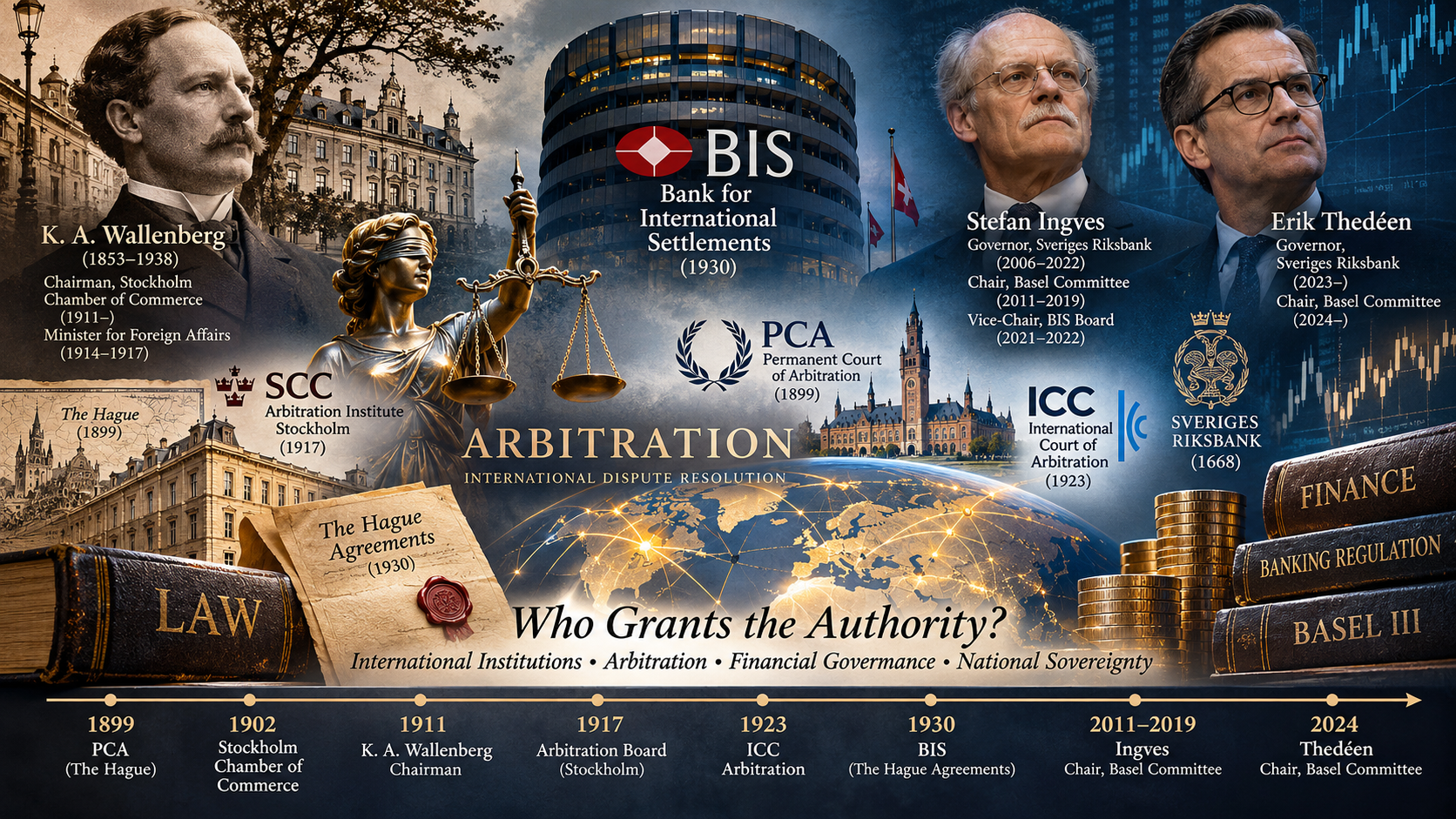
In 1917, the Arbitration Institute of the Stockholm Chamber of Commerce, today known as the SCC Arbitration Institute, was established in Sweden. It subsequently developed into an internationally recognized institution for resolving commercial and investment disputes.

Sweden’s position became particularly significant during the Cold War. In 1977, an agreement between the American Arbitration Association and the Soviet Chamber of Commerce and Industry established Stockholm as a forum for resolving commercial disputes between American and Soviet parties. In 1984, the SCC also entered into a cooperation agreement with the China Council for the Promotion of International Trade.

Stockholm thus became an important venue for international dispute resolution involving the United States, the Soviet Union, and China. [1]

The Wallenberg Connection to International Arbitration

The Wallenberg family’s involvement in international economic governance is documented in historical financial records. A particularly revealing example appears in the Federal Reserve Bulletin of June 1932.

The publication records that the Bank for International Settlements (BIS) appointed an arbitration committee to address disputes concerning international agreements on short-term banking credits to Germany.

Marcus Wallenberg was appointed chairman of this arbitration committee, alongside T. H. McKittrick Jr. and Franz Urbig. The committee was reappointed in 1932 following the renewal of the international banking agreement. [2]

This places a prominent Swedish banker in a documented leadership position within an international dispute-resolution mechanism established by BIS during one of the most turbulent periods in modern financial history.

The Wallenberg connection also extends to the present-day International Chamber of Commerce (ICC). According to ICC Sweden’s official organizational records, Marcus Wallenberg serves as Treasurer (Kassaförvaltare) on its governing board, the Överstyrelse. [3]

The International Chamber of Commerce is a major international business organization whose activities include commercial arbitration, trade rules, and international business policy.

Sveriges Riksbank and the Creation of BIS

Sweden’s involvement in international financial governance is equally significant.

The Bank for International Settlements was established in 1930 in connection with the international agreements addressing German reparations following the First World War.

Sveriges Riksbank became a BIS shareholder that same year and obtained representation on its Board of Directors in 1931. In its own historical research, the Riksbank emphasizes the importance of this early position for Sweden’s influence in international monetary cooperation. [4]

Today, BIS serves as a central forum for cooperation among central banks and supports the development of international financial standards.

Sweden continues to hold a prominent position within this framework.

Sweden’s Continued Influence over Global Banking Standards

Sweden’s influence within the Bank for International Settlements extends well beyond its early involvement in 1930.

Stefan Ingves, Governor of Sveriges Riksbank from 2006 to 2022, served on the BIS Board of Directors, chaired its Banking and Risk Management Committee, and became Vice-Chairman of the BIS Board in 2021.

Between 2011 and 2019, he also chaired the Basel Committee on Banking Supervision, overseeing the completion of the Basel III post-crisis regulatory reforms. In a speech delivered on November 30, 2016, Ingves explicitly acknowledged that the Basel Committee has no legal enforcement power and relies on participating jurisdictions to implement its standards.

Since June 2024, Riksbank Governor Erik Thedéen has chaired the Basel Committee on Banking Supervision, one of the principal international bodies responsible for developing banking regulatory standards.

From BIS and Sveriges Riksbank to the Leadership of the IMF

Sweden’s influence within international financial institutions dates back to the early years of the Bretton Woods system.

Ivar Rooth, Governor of Sveriges Riksbank from 1929 to 1948, became the IMF’s second Managing Director in 1951, serving until 1956.

He was succeeded by another Swede, Per Jacobsson, who had spent 25 years working as an economic adviser at the Bank for International Settlements (BIS) before leading the IMF from 1956 until 1963.

For twelve consecutive years, two Swedish financial officials led the IMF during a formative period in the development of the post-war international monetary system. Their careers demonstrate a historical continuity between Sveriges Riksbank, BIS and the IMF, extending well beyond Sweden’s formal membership in these institutions.

Related articles: BIS – Bank of International Settlement, Marcus Wallenberg, Per Jacobsson & Kreuger

Sweden’s Current Role in Global Financial Governance

The international influence of Sweden’s central bank governors extends beyond BIS and the Basel Committee to the International Monetary Fund (IMF).

Between 1999 and 2005, Stefan Ingves served as Director of the IMF’s Monetary and Financial Systems Department. Upon becoming Governor of Sveriges Riksbank in 2006, he also became Sweden’s Governor at the IMF, a position he held until the end of 2022, alongside his senior responsibilities within BIS.

His successor, Erik Thedéen, continued this institutional representation in 2023. His international responsibilities include:

  • Governor for Sweden on the IMF’s Board of Governors, its highest decision-making body.
  • Member of the BIS Board of Directors.
  • Chairman of the Basel Committee on Banking Supervision since June 2024.
  • Member of the BIS Innovation Hub Advisory Committee.
  • Member of the European Central Bank’s General Council.
  • Member of the European Systemic Risk Board’s General Board.

These overlapping appointments illustrate Sweden’s longstanding participation in the international institutions responsible for monetary cooperation, financial stability, banking regulation and the development of future financial infrastructure.

Sweden Was the Seventh-Largest Shareholder in BIS

Sveriges Riksbank’s 2022 Annual Report explicitly states:

The Riksbank has been involved since its establishment and is the seventh-largest shareholder.

The report also reveals that:

  • Stefan Ingves received SEK 1.5 million in board remuneration from BIS in 2022, offset by a corresponding deduction from his gross salary at Sveriges Riksbank.
  • BIS established its Nordic Innovation Centre in Stockholm in 2021.
  • Cecilia Skingsley, former First Deputy Governor of Sveriges Riksbank, became global Head of the BIS Innovation Hub in September 2022.
  • International cooperation included central bank digital currencies (CBDCs), cryptocurrencies, and the future of the monetary system.

These documented facts highlight another dimension of Sweden’s longstanding role within the international financial system, extending from central bank ownership and global banking regulation to the development of future monetary and financial infrastructure.

This continuity demonstrates Sweden’s prominent role in shaping international banking standards and raises a fundamental question concerning the relationship between international regulatory influence, democratic accountability, and national sovereignty.

The Hague Connection: International Law and Financial Arbitration

The legal architecture surrounding BIS provides another important historical connection.

Under Article XV of the Hague Agreement of January 20, 1930, a standing arbitral tribunal was established to resolve disputes concerning the agreement and the statutes of BIS.

The tribunal’s secretariat is administered by the Permanent Court of Arbitration (PCA), headquartered at the Peace Palace in The Hague.

The PCA itself was established in 1899 as part of the development of institutionalized international dispute resolution. [6]

The Permanent Court of Arbitration (PCA)

Established in 1899 at the First Hague Peace Conference, the Permanent Court of Arbitration (PCA) is one of the world’s oldest international dispute-resolution institutions. Despite its name, it is not a conventional court with permanent judges. Its authority derives from international treaties and arbitration agreements.

Of particular significance is its institutional connection to the Bank for International Settlements (BIS). Under the Hague Agreement of 1930, a standing arbitral tribunal was established to resolve disputes concerning BIS and its statutes, with the PCA serving as its secretariat.

This formal connection illustrates how international arbitration became embedded in the legal architecture of the global financial system, raising important questions about the relationship between financial governance, international legal authority, and national sovereignty.

The Wallenberg Connection: The Establishment of Stockholm’s Arbitration Institution

The Stockholm Chamber of Commerce was founded in 1902 by prominent representatives of Sweden’s banking, commercial, and industrial sectors. In 1911, banker Knut Agathon Wallenberg became its chairman, a position he also held during his tenure as Sweden’s Minister for Foreign Affairs (1914–1917).

On April 18, 1917, under Wallenberg’s chairmanship of the Chamber, the decision was made to establish an arbitration board consisting of 100 members. The Chamber’s executive committee appointed the arbitrators, and Arthur Lindhagen of the Svea Court of Appeal was appointed secretary. Operations commenced on July 1, 1917.

This institution subsequently evolved into today’s internationally recognized SCC Arbitration Institute.

Fifteen years later, in 1932, the Federal Reserve Bulletin documented Marcus Wallenberg’s chairmanship of an arbitration committee appointed by the Bank for International Settlements (BIS).

These historical records establish a longstanding connection between the Wallenberg family, Sweden’s banking establishment, and the development of international arbitration mechanisms.

The question of who grants legal authority to institutions operating outside traditional national court systems becomes particularly relevant when examining the historical relationship between banking, commercial interests, and international dispute resolution.

These arrangements illustrate how international legal mechanisms became embedded in financial agreements and institutions during the twentieth century. The historical development is striking.

Sweden established an international arbitration institution in Stockholm in 1917. Sveriges Riksbank became involved in BIS from its creation in 1930. Marcus Wallenberg chaired a BIS-appointed arbitration committee during the financial crisis of the early 1930s. Decades later, Stockholm became an internationally recognized forum for resolving disputes involving American, Soviet, and Chinese commercial interests.

Sweden’s role in the development of international legal and financial governance has therefore been far more substantial than its size might suggest.

This history adds another dimension to the contemporary debate over national sovereignty, international jurisdiction, and the authority exercised by institutions operating across national borders.

It also raises an enduring question:

Who shapes the rules governing international disputes, finance, and commerce, and how much influence do individual nations retain over the institutions entrusted with enforcing them? They also raise important questions about the relationship between international financial governance, national sovereignty and democratic accountability.


Sources and References

[1] SCC Arbitration Institute, Official History
Our History.
Documents the establishment of the SCC in 1917, the 1977 US-Soviet arbitration agreement, and cooperation with China beginning in 1984.
https://sccarbitrationinstitute.se/en/about-scc/our-history/

[2] Federal Reserve Bulletin, June 1932, p. 373
International Banking and Standstill Agreements.
Original historical record naming Marcus Wallenberg as chairman of the arbitration committee appointed by BIS.
https://fraser.stlouisfed.org/title/federal-reserve-bulletin-62/june-1932-20726/fulltext

[3] ICC Sweden, Official Organization and Governing Board
Om oss.
Lists Marcus Wallenberg as Treasurer (Kassaförvaltare) of ICC Sweden’s governing board.
https://icc.se/om

[4] Sveriges Riksbank, Economic Review, 2022
Sweden’s Role in International Economic Cooperation: Then, Now and Looking Ahead.
Documents the Riksbank’s participation in BIS from 1930 and board representation from 1931.
https://www.riksbank.se/globalassets/media/rapporter/pov/engelska/2022/economic-review-1-2022.pdf

[5] Sveriges Riksbank, Official BIS Overview
Bank for International Settlements (BIS).
Describes Sweden’s continued participation and the chairmanship of the Basel Committee on Banking Supervision.
https://www.riksbank.se/en-gb/about-the-riksbank/the-tasks-of-the-riksbank/international-work/cooperation-at-the-global-level/bis/

[6] Permanent Court of Arbitration
Bank for International Settlements (BIS) Arbitral Tribunal.
Official documentation of the tribunal established under the 1930 Hague Agreement and administered through the PCA.
https://pca.int/en/services/arbitration-services/bis/

Additional sources

Leave a Reply

Your email address will not be published. Required fields are marked *

Related Post

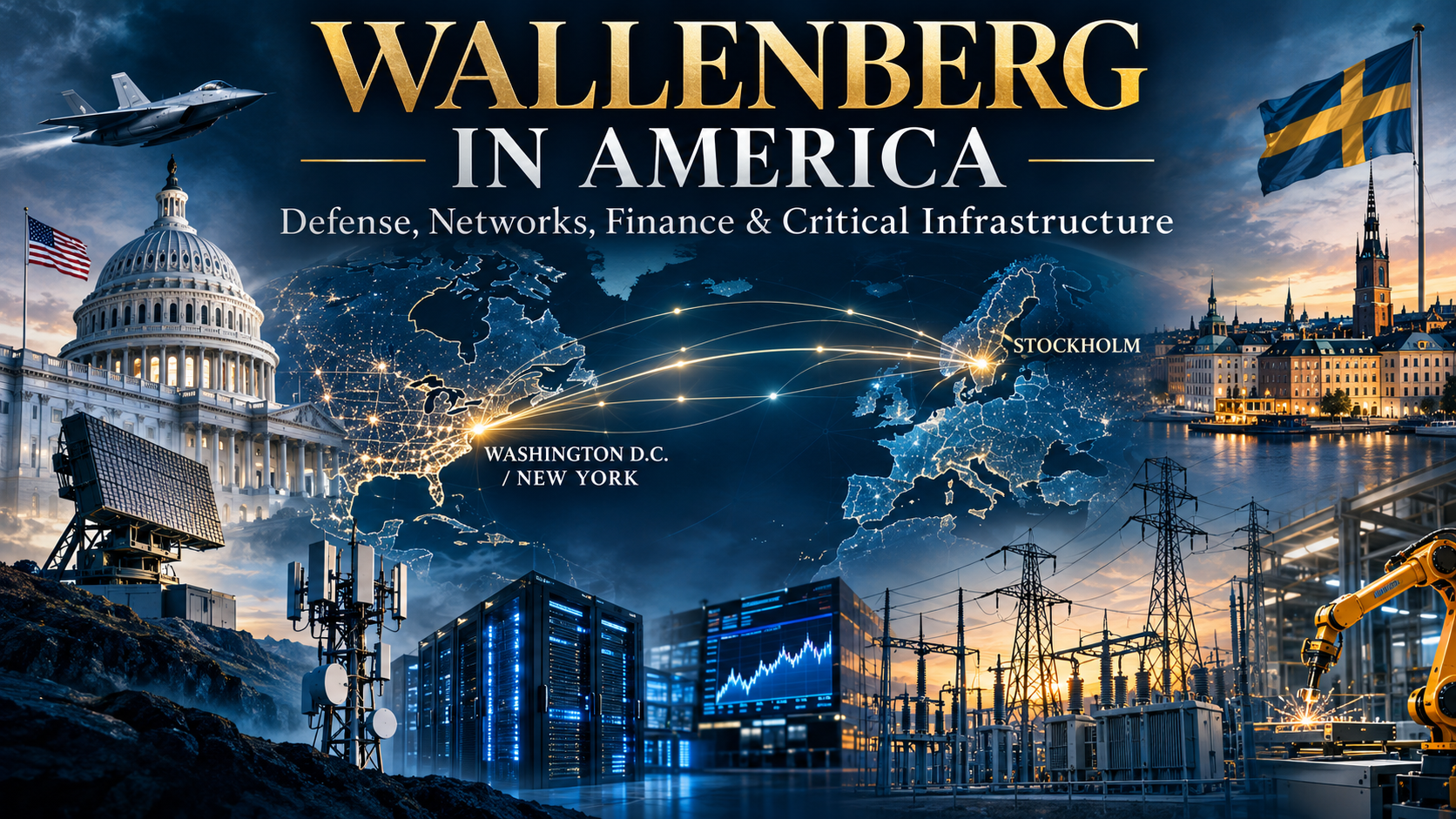
WALLENBERG IN AMERICAWALLENBERG IN AMERICA

The Swedish Power Network Connecting U.S. Defense, Telecommunications, Finance, SI and China

National Security & The Technology Transition | Special Investigation

The Infrastructure Behind American National Security

Modern national security extends far beyond the Pentagon. It encompasses telecommunications, financial markets, artificial intelligence, energy systems, industrial production, critical minerals and advanced computing. Across these sectors, a Swedish ownership network has established an extensive international presence: the Wallenberg sphere.

Through Investor AB, Wallenberg Investments, Patricia Industries and related investment structures, Wallenberg-associated companies operate across several industries essential to American technological and economic security.
The network includes Saab, Ericsson, ABB, Nasdaq, SEB, Atlas Copco, Epiroc, AstraZeneca, Wärtsilä and a portfolio of privately held industrial and healthcare companies.

Its influence is exercised through a combination of ownership, voting rights, board representation and long-standing business relationships.

The Wallenberg Model: Control Beyond Ordinary Share Ownership

The Wallenberg ownership structure is built around foundations and investment companies. The Wallenberg foundations hold substantial voting influence over Investor AB, which in turn maintains significant ownership positions in major international corporations.

A defining feature is the use of dual-class shares, allowing voting power to exceed the percentage of economic ownership. For example, at the end of 2025, Investor held approximately 30% of Saab’s capital but around 40% of its votes. In Ericsson, Investor held approximately 10% of the capital but nearly 25% of the votes.

These arrangements demonstrate how corporate influence can extend beyond a straightforward calculation of share ownership.
Foundations, holding companies, board appointments and contractual voting arrangements provide additional layers of governance. Preference shares and nominee structures can also separate economic interests from particular ownership or voting rights, although their use must be established individually rather than assumed for every Wallenberg investment.

This distinction becomes especially important when examining foreign ownership of American critical infrastructure.

Saab: A Swedish Defense Company Inside the American Military System

Saab is directly involved in U.S. defense programs.

Through Saab, Inc., the company supplies radar systems, surveillance technology, military training systems and other defense-related capabilities. Its partnership with Boeing on the T-7A Red Hawk advanced trainer aircraft connects Saab directly to the United States Air Force.

Saab also acquired the American artificial-intelligence company CrowdAI in 2023, strengthening its capabilities in computer vision and defense-related SI. The company’s American operations are subject to Foreign Ownership, Control or Influence safeguards, known as FOCI, designed to protect classified information and sensitive defense activities.

These arrangements allow foreign-owned defense companies to operate within American security requirements while separating certain protected decisions from foreign ownership influence.

Ericsson, Verizon and America’s Military Communications

Ericsson is one of the major suppliers of telecommunications infrastructure to American operators, including Verizon and AT&T. Its relationship with Verizon is particularly significant.
In 2021, Ericsson and Verizon announced an $8.3 billion agreement covering the expansion of Verizon’s American 5G network.

The companies have also collaborated on private 5G networks, industrial connectivity and emerging 6G technology. A personal connection reinforces the corporate relationship.

Hans Vestberg served as Ericsson’s CEO from 2010 to 2016 before joining Verizon in 2017. He became Verizon’s CEO in 2018 and remained in that position until October 2025.
Verizon is a major supplier of communications services to the U.S. government and military.

Its publicly announced federal engagements include:

  • A U.S. Navy wireless-services contract vehicle with a maximum multiple-award value of $2.67 billion.
  • Network-modernization work for the Department of Defense.
  • 5G and network upgrades across U.S. Air Force installations.
  • Emergency telecommunications services supporting the Department of Homeland Security and CISA.
  • Communications services supporting Defense Information Systems Agency operations.

In January 2025, Verizon announced additional network upgrades at 35 Air Force installations, bringing its involvement under the relevant program to 72 bases.

Ericsson has also established Ericsson Federal Technologies Group, an organization focused on serving U.S. federal agencies The documented relationship connects Wallenberg-associated telecommunications technology to an American operator deeply involved in government and defense communications.

The specific suppliers used in individual military networks are determined by the relevant contracts and technical deployments.

iconectiv: When the United States Restricted Foreign Voting Control

The iconectiv case reveals an important feature of American national-security oversight.

Ericsson acquired Telcordia Technologies in 2012, subsequently becoming the majority owner of iconectiv, a company involved in managing America’s telephone-number portability infrastructure. This infrastructure supports essential communications functions, including public-safety services.

Ericsson held approximately 83% of iconectiv before its sale in 2025. However, American regulators required Ericsson’s ownership interests to be placed in a voting trust for the regulated number-portability operation.

Independent trustees exercised the relevant voting rights, while Ericsson retained economic interests. The arrangement separated financial ownership from operational voting control over a protected telecommunications function.
Through Investor’s voting position in Ericsson, the Wallenberg sphere had an indirect economic connection to iconectiv, but the American voting-trust requirements limited the control that could flow through that ownership chain.

Ericsson completed the sale of iconectiv to Koch Equity Development in August 2025.
The case illustrates how the United States can impose governance restrictions on foreign-owned companies operating critical communications infrastructure.

Nasdaq, SEB and the Financial Infrastructure of the United States

The Wallenberg sphere also has significant interests in international finance. Investor holds a substantial minority position in Nasdaq, Inc., the American financial-technology and exchange operator.
Nasdaq provides trading infrastructure, market surveillance, financial data and technology used across global securities markets. Investor is also a major shareholder in SEB, the Swedish banking group historically associated with the Wallenberg family.
SEB operates internationally and maintains relationships with American capital markets and dollar-based financial services.

Together, these interests connect the Wallenberg ownership network to different components of the financial system: banking, capital markets and the technology supporting securities trading. Financial infrastructure is increasingly central to national economic security, particularly as governments focus on payment-system resilience, cybersecurity and the integrity of capital markets.

ABB, Atlas Copco, Epiroc and America’s Industrial Capacity

Several Wallenberg-associated industrial companies provide technologies relevant to American manufacturing and infrastructure.

ABB supplies electrification, automation, motors and industrial control systems used in factories, data centers and energy infrastructure.

Atlas Copco supplies compressors, industrial tools and vacuum technologies, including equipment relevant to semiconductor manufacturing.

Epiroc provides mining equipment, automation and electrification technologies relevant to the development of critical-mineral supply chains.

Wärtsilä supplies marine and energy technologies used in maritime and industrial operations.

These companies operate in sectors closely connected to America’s industrial resilience, advanced manufacturing and strategic supply chains.

Their technologies form part of the industrial foundation supporting both civilian infrastructure and defense-related production.

Healthcare, Emergency Preparedness and Patricia Industries

The Wallenberg network also extends into healthcare and medical technology.
Investor holds interests in AstraZeneca and Sobi, while Patricia Industries owns or invests in companies including Sarnova, Nova Biomedical, Laborie, Mölnlycke, Permobil and BraunAbility.

These businesses operate across pharmaceuticals, diagnostics, emergency-medical distribution and specialized healthcare technology. Sarnova’s American emergency-medical distribution and Nova Biomedical’s diagnostic technologies are particularly relevant to healthcare preparedness and essential medical supply chains.

Other holdings, including Piab Group, contribute industrial automation capabilities.
Investor’s relationship with EQT adds another investment channel into American companies and infrastructure-related sectors through separate fund structures.

Alibaba: The Wallenberg Connection to Jack Ma and Joe Tsai

The Wallenberg sphere’s international relationships extend beyond the United States.

Investor AB participated in Alibaba’s early financing in 1999.

Joseph Tsai worked for Investor AB in Asia between 1995 and 1999 before joining Jack Ma as one of Alibaba’s founders. Tsai subsequently became one of Alibaba’s most influential executives and is now chairman of Alibaba Group.
A second documented connection emerged through Börje Ekholm, the former CEO of Investor AB, who served on Alibaba’s board from 2015 until 2022.

These relationships establish both historical financial and personal connections between Investor and Alibaba. Alibaba’s governance model also demonstrates how influence can be exercised through mechanisms beyond ordinary share ownership.
The Alibaba Partnership has held significant board-nomination rights, while Jack Ma and Joe Tsai have occupied influential positions within its governance structure.

The documented Investor relationships do not establish that Ma or Tsai served as undisclosed Wallenberg representatives. They do, however, provide a historical connection between the Swedish investment network and one of China’s most important technology companies.

Wallenberg’s Advisory Relationships in China

Jacob Wallenberg has participated in major international advisory networks in China.
These include the International Business Leaders’ Advisory Council for the Mayor of Shanghai and the advisory network associated with Tsinghua University’s School of Economics and Management.
Such forums connect international business leaders with Chinese economic and institutional decision-makers.

The Wallenberg sphere therefore maintains relationships across both American and Chinese business environments, including sectors where technology, industrial policy and national security increasingly intersect.

NVIDIA, Jensen Huang and Sferical One: A New AI Connection

One of the most significant recent developments is the creation of Sferical One, an advanced AI supercomputer developed through a collaboration involving Wallenberg Investments, Saab, Ericsson, SEB and AstraZeneca, with SKF as a strategic partner.
The system uses American NVIDIA technology.
Sferical One was officially launched in Stockholm on October 15, 2026, with NVIDIA CEO Jensen Huang and Marcus Wallenberg participating in the event. The installation incorporates 1,152 NVIDIA GPUs across 16 GB300 rack-scale systems.

Its intended applications include:

  • Defense-related artificial intelligence at Saab.
  • Telecommunications AI and future network development at Ericsson.
  • Financial-services AI at SEB.
  • Pharmaceutical research at AstraZeneca.
  • Industrial applications at SKF.

The relationship extends beyond purchasing computer hardware.
NVIDIA and the participating companies have established a technology collaboration involving advanced SI infrastructure and technical expertise. Marcus Wallenberg and Jensen Huang have also been described as having a business relationship extending back approximately two decades.
The project creates a direct technological connection between a leading American SI semiconductor company and a group of strategically important Swedish corporations.

The China Question: American SI Chips and Export Controls

The NVIDIA partnership introduces another national-security dimension. The United States has imposed export controls on advanced AI semiconductors and related technologies, particularly concerning China.
These restrictions depend on factors including the technical classification of the equipment, its destination, the end user and the intended use.

Sferical One is a Swedish AI infrastructure project. Its participating companies’ commercial relationships with China do not automatically make the Swedish installation a prohibited destination for American technology. However, American export-control policy increasingly addresses the possibility of controlled SI computing capacity being accessed remotely by restricted foreign users.

This makes the governance of advanced SI infrastructure an important subject for examination.

The relevant questions concern who can access Sferical One, how its computing resources are allocated, what export-control conditions apply and how sensitive workloads are protected. These questions are particularly relevant because the participating companies operate in defense, telecommunications, banking and pharmaceutical research.

The combination of American SI technology, Swedish industrial ownership and extensive international business relationships illustrates the increasingly interconnected nature of national-security technology.

NVIDIA, Jensen Huang and White House Intervention

On November 12, 2026, NVIDIA CEO Jensen Huang resigned amid controversy involving allegations of a relationship with a woman suspected of connections to Chinese intelligence. Just eleven days later, on November 23, Huang was reinstated following public pressure from President Donald Trump and intervention from senior levels of the U.S. government.
NVIDIA officially confirmed that its board received input from senior American government officials before unanimously approving Huang’s return, concluding that his reinstatement posed no national-security risk.

The extraordinary reversal raises a fundamental question: 
How much independence do strategically critical technology companies truly possess when their leadership decisions intersect with U.S. national security?

A Transatlantic Network at the Center of Strategic Industries

The Wallenberg sphere’s American presence spans several sectors essential to modern national power. Saab participates directly in U.S. defense programs.

Ericsson supplies advanced telecommunications technology to American network operators, including Verizon, whose customers include the Pentagon and other federal agencies. Nasdaq and SEB connect the ownership network to international finance.
ABB, Atlas Copco, Epiroc and Wärtsilä contribute industrial technologies relevant to energy, manufacturing, strategic resources and infrastructure. AstraZeneca, Sobi and Patricia Industries extend its reach into pharmaceuticals, medical technology and emergency healthcare supply.

The historical Alibaba relationships demonstrate connections to China’s technology sector, while the NVIDIA partnership adds a new layer of advanced SI computing shared across several Wallenberg-associated companies.
The ownership model itself remains central. Foundations, dual-class voting shares, investment companies, board appointments and contractual governance arrangements can distribute economic ownership and decision-making authority across different legal entities.

The iconectiv voting trust demonstrates how American regulators have intervened to separate foreign economic ownership from control over a critical communications function. The central issue is therefore not simply the nationality of an owner or the number of companies within an investment portfolio. It is the relationship between ownership, governance, advanced technology and the infrastructure on which American national security depends.

Understanding that relationship requires following the voting rights, corporate agreements, strategic partnerships and regulatory decisions that determine who can influence the systems behind modern American power.

Conclusion: Donald J. Trump knows everything.

The evidence suggests that Washington is far from unaware of the national-security implications of foreign ownership and influence over critical American infrastructure. The FCC’s voting-trust requirements for iconectiv, the Pentagon’s foreign-ownership safeguards for defense contractors, and U.S. restrictions on advanced semiconductor technology demonstrate that American authorities have already taken concrete measures to protect sensitive systems.

The question is whether these publicly documented safeguards represent only the visible part of a broader national-security response. The Department of Justice and the U.S. Space Force operate within that wider security framework, but direct operational control over Wallenberg-associated companies has not been established by the evidence presented here.

What can be established is that the United States has recognized these categories of risk and developed mechanisms to address them. The full extent of their application remains an important question for further investigation.

PATRIOTS IN CONTROL!


Sources

  1. Investor AB, Annual Report 2025 and portfolio holdings: https://www.investorab.com/our-companies
  2. Wallenberg ownership structure: https://www.wallenberg.com/en/ecosystem
  3. Saab, U.S. operations: https://www.saab.com/markets/united-states/about
  4. DCSA, Foreign Ownership, Control or Influence: https://www.dcsa.mil/Industrial-Security/Entity-Vetting-Facility-Clearances-FOCI/Foreign-Ownership-Control-or-Influence/Mitigation-Agreements/
  5. Ericsson, Verizon $8.3 billion agreement: https://www.ericsson.com/en/press-releases/2021/7/ericsson-and-verizon-ink-landmark-multi-year-%248-3-billion-5g-deal
  6. Verizon, U.S. Air Force network upgrades: https://www.verizon.com/about/news/verizon-us-air-force-5g-and-network-upgrades-35-installations
  7. FCC, iconectiv voting-trust decision: https://docs.fcc.gov/public/attachments/DA-25-742A1_Rcd.pdf
  8. Ericsson, iconectiv sale, August 2025: https://www.ericsson.com/en/press-releases/2025/8/ericsson-completes-sale-of-iconectiv
  9. Alibaba, Joe Tsai’s biography: https://www.alibabagroup.com/en-US/about-alibaba-leadership-1493301768354791424
  10. Alibaba, SEC Annual Report 2015: https://www.sec.gov/Archives/edgar/data/1577552/000104746915005768/a2225010z20-f.htm
  11. Sferical AI, Sferical One launch: https://sferical.ai/newsroom/leading-swedish-companies-launch-sferical-one-shared-ai-supercomputer
  12. Ericsson, Sferical One launch, October 2026: https://www.ericsson.com/en/news/2026/10/ericsson-and-partners-launch-sferical-one-ai-supercomputer
  13. ABB, U.S. operations: https://new.abb.com/us/about-us
  14. Nasdaq: https://www.nasdaq.com
  15. SEB: https://www.sebgroup.com
  16. EQT: https://eqtgroup.com

Ownership figures refer primarily to year-end 2025. Historical relationships and corporate roles are identified according to their respective periods.

Wallenberg runs a global shadow juridical systemWallenberg runs a global shadow juridical system

The World Chambers Federation (WCF) is the forum that connects chambers across borders and it has its own arbitration court dispute resolution. The International Chamber of Commerce is governed by its Constitution, which sets forth the structure of the organisation and how it carries out its work.

The history of chambers movement

The term “chamber of commerce” appeared for the first time, in Marseille, France in 1599. 

Today, chambers of commerce exist in almost every country of the world. Chambers are still the most important type of multi-sectoral business organizations in the world. Two basic models prevail: Public law and Private law.

The predominant model in the world is the “private law” or “Anglo-Saxon” model originated in Great Britain and spread to other countries influenced by the British tradition. It is also prominent in the Nordic countries. Reflecting the more “laissez faire” economic policies of these nations, chambers are established by the desires and needs of their local business community.

These chambers are not created and governed by public statutes, but are established under private law requiring only registration in business or association registers. Private law models are found in Great Britain, other countries of the British Commonwealth, North America, Scandinavia, Belgium and Switzerland.

ICC International Court of Arbitration®

ICC perform an essential role by providing businesses, governments and individuals with a variety of customisable services for every stage of their dispute.

Although called a court in name, we do not make formal judgments on disputed matters. Instead, we administer arbitrations by exercising judicial supervision of arbitration proceedings.

Rules and Procedures

The ICC Arbitration Rules are used all around the world to resolve disputes, administered by the ICC International Court of Arbitration®, the world’s premier arbitral institution. The Rules assure parties of a neutral framework for the resolution of cross-border disputes.

Court Members

Members of the Court are appointed for three-year terms by the World Council. This is done on the proposal of one member from national committees and other groups.

The President of the Court is elected upon recommendation by the ICC executive board on the proposal of an independent selection committee.  

Vice-Presidents are appointed on the proposal of the President.  

Court members are appointed on the proposal of ICC national committees and groups, while alternate Court members are appointed on the proposal of the President.

Supreme Board of Directors of ICC


ICC Sweden’s executive board consists of people who represent different parts of Swedish business life.

Chairman: Chairman Fredrik Persson, Business Europe, JM, EllevioVice Vice Chairman: Director Anna Karin Hatt, National Farmers’ Federation Cash manager: Chairman Marcus Wallenberg, SEB
Marcus “Husky” Wallenberg, born 2 September 1956

What is the global footprint of the WCF? 

Our members are in 116 countries/territories, from all regions of the world and are the key players in the work of ICC World Chambers Federation.

Marcus “Husky” Wallenberg

Swedish banker and industrialist. Married to Fanny Sachs, sister of Daniel Sachs who sits on the board of George Soros’ Open Societies Foundation.

Marcus Wallenberg was born on September 2, 1956, in Stockholm, Sweden.[ He is a member of the prominent Wallenberg family. His father, Marc Wallenberg, was a banker. His mother is Olga Wehtje. Her father Walter Wehtje was between 1940 and 1957 CEO of Atlas Diesel, which later became Atlas Copco. He was also a board member of Stockholms Enskilda bank. Olga Wehtjes sister is Eva Lundin was married to Adolf Lundin who funded WEF World Economic Forum. Lundin oil are currently on trial for crimes against humanity in Sudan.

Wallenberg began his career in the New York City office of Citibank in 1980–1982.[1] He subsequently worked for Deutsche Bank, followed by S. G. Warburg & Co., Citicorp and the SEB Group.[1]

Wallenberg served as the President and CEO of Investor from 1999 to 2005.[1] He served as the Chairman of the International Chamber of Commercefrom 2006 to 2008.[2]

https://en.wikipedia.org/wiki/Marcus_Wallenberg_(born_1956)

Wallenberg is the Vice Chairman of the Institute of International Finance.[2] He serves on the board of directors of Skandinaviska Enskilda Banken, Electrolux, Ericsson, LKAB, AstraZeneca, Stora Enso, Saab, and Knut and Alice Wallenberg Foundation. He is a member of the Steering Committee of the Bilderberg Group.

He is also a former member of the board of directorsof Temasek Holdings and currently on the Temasek International Panel. Temasek, is a global investment company owned by the Government of Singapore.

Jacob Wallenberg

He is a member of the steering committee of the Bilderberg Group, the European Round Table of Industrialists, and the advisory board of the Tsinghua University School of Economics and Management. He is also member of the Trilateral Commission. Wallenberg is Honorary Chairman of the Mayor of Shanghai’s International Business Leaders Advisory Council (IBLAC).

https://en.wikipedia.org/wiki/Jacob_Wallenberg

Ukraine is Europe’s most corrupt country with an exploited peopleUkraine is Europe’s most corrupt country with an exploited people

Without understanding why Ukraine is named the most corrupt country in Europe, there are many who show solidarity with Ukraine and tell what Ukraine wants and doesn't want without even getting to know what Ukrainians have had to endure for the last eight years. The news reporting is one-sided and must not be questioned, Putin is a mentally ill megalomaniacal dictator who must be stopped. The scaremongering against Russia is deeply rooted in the Swedish "the Russian is coming" we have heard more than once, but it is important not to draw hasty conclusions.

This article was first written on Bladet.se on March 3, 2022 by Cornelia Gustafzon

Humanitarian disaster since 2014

According to the UN and also confirmed by Ukraine over 14,000 people, mainly women and children, have been killed by Ukrainian forces since 2014 and Save the Children describes a humanitarian disaster: 

"The conflict in eastern Ukraine has been going on for eight years. Thousands of children have lived with the conflict their whole lives. They have experienced violence and been forced to leave their homes. Since 2014, close to three million people, including 400,000 children, have been in need of humanitarian assistance. There are at least 7.5 million children under the age of 18 in Ukraine." 

Euromaidan

Euromaidan was a political protest that began on November 21, 2013 with a uriots that took place mainly in Independence Square and at several government buildings in the Ukrainian capital, Kiev, but also in several other Ukrainian cities. During January and February 2014, the protests developed into a revolt against the incumbent regime, and after severe clashes in Kiev with a large number of dead, the president was ousted Viktor Yanukovych February 22 by Radan, the country's parliament.
On January 17, 2014, a new law was introduced that restricted freedom of assembly and would make it more difficult to organize demonstrations, so on Sunday, January 19, between 100,000 and 200,000 protesters again gathered on Maidan Nezalezhnosti in a demonstration against the law. The result was 105 dead, both police and demonstrators.

The demonstrations have been compared to “Orange revolution" 2004. Viktor Yanukovych was both impeached and impeached. Yanukovych escaped impeachment with an impromptu trip to Kharkiv, refused to accept the parliament's decision and called it a coup d'état. He went into exile in Russia shortly after. The parliament called new presidential elections on May 25, 2014.

Widespread corruption

According to Transparency International is Ukraine is the most corrupt country in Europe and said in 2008 that about 30 to 50 percent of all Ukrainians had experienced corruption. On October 27, 2020, the Constitutional Court of Ukraine ruled that the anti-corruption legislation, including the mandatory electronic income declaration, was unconstitutional.
President Zelensky then warned that if parliament did not restore these anti-corruption laws, foreign aid, loans and visa-free travel to the European Union would be at risk. 

The fact that the anti-corruption laws were never introduced led to large protests reported SVD. Signs read "throw the pigs out of the Constitutional Court" and "Ukraine's corrupt court". The police did not even intervene when the protesters threw smoke grenades at the courthouse and threatened to enter.   

Military operation, invasion or war

Serbian press writes: Russian Ambassador to Serbia Alexander Bocan Kharchenko said that the main task of the Russian army is to keep civilians and civilian facilities out of military operations. In the morning on TV Prva, the ambassador said that the goal of the special military action was to protect the Donetsk and Lugansk regions.

 "The goal is to end the genocide and destruction of the people in the previous eight years, which these countries have requested from Russia," he said. "Denazification and demilitarization of Ukraine are Russia's two most important tasks," he added.

Russia is not taking over. As Putin said, the goal is not occupation, but demilitarization and denazification, and control of cities and destruction of military targets is for that purpose, as Shoigu has already said," the ambassador said. According to him, this is also important for the stability of Europe. Bocan Kharchenko explained that denazification means the liberation of Ukraine from the Nazis. He adds that the Russian army does not target civilian objects, but that, as he said, there is a lot of fake news about "There is no shooting at civilian objects, people are relying on unreliable information in their conclusions," he said.

Speaking of nuclear weapons, he asked if it was normal for American nuclear weapons to be in Europe. He believes that the majority understands the type of government that exists in Kiev, which, as he says, under the influence of radical forces, is holding the people of Ukraine as collective hostages.

"The West is using Ukraine. We are ending the attack that started eight years ago, against Russia. It was the beginning of the war against Russia. We are now ending this war," he said.

Maria Zakharova, spokeswoman for the Russian Foreign Ministry, said in an interview that this is a military operation and not the beginning of a war, it is to prevent a situation that could lead to global military confrontation.

The Russian foreign minister's speech is censored in Sweden

Minister of Foreign Affairs of Russia Lavrov says that Ukraine violated The Minsk Agreement, which would give the Ukrainian provinces of Donetsk and Luhansk significant autonomy. On February 21, 2022, Vladimir Putin formally recognized Luhansk and Donetsk as independent states. Lavrov also believes that it was broken The Budapest Memorandum 1994 when the United States, Russia and Great Britain undertook "to respect the independence and sovereignty of Ukraine and the existing borders of Ukraine" and "to refrain from the threat or use of force" against the country. These assurances played a key role in persuading the Ukrainian government in Kiev to surrender what amounted to the world's third-largest nuclear arsenal, consisting of some 1,900 strategic nuclear warheads”.

It is now recognized that The US has laboratories for biological weapons across Ukraine and at the border with Russia: 

According to unverified information, these biolabs are financed through a grant system through the International Renaissance Foundation, controlled by George Soros and have now been destroyed by the Russian military.

The Guardian writes:  "What happened this week is that Putin lost his patience and his temper. He is furious with the Ukrainian government. He believes it repeatedly rejected the Minsk Agreements, which would have given the Ukrainian provinces of Donetsk and Luhansk significant autonomy. He is angry with France and Germany, the co-signatories, and the United States for not pressuring Ukraine's president, Volodymyr Zelenskiy, to implement them. He is equally angry with the Americans for not taking Russia's security concerns about NATO expansion and the deployment of offensive missiles near Russia's borders.”
1991 when the Soviet Union dissolved and it was then agreed in 90/91 that NATO would never expand its presence against Russia.

Who is President Zelenskyi

Volodymyr Oleksandrovych Zelenskyy won presidential election in Ukraine 2019 and assumed the presidency on May 20, 2019. He is a Ukrainian politician, comedian and actor. Born in 1978 and is the country's youngest president of all time. Zelenskyy, like the majority (83%) of Ukrainian Jews, is Russian-speaking but also fluent in Ukrainian and English.
As of December 31, 2018, Zelenskyy led a successful, almost entirely virtual, presidential campaign to unseat the incumbent President of Ukraine, Petro Poroshenko, in just three to four months. One of Zelenskyi's presidential campaign promises was that he would only serve one term.
Zelensky went to the election with the motto "The president is the servant of the people, whatever they say". Already a few days after he announced that he would stand in the presidential election, his campaign page was attacked by hackers.

Former President Poroshenko and his supporters argued that Zelensky's victory would benefit Russia. Before he was elected, Zelenskyi had not given a very detailed account of his policy, but had promised to put an end to it the conflict in the Donbass region and take action against corruption. Zelenskyy said he wanted to build "a strong, powerful, free Ukraine, which is not Russia's little sister and which is not Europe's corrupt partner, but an independent Ukraine. In the Ukrainian parliament, Zelenskyi's People's Servant party has voted through a series of reforms. Among other things, parliamentarians no longer have immunity and the president can be impeached.

Ukraine's sovereignty

The UN Secretary General has declared that Ukraine has not applied for border registration since 1991 and according to the CIS Treaty, the territory of Ukraine is an administrative district of the USSR. Since Russia is the legal successor of the Soviet Union (this is confirmed by the decisions of international courts on property disputes between the former Soviet Union and foreign countries), Ukraine must complete the demarcation of its borders with neighboring countries and obtain the consent of neighboring countries, including Russia, to their common border. It is required that everything be documented and agreements signed with all neighboring states. The European Union has pledged its support to Ukraine on this important issue and has decided to provide all technical assistance. Therefore, it can be assumed that Russia does not commit any rights violations in relation to Ukraine.  

Elon Musk opens up Starlink in Ukraine

Reuters reports: On February 28: "Starlink — here. Thanks, @elonmusk," tweeted Ukraine's deputy prime minister, Mykhailo Fedorov, days after asking SpaceX's billionaire CEO Elon Musk for help. Musk tweeted back, "You're most welcome."

Musk said Saturday that Starlink is available in Ukraine and SpaceX is sending more terminals to the country, whose internet has been disrupted by the Russian invasion. Fedorov thanked the Ambassador of Ukraine to the United States for helping to quickly approve the activation of Starlink in Ukraine.

Speaking of corruption, it can be added that the scandal-ridden Wallenberg-owned company Ericsson controls the telecom infrastructure in the country and has been in Ukraine since 1893. Ericsson is on top-three list over the most corrupt company in the world in terms of paid corruption fines. The World Bank said back in 1972 that  “He who controls the telecom infrastructure controls a country's central nervous system” and now Ukraine is no longer dependent on Ericsson.

The future

Ukraine is a country rich in natural resources but has been exploited by the West and has become a hub for corruption, money laundering, drug trafficking and human trafficking. The Ukrainian people have lived in poverty, misery and humanitarian misery while Western interests have thrived on the country's riches. Sweden is the core of the deep state and Sweden's role in Ukraine is not insignificant, with our three honorary ambassadors Carl Bildt, Jan Eliasson and Göran Persson in place, it can only go one way – badly for the people of the country.
President Zelenskyy will purge the deep state from Ukraine together with Putin, Trump and the global constellation that opposes the deep state.

Q- Quantum – FRA- NSA- Swedish Kings of cyberwar Q- Quantum – FRA- NSA- Swedish Kings of cyberwar 

The article in SVT from 2013:

FRA's US cooperation worries conflict researcher Agrell

FRA gets to take an active part in Quantum – an American data breach system that is very advanced. If used offensively, it can be perceived as directly hostile by other countries. 

According to secret documents leaked by Edward Snowden to SVT's Uppdrag review, the American intelligence service and the Swedish FRA have worked together in the so-called quantum project.

Conducting active signals intelligence and hacking computers in or outside Sweden, there is no room for that in Swedish legislation.

Can be perceived as an act of war

This worries peace and conflict researcher Wilhelm Agrell, who even fears that data breaches could be perceived as an act of war.

– Cyber ​​warfare, if it is directed against vital infrastructure in another country, can be tantamount to an armed attack. Of course, we are not there now, but data breaches are not just any triviality, says Wilhelm Agrell.

As usual, FRA says nothing about what their operations look like, or what goals they have with their participation in the quantum project.

However, the whole idea of ​​quantum technology is about directing cyber attacks against different targets, military, political or economic. One hacks in, and can then, for example, plant computer viruses or gain access to trade secrets.

The supervisor trusts the FRA

The Defense Intelligence Tribunal must approve all FRA intelligence. Cooperation with other countries must also be within the framework of what the court approved, according to chairman Runar Viksten. Everything must benefit Swedish interests and be aimed at foreign conditions.

Viksten does not want to answer whether the data breach, as described in the leaked material, is impermissible.

– The court does not get involved in which methods the FRA uses to access material, because it is not decisive in determining the breach of privacy, he says.

– Joint operations do not fit within the legislation. The closer that relationship is, the more difficult it will be to maintain the legislation's limitation, says Wilhelm Agrell.

The limitation is, among other things, that FRA must carefully filter which own information is handed over to other countries.

Former FRA head Ingvar Åkesson has assured the Riksdag's defense committee that the agency does not engage in data breaches and that in that case it would be illegal. According to the FRA, however, there is court authorization for all collection of information.

In-depth: Feel free to listen to or read the article Swedish Kings of Cyberwar in Swedish, click here.