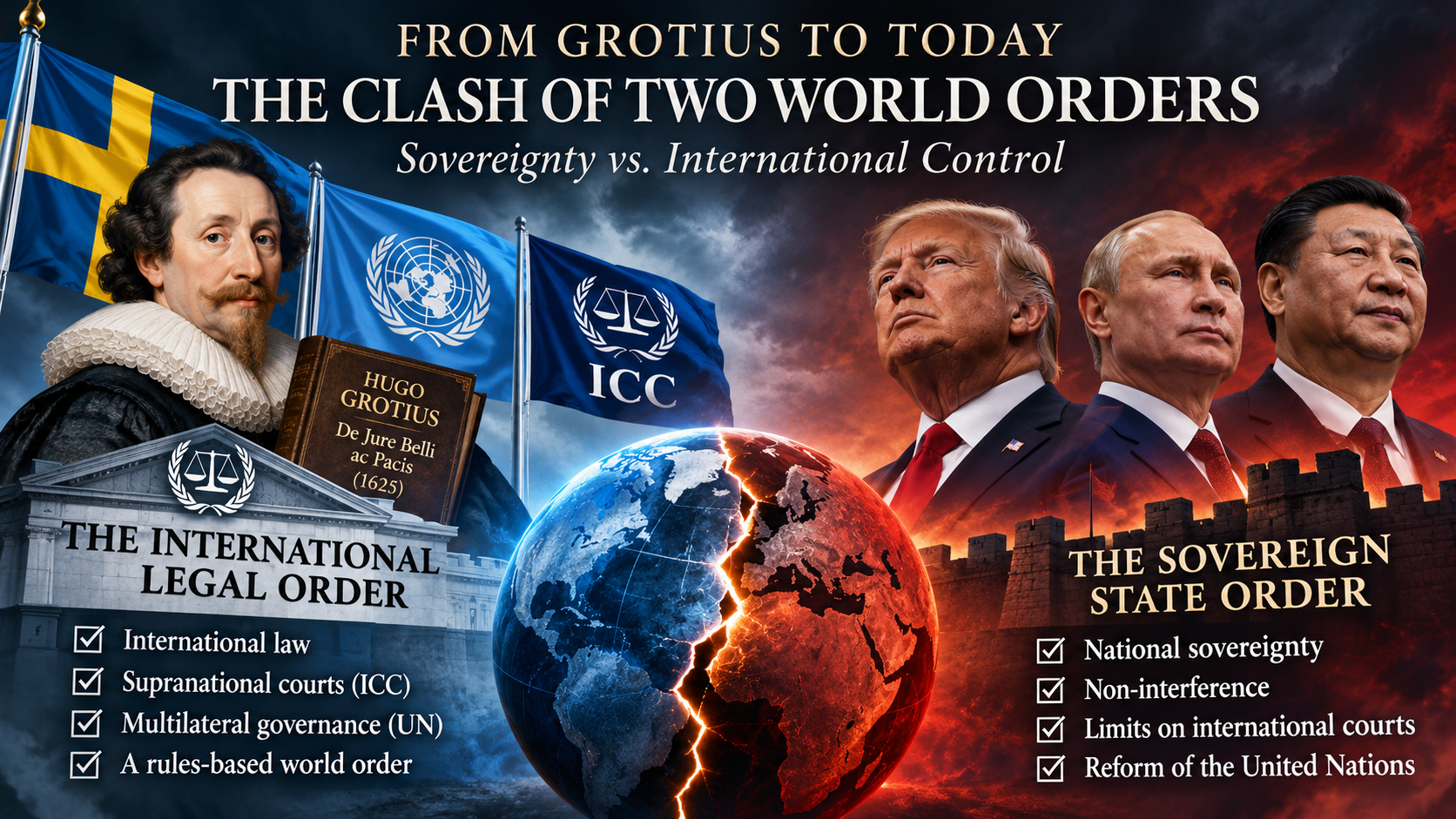
TRUMP, PUTIN, AND XI CHALLENGE THE INTERNATIONAL LEGAL ORDER


From Grotius to the ICC: Who Gave International Institutions the Authority to Override Sovereign Nations?

The joint declaration issued by Donald Trump, Vladimir Putin, and Xi Jinping on November 19, 2026, addressing United Nations reform, national sovereignty, and the jurisdiction of the International Criminal Court (ICC), raises a fundamental question that is rarely confronted in Sweden’s political debate:

Who gave international institutions the authority to exercise legal power over sovereign nations and their representatives?

The declaration explicitly emphasizes state consent and the immunities of state officials while warning against abuses of jurisdiction by the ICC and similar institutions. It also commits the three countries to pursuing reform of the United Nations. [1]

Sweden and the European Union continue to defend an international legal order in which international courts and institutions exercise significant authority. Yet the legitimacy, limits, and democratic accountability of that authority deserve far greater scrutiny.

At the heart of this confrontation lies a question that has shaped international relations for centuries:
Does sovereignty ultimately belong to independent nations, or can international institutions exercise authority over them without their consent?

From Grotius to the Rise of International Institutions

In the seventeenth century, Hugo Grotius developed influential ideas about the legal principles governing relations between states.His landmark work, De Jure Belli ac Pacis (On the Law of War and Peace), published in 1625, became one of the foundational texts in the intellectual development of modern international law.
Grotius was later recruited into Swedish diplomatic service by Axel Oxenstierna, Sweden’s powerful Lord High Chancellor, and appointed Sweden’s ambassador to France in 1634. [2]

The historical connection is significant. Sweden was not merely an observer of the early development of international legal thought. Through Oxenstierna and Grotius, it was directly connected to the political and diplomatic environment in which these ideas gained influence. Four centuries later, Sweden remains a committed defender of international legal institutions.

But Grotius’s intellectual legacy also raises a fundamental question:
Who should have the ultimate authority to interpret and enforce international legal principles, particularly when those principles conflict with the sovereignty of independent nations?

This question becomes especially important when international institutions claim jurisdiction over citizens of countries that never agreed to their founding treaties.

The ICC’s Contested Claims of Jurisdiction

The United States, Russia, and China have never ratified the Rome Statute, the treaty establishing the International Criminal Court.
Nevertheless, the ICC maintains that it can exercise jurisdiction over nationals of non-member states under certain circumstances, including when alleged crimes are committed on the territory of a state that has accepted the Court’s jurisdiction.
Article 12 of the Rome Statute provides the treaty basis for this form of territorial jurisdiction. [3]

This is where the fundamental dispute begins.

The ICC claims the authority to exercise such jurisdiction. But why should an international court be able to prosecute nationals of a sovereign country that never consented to its founding treaty?

The Court relies on provisions of the Rome Statute, particularly Article 12, which establishes conditions for the exercise of its jurisdiction. Its legal rationale draws on the principle of territorial jurisdiction, under which a state may exercise criminal jurisdiction over acts committed within its territory. But the existence of a legal argument does not eliminate the deeper question of legitimacy.

Can states that have joined an international treaty confer authority on an international institution to prosecute citizens of countries that have not joined that treaty? And where should the limits of such authority be drawn?
These are not merely technical legal questions. They concern sovereignty, consent, democratic accountability, and the boundaries of international institutional power.

The Trump administration has explicitly challenged the ICC’s jurisdiction over American and Israeli personnel.
In Executive Order 14203, signed on February 6, 2025, President Trump argued that the Court’s actions threatened American sovereignty, national security, and foreign policy interests. [4]

The November 2026 declaration demonstrates that Washington, Moscow, and Beijing have now publicly expressed a shared concern about international criminal jurisdiction and the protection of state officials. [1]

Sweden and the EU Defend the Existing Rules-Based International Order

Sweden and the European Union have made the defense of the ICC and the broader international legal order central elements of their foreign policies. In May 2025, Swedish Foreign Minister Maria Malmer Stenergard confirmed Sweden’s commitment to protecting the ICC’s independence and stated that the Swedish government supported the possible activation of the EU Blocking Statute in response to American sanctions. [5]

The United States, meanwhile, has used economic sanctions to challenge what the Trump administration regards as unacceptable assertions of judicial authority. This confrontation exposes two competing approaches to international law. One emphasizes the authority of international institutions to exercise powers established through multilateral treaties.

The other emphasizes national sovereignty, state consent, and the limits that should apply to institutions seeking to exercise authority beyond the states that created them. For Sweden, the conflict carries an additional economic dimension.
Swedish corporations and banks are deeply connected to American markets, technology, and international financial infrastructure.

The United States possesses substantial economic leverage through the dollar, financial sanctions, export controls, and access to its domestic market. According to the Bank for International Settlements, the US dollar was on one side of 89.2 percent of all foreign exchange transactions in April 2025, illustrating its central position in global finance. [6]

This creates a difficult question for Swedish policymakers:
How far are Sweden and the European Union prepared to go to defend the ICC’s contested authority if doing so threatens Swedish economic interests and relations with the United States?

The issue is no longer confined to diplomatic statements or competing legal interpretations. It also concerns the economic consequences of defending an international institution whose jurisdiction is challenged by major powers.

Oxenstierna 2.0: What Kind of International Order Is Sweden Defending?

The renewed use of the expression Oxenstierna 2.0 in Swedish political discussions makes the historical connection to Grotius particularly interesting. In June 2026, Sweden’s Christian Democrats presented a reform initiative under that name, proposing changes to the relationship between government ministries and public authorities, with the stated aim of strengthening the state’s ability to implement political decisions. [7]

Axel Oxenstierna helped build the administrative foundations of the Swedish state. Hugo Grotius helped shape the intellectual foundations of modern international law. Four hundred years later, Swedish politicians invoke Oxenstierna as a symbol of effective state administration while continuing to defend international institutions whose authority is increasingly contested.

The modern expression Oxenstierna 2.0 has primarily been used in discussions about administrative reform, rather than as an explicit reference to Grotius or the ICC. However, Sweden’s Prime Minister, Ulf Kristersson, stated during a press conference that “Oxenstierna still applies today.” What exactly he meant by that remains unclear. Nevertheless, the historical parallel raises an important question.

Should Sweden’s political leadership place greater emphasis on national sovereignty and Swedish interests, or continue defending international institutions whose authority is subject to profound legal and political disagreement?

The question becomes particularly pressing when the defense of those institutions risks bringing Sweden into conflict with the United States, one of its most important economic and security partners.

Sweden, Wallenberg, and the Origins of International Financial Arbitration

Sweden has played a significant role in the development of international arbitration and financial governance for more than a century.

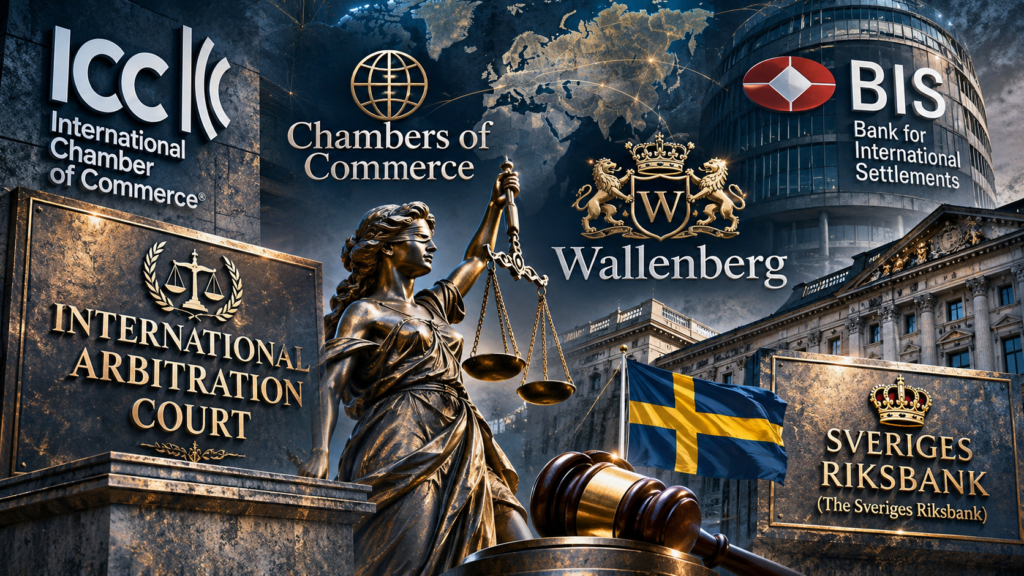
In 1917, the Arbitration Institute of the Stockholm Chamber of Commerce, now known as the SCC Arbitration Institute, was established. Stockholm later became an important center for resolving international commercial disputes, including those involving the United States, the Soviet Union, and China. [8]

The Wallenberg family’s involvement is documented in historical records. According to the Federal Reserve Bulletin of June 1932,
Marcus Wallenberg served as chairman of an arbitration committee appointed by the Bank for International Settlements (BIS) to address disputes involving international banking agreements concerning Germany. [9]

The connection continues through the International Chamber of Commerce (ICC), where Marcus Wallenberg is listed as Treasurer of ICC Sweden’s governing board. [10]
Sweden’s central bank, Sveriges Riksbank, became a shareholder in BIS when it was established in 1930 and gained representation on its Board of Directors in 1931. [11]

BIS itself was established through international agreements concluded at The Hague in 1930. These arrangements also created a standing arbitral tribunal whose secretariat is administered by the Permanent Court of Arbitration, founded in 1899. [12]

Together, these historical records reveal Sweden’s longstanding involvement in the institutions connecting international finance, arbitration, and legal governance.

From Hugo Grotius and Axel Oxenstierna to the Riksbank, the Wallenberg family, and BIS, Sweden’s influence on international institutional development extends across several centuries. This history raises a fundamental question: 

Who shapes the rules governing international finance and dispute resolution, and where does the authority of sovereign nations end and that of international institutions begin?

Who Gave International Criminal Court ant the International Arbitration Courts Their Authority?

The Stockholm Chamber of Commerce established its arbitration board in 1917, laying the foundations for today’s internationally recognized SCC Arbitration Institute, based in Stockholm.

This raises a fundamental question about the origins of judicial authority. Unlike national courts, arbitration institutions derive their authority primarily from agreements between the parties involved, while national legislation determines the legal framework and enforceability of arbitral awards.

But who ultimately determines the boundaries of that authority, particularly when private institutions become influential in resolving disputes involving multinational corporations, sovereign states, and international financial interests?

The distinction between contractual arbitration and state judicial power is central to understanding how international legal authority has developed beyond traditional national court systems.

Who grants these institutions their authority, who holds them accountable, and whose interests do they ultimately serve?

The confrontation surrounding the ICC ultimately concerns the source and limits of legal authority. International institutions cannot resolve every question of legitimacy, jurisdiction, or democratic accountability simply by invoking their own founding treaties. The fact that a court claims jurisdiction does not mean that every sovereign nation accepts its authority.
Nor does the existence of a treaty automatically settle the broader political and philosophical debate over whether its provisions should apply to nationals of states that never consented to it.
The November 19 declaration brings this debate into sharper focus. Three permanent members of the UN Security Council have jointly emphasized state consent and official immunities while calling for reform of the United Nations. [1]

The central question is therefore not merely what the ICC believes it is entitled to do, but why sovereign nations should accept those claims when they have never agreed to the Court’s founding treaty.

This is the fundamental conflict between national sovereignty and the contested authority of international institutions.

And it is a conflict that Sweden and the European Union can no longer afford to ignore.

Sources and References

[1] The White House, November 19, 2026
U.S.-Russia-China Heads of State Declaration toward Peace.
Official joint declaration addressing UN reform, state consent, immunity of state officials, ICC jurisdiction, energy, and nuclear security.
https://www.whitehouse.gov/briefings-statements/2026/11/u-s-russia-china-heads-of-state-declaration-toward-peace
[2] Encyclopedia.com, Hugo Grotius
Grotius, Hugo (Huigh de Groot; 1583–1645).
Historical account of Grotius’s relationship with Axel Oxenstierna and his appointment as Sweden’s ambassador to France.
https://www.encyclopedia.com/history/encyclopedias-almanacs-transcripts-and-maps/grotius-hugo-huigh-de-groot-1583-1645
[3] International Criminal Court
Rome Statute of the International Criminal Court, particularly Articles 12 and 13.
The treaty provisions governing the Court’s jurisdiction, including territorial jurisdiction and referrals by the UN Security Council.
https://www.icc-cpi.int/sites/default/files/2024-05/Rome-Statute-eng.pdf
[4] The White House / Federal Register, February 6, 2025
Executive Order 14203: Imposing Sanctions on the International Criminal Court.
President Trump’s official explanation of the American government’s objections to ICC jurisdiction and the national security rationale for sanctions.
https://ofac.treasury.gov/system/files/2025-02/eo14203.pdf
[5] Swedish Parliament, May 7, 2025
Sweden’s Actions in Defense of the International Criminal Court.
Written response by Foreign Minister Maria Malmer Stenergard concerning Sweden’s support for the ICC and the possible activation of the EU Blocking Statute.
https://www.riksdagen.se/sv/dokument-och-lagar/dokument/svar-pa-skriftlig-fraga/sveriges-agerande-till-forsvar-for-internationella_hc121103
[6] Bank for International Settlements, September 2025
Triennial Central Bank Survey: OTC Foreign Exchange Turnover in April 2025.
Official statistics documenting the US dollar’s dominant role in global foreign exchange markets. https://www.bis.org/statistics/rpfx25_fx.pdf
[7] Swedish Parliamentary Debate and Public Reporting, 2026
Oxenstierna 2.0: Proposals to Reform Sweden’s Administrative Model.
https://www.publikt.se/nyhet/sa-vill-partierna-forandra-staten-27996
[8] SCC Arbitration Institute: Our History
[9] Federal Reserve Bulletin, June 1932
[10] ICC Sweden: Organization and Governing Board
[11] Sveriges Riksbank: Economic Review, 2022
[12] Permanent Court of Arbitration: BIS Arbitral Tribunal

Additional primary source: Ministry of Foreign Affairs of China, November 19, 2026
China-Russia-U.S. Heads of State Declaration toward Peace.
China’s official publication of the joint declaration.
https://www.fmprc.gov.cn/eng./xw/zyxw/202611/t20261119_12063224.html

Additional Source: SCC Arbitration Institute, Official History


Editorial note: This article presents a critical analysis of international institutional authority from the perspective of national sovereignty. Its legal and historical claims are supported by the sources above, while questions concerning legitimacy, democratic accountability, and the proper limits of international jurisdiction reflect the article’s analytical perspective.

Leave a Reply

Your email address will not be published. Required fields are marked *

Related Post

Wallenberg and China!Wallenberg and China!

Imagine that a strict dictatorship approves foreign companies with monopoly in the country.

In the middle of the pandemic, Wallenberg traveled in a specially chartered plane to bring home lab equipment from China:

https://www.svd.se/a/b5V20g/wallenbergs-kupp-spelet-bakom-unika-coronalabbet

Wallenberg has invested more in China than China has in Sweden!

China says that a few Swedes are brutally meddling in China's internal affairs:

https://sverigesradio.se/artikel/7373890?fbclid=IwAR3n51xe4imXR7Cg2GthDpjppPLMVQLMiHVYPiQ-LysiZzC2bcfiQ2ctmww

Ericsson uses slave labor in China:

https://www.expressen.se/gt/ericsson-i-samarbete-med-kritiserad-slavfabrik-i-kina/

Jacob Wallenberg:

"My involvement as a member of the Shanghai Mayor's International Council for 25 years, and the corresponding involvement in Tsinghua University's International Council, gives me insights and contact points to Chinese society that give me the opportunity to express views on how trade and other exchanges should be conducted. We in the family believe in keeping the dialogue open and straight."

https://www.svd.se/over-100-miljarder-pa-spel-for-wallenberg-i-kina?fbclid=IwAR1Q7d22dk4Tl7Vazl0oZZ5xfIaDhzTaSoxBVMYvK1VMTTpeIXpu_POIzw4

Full article:

"Wallenberg on China: "Nothing to gain from confrontation"
On Monday, October 21 this year – just a day after thousands of protesters clashed with police in Hong Kong in yet another showdown – Jacob Wallenberg sat down in a beige, throne-like armchair in a room in Shanghai. Next to him was another man in a suit in a similar chair.

The whole thing resembled a summit meeting between two world leaders.

Which it, in its way, was.

The man is not just anyone. His name is Li Qiang, he is the secretary of the Communist Party in Shanghai. As a member of the party's 25-member Politburo, the party's governing body, he is one of the most powerful men in all of China.

The American Maurice R Greenberg, former head of the American insurance giant AIG, was also present at the meeting.

The event is in the picture. It is published on the online edition of the state-owned daily newspaper Shanghai Daily together with a short summary:

"Li thanked the two guests for their participation in the creation of IBLAC and their valuable advice and suggestions for Shanghai's social and economic development."

IBLAC stands for International Business Leaders Advisory Council and is a council of global business leaders linked to the mayor of Shanghai. Jacob Wallenberg and Maurice Greenberg were in town for the council's annual meeting. Which was also the reason for the meeting with Li Qiang.

It is not unusual for Jacob Wallenberg to meet a person from China's top management. Wallenberg has been a member of IBLAC for many years, and was also its chairman for a period.

Contacts with high-level Chinese political leaders have been important for many larger companies that have operated in China over the years, says Kristina Sandklef, senior China advisor at the consulting firm Consilio International.

– In general, it is useful to have political contacts when conducting business in China. It makes life easier in every way. It can be enough to have a picture in the reception with a representative from your own company together with a local leader of the Communist Party, so that visitors know you have contacts, says Kristina Sandklef.

According to Oscar Almén, researcher and China expert at Total Defense's research institute FOI, the role of politics in Chinese business life has increased in recent years.

– Considering that politics is so present in China's closed system, and has become even more present during Xi Jinping's time in power, it is clear that political contacts are generally good for foreign companies to have, says Oscar Almén, who also recently published a review of Chinese company purchases in Sweden.

Exactly how the Wallenberg family's political connections have helped the group's companies is difficult to determine. Clearly, China today is of enormous importance to the Wallenberg group and its companies, and has been so for several years. In 2018 alone, six of the Wallenberg group's largest industrial companies had revenues in China of over SEK 130 billion, according to SvD's calculations. That is 80 percent more than the same six companies brought in from China in 2010.

These are listed companies that are owned in several stages, via the listed management company Investor and the unlisted FAM, which in turn is owned and controlled by the Wallenberg foundations. FAM and Investor own shares with large voting rights, which give the family and its representatives a leading position in the companies.

For several of the companies, China is today the second largest market.

In the workshop giant Atlas Copco, Chinese customers accounted for 18 percent of sales last year. In ABB, the same figure was 15 percent. In the ball bearing manufacturer SKF, 16 percent.

This can be compared with the share of Sweden's exports to China, which in 2018 was 4.7 percent. Admittedly, the mentioned companies are global and China represents the equivalent of 19 percent of the world economy, calculated as GDP. But it is still clear that China is a far more important market for the Wallenberg family's company than for several other Swedish global companies. For example, the China share of Sandvik's sales was only 7 percent and of Assa Abloy's 6 percent.

This hospital visit subsequently happened to create a special bond between me and Jiang Zemin.

Should China's latest threat, as formulated by ambassador Gui Congyou last week in an interview with Göteborgs-Posten, to "restrict exchange and cooperation in economics and trade" with Sweden become serious, it could have major consequences for the Wallenberg group's companies. And thus for the Swedish shareholders and pension savers who have money invested in the companies.

Swedish occupational pension companies, for example, have tens of billions invested in the Wallenberg group, and are thus dependent on the income from China. In Investor alone, the civil servants' Alecta and the labor movement's AMF are second and third on the list of largest owners after the Wallenberg foundations. Alecta's pensioners today own Investor shares worth SEK 23.6 billion, and AMF's pensioners and fund unit owners SEK 17.7 billion, according to the ownership service Holdings.

Peter Wallenberg receives President Hu Jintao during his visit to Sweden in the summer of 2007. Erik Belfrage, Hans Stråberg, Carl-Henric Svanberg, Peter Wallenberg Jr, Marcus Wallenberg and Jacob Wallenberg sit along the wall.

The Wallenberg family's financial contacts with China go back a long way. Jacob's father Peter Wallenberg has told in the newspaper "Företagsminnen" that he visited China already at the end of the 1970s, in connection with Deng Xiaoping becoming leader and initiating the economic reform program that today – four decades later – has made China the world's second largest economy.

Peter Wallenberg was then able to establish personal relationships with China's absolute top echelon. During a trip in the country, he was invited to dinner by the then mayor of Shanghai, Jiang Zemin. At dinner, Peter Wallenberg mistakenly thought he had a heart attack and was taken to hospital.

"This hospital visit then happened to create a special bond between me and Jiang Zemin, after all, he had helped save my life. 'What about your old heart?', he jokingly asked when we met again," said Peter Wallenberg to Företagsminnen.

When Jiang Zemin succeeded Deng Xiaoping as leader in 1989, the Wallenberg family was thus in direct contact with the top. The relationship continued when Hu Jintao then took over power in 2002. When Hu Jintao visited Stockholm in the summer of 2007, Peter Wallenberg was one of those who received the president.

There is much evidence that the close relations have remained close even after 2012, when Xi Jinping became president. The Li Qiang whom Jacob Wallenberg met the other month is, according to the South China Morning Post, close to Xi Jinping. According to the newspaper, Li Qiang is one of Xi Jinping's allies from Zhejiang province. According to the newspaper, Li Qiang was Xi Jinping's secretary for three years, when he was the leader of the Communist Party in Zhejiang.

Li Qiang's representative in Shanghai, Han Zheng, is another of the party leaders with whom Jacob Wallenberg has had contact over the years. And Han Zheng is not just anyone. Today, he is one of seven members of the Politburo's innermost circle, Xi Jinping's so-called "standing committee". It is Han Zheng who can be seen in the picture next to Jacob Wallenberg, at a press conference in 2011.

Jacob Wallenberg with Han Zheng in 2011, when Han Zheng was mayor of Shanghai. Today, he is one of seven in the inner circle of the Communist Party's Politburo, its so-called "standing committee" led by President Xi Jinping.

In parallel with the Wallenberg family cultivating its political relationships, the group's companies have built up a considerable presence on the ground in China. Today, the country is not only an important market for the group. Several of the companies have large production facilities in the country. SKF today, for example, has nine Chinese factories that are subcontractors to the automotive industry. China is also the country where SKF has the most employees in the world.

We have also seen before that this type of threat is a way of showing domestic politics that you dare to stand up to Western states.

ABB is another Wallenberg giant with a large Chinese presence. In November 2018, the group inaugurated a manufacturing and development center in Xiamen, which when completed will be the group's largest innovation and manufacturing facility with 3,500 employees, a total investment of approximately SEK 3 billion. In 2018, ABB also decided to build a new robot factory in Shanghai.

The Wallenberg companies also usually cooperate on networks and political contacts worldwide. Johan Forssell, CEO of the group's investment company Investor, confirmed as recently as the other week that it is very much continuing. According to Forssell, one of the most important things Investor can contribute to the companies is the network in Asia, and especially in China.

Admittedly, several of the above-mentioned companies are not entirely Swedish. ABB, Astra Zeneca and Stora Enso even have headquarters abroad. But given how well-known the Wallenbergs are in China, it is probably obvious to the authorities in the country that the family is its largest owner. And that the companies could be affected by an economic conflict.

According to Oscar Almén, researcher at FOI, the consequences depend on which means China chooses to respond with.

– If they choose the trade route, with tariffs and the like, then the issue ends up in the EU, which regulates Swedish trade relations. Then there are ways to make it more unofficial, where Swedish companies in China can be affected in a number of other ways, says Oscar Almén.

– You can compare it to what happened to the salmon after the conflict with Norway. Sanitary tests for imported salmon became stricter and the possibility of obtaining import licenses became more difficult. However, it was not the Chinese government that officially implemented this. Through small means, it could produce big effects, he says.

According to Oscar Almén, however, it is not certain that China will actually go ahead with its threat.

– China must make a calculation of how costly it can be, the country is also dependent on several of the companies that operate in the country. We have also seen in the past that this kind of threat is a way to show domestic politics that you dare to stand up to Western states and it also works as a way to scare others not to challenge China in the future.

The Wallenberg family has repeatedly had to answer for their close connections to China and how that rhymes with the country's problems with human rights. All along, the family has defended itself by saying that their presence contributes to economic development and thus strengthens the direction towards democracy.

Like, for example, Jacob Wallenberg in Ekot's Saturday interview in 2006:

"It has been an incredible development thanks to the fact that you actually approve of economic development. And then I think the democratic development also follows. Or, rather, I don't think so. I am completely convinced that it is so."

That increased wealth in China would lead to increased democracy is an argument that is becoming increasingly difficult to assert.

The question is even more relevant today. Several politicians and human rights organizations are clear in their conclusion that under Xi Jinping in power, China has taken several steps in a more repressive, less democratic direction.

As Human Right Watch begins its latest report on the situation in the country.

"President Xi Jinping, born in 1953, has indicated his intention to rule indefinitely after China's legislature in March added an amendment to the constitution aimed at abolishing the outer term limit for the presidency. This move was also characteristic of the increasing repression."

Oscar Almén at FOI is skeptical of the belief that economic development would also improve the situation for human rights.

– That increased wealth in China would lead to increased democracy is an argument that is becoming increasingly difficult to assert. Today, China is moving more and more towards an autocratic system, on all levels, with reduced freedoms and increased political control, he says, but points out that there are occasional exceptions that go in the opposite direction.

– The opportunity for individual citizens to sue the state has increased in recent years and we have also seen more people who have taken advantage of that opportunity. That's important to remember, even if the overall trend is toward more political control.

Several recent events have also strengthened the thesis that the regime in Beijing is moving in a more repressive direction. One example is the repeated revelations of China's treatment of minorities in Xinjiang province, where over a million people have been put in various camps and prisons.

Representatives of the Chinese regime have described the camps primarily as schools, where the inmates were students. But as several international media and organizations have shown, it is rather about far more brutal institutions where anyone who resists is punished. The New York Times recently revealed that the hard-line measures were ordered from China's top political leadership. In a speech to party representatives, President Xi Jinping is said to have demanded that "no mercy" should be shown to the Muslim minority population and that the country used all the "tools of dictatorship" in that work.

The development in Hong Kong is another current example. The authorities' treatment of the protesters and the bill they were protesting are both seen as examples of a more hardline approach by the central government in Beijing.

For Sweden, the imprisonment of the Swedish-Chinese publisher Gui Minhai has turned up the criticism against the methods of the Chinese state power. Which is now the background to Ambassador Gui Congyou's threat in the GP the other day about "countermeasures". When and how these will be put into practice is still unclear. Foreign Minister Ann Linde told Ekot after the statement that the Foreign Ministry "did not receive any concrete information about this from Beijing" via the normal channels.

In the GP interview, Gui Congyou repeats the response that China often uses when people or organizations in other countries criticize the government's actions and policies:

"The policies of the Chinese government are China's internal affairs. No countries, organizations or private individuals have the right to interfere," he says in the interview.

SvD has asked Jacob Wallenberg a number of specific questions about how he views the group's activities in China today and the family's contacts with the country's political leadership. Jacob Wallenberg did not want to answer the questions directly, but instead formulated a written statement to SvD.

In the statement, he writes that the family generally "has a strong belief that trade and openness favors economic development and creates conditions for increased prosperity for all and also contributes to peaceful coexistence between countries. This also applies to China.".

Jacob Wallenberg emphasizes, however, that the country's expansion is not viewed uncritically.

"China's economic growth and ambition do not mean that one should be naive about the political role China wishes to play, and therefore it is important to place the same demands on China in terms of trade and competition as are placed on other developed countries. It must be a level playing field."

Jacob Wallenberg writes that he has spoken on several occasions with China's leaders about the country's problems with human rights. But he also repeats his previously expressed belief that with economic development should also come increased civil liberties and rights in the long run.

"That this has not yet happened in China, I regret, which I have also repeatedly and clearly raised with Chinese leaders. But politics – not business – should deal with political issues. I believe that increased transparency and openness is a prerequisite for continued long-term economic development in China."

In the statement, however, Jacob Wallenberg mentions nothing about any specific issues that he has discussed with the Chinese leaders he met, such as the issue of the imprisoned Swedish-Chinese publisher Gui Minhai and the prison camps in Xinjiang. Nor if he believes that the threats from the Chinese ambassador can affect the Wallenberg companies' large presence in China.

"The relationship with China is complicated. I advocate dialogue and long-termism, continued trade and exchange at all levels. We have nothing to gain from confrontation, but we must stand up for our values ​​and use our trusted contact points to highlight our concerns and common challenges."

Jacob Wallenberg writes that they will continue to cultivate contacts with the Chinese leaders in the future.

"Since the opening of China, the family has strived for close relations with the political leadership in China. Hopefully, this has benefited the companies' opportunities to establish themselves and grow in the Chinese market," writes Jacob Wallenberg.

Nor does he harbor any thoughts of quitting as a member of IBLAC in Shanghai, where he meets Politburo members such as Li Qiang and Han Zheng.

"My involvement as a member of the Shanghai Mayor's International Council for 25 years, and the corresponding involvement in Tsinghua University's International Council, gives me insights and contact points to Chinese society that give me the opportunity to express views on how trade and other exchanges should be conducted. We in the family believe in keeping the dialogue open and straight."

Wallenberg Sweden’s Shadow GovernmentWallenberg Sweden’s Shadow Government

Sweden is a small country but very sharp.
Wallenberg is the core of the deep state, the shadow government or non-elected people who rule in the background or whatever you want to call it. Whose motto is Esse Non Videri, act without being seen.
They control the telecom infrastructure, telephony, broadband, 5G, etc. through Ericsson and the power supply through ABB in 184 countries, they control Nasdaq and the technology for 150 stock exchanges. They control SEB for banking, Astra Zeneca which makes vaccines, Atlas Copco which deals with mines and extraction of natural resources, SAAB which makes weapons, fighter planes, Redbee which has over 400 TV stations incl. BBC etc etc. All tech companies such as Apple, Google, Amazon, Facebook, Twitter, Microsoft, etc. have their server halls in Sweden and pay license fees to Wallenberg in order to be on the internet, thus Wallenberg has great control over their operations. In addition to this, which is also shown in the feature that finances them research, education, legal education, training in weapons, democratic issues, etc., etc. The list can be made long and this family is undoubtedly the most influential on earth. When Trump said he would “drain the swamp”, he meant it. The fungus that sucked out all the nutrition, all the liquid, all the wealth from the rest of the peoples on earth. With each passing day we see the decay and operating without being seen doesn’t really work for them. Now the whole world sees how this ecosystem that Wallenberg built works and who benefits. They are behind the Federal Reserve Act, the Bilderberg group where Wallenberg is still chairman (there is interesting documentation on Wikileaks) and the EU. Intelligence services are controlled by Ericsson, eavesdropping goes through them and thus also the Darknet, which they could have easily shut down if they wanted to. Sweden (or Wallenberg which is Sweden) is the sixth eye in Five Eyes, only that they have control over everything without being involved. Wallenberg is the invisible enemy and the people in the shadows that Trump talks about. Sweden is neither neutral, nor a small country, and definitely not a humanitarian superpower. The suffering, poverty and misery that this family has caused the whole world is indescribable and everything is coming out now in the light of reality and we will be ashamed as Swedes. Which party or politician sheds light on this, no, no one, because they are appointed by the same family and no one can become a politician without Wallenberg’s approval. So no, we haven’t had democracy either.
Their time is over now!

Wallenberg runs a global shadow juridical systemWallenberg runs a global shadow juridical system

The World Chambers Federation (WCF) is the forum that connects chambers across borders and it has its own arbitration court dispute resolution. The International Chamber of Commerce is governed by its Constitution, which sets forth the structure of the organisation and how it carries out its work.

The history of chambers movement

The term “chamber of commerce” appeared for the first time, in Marseille, France in 1599. 

Today, chambers of commerce exist in almost every country of the world. Chambers are still the most important type of multi-sectoral business organizations in the world. Two basic models prevail: Public law and Private law.

The predominant model in the world is the “private law” or “Anglo-Saxon” model originated in Great Britain and spread to other countries influenced by the British tradition. It is also prominent in the Nordic countries. Reflecting the more “laissez faire” economic policies of these nations, chambers are established by the desires and needs of their local business community.

These chambers are not created and governed by public statutes, but are established under private law requiring only registration in business or association registers. Private law models are found in Great Britain, other countries of the British Commonwealth, North America, Scandinavia, Belgium and Switzerland.

ICC International Court of Arbitration®

ICC perform an essential role by providing businesses, governments and individuals with a variety of customisable services for every stage of their dispute.

Although called a court in name, we do not make formal judgments on disputed matters. Instead, we administer arbitrations by exercising judicial supervision of arbitration proceedings.

Rules and Procedures

The ICC Arbitration Rules are used all around the world to resolve disputes, administered by the ICC International Court of Arbitration®, the world’s premier arbitral institution. The Rules assure parties of a neutral framework for the resolution of cross-border disputes.

Court Members

Members of the Court are appointed for three-year terms by the World Council. This is done on the proposal of one member from national committees and other groups.

The President of the Court is elected upon recommendation by the ICC executive board on the proposal of an independent selection committee.  

Vice-Presidents are appointed on the proposal of the President.  

Court members are appointed on the proposal of ICC national committees and groups, while alternate Court members are appointed on the proposal of the President.

Supreme Board of Directors of ICC


ICC Sweden’s executive board consists of people who represent different parts of Swedish business life.

Chairman: Chairman Fredrik Persson, Business Europe, JM, EllevioVice Vice Chairman: Director Anna Karin Hatt, National Farmers’ Federation Cash manager: Chairman Marcus Wallenberg, SEB
Marcus “Husky” Wallenberg, born 2 September 1956

What is the global footprint of the WCF? 

Our members are in 116 countries/territories, from all regions of the world and are the key players in the work of ICC World Chambers Federation.

Marcus “Husky” Wallenberg

Swedish banker and industrialist. Married to Fanny Sachs, sister of Daniel Sachs who sits on the board of George Soros’ Open Societies Foundation.

Marcus Wallenberg was born on September 2, 1956, in Stockholm, Sweden.[ He is a member of the prominent Wallenberg family. His father, Marc Wallenberg, was a banker. His mother is Olga Wehtje. Her father Walter Wehtje was between 1940 and 1957 CEO of Atlas Diesel, which later became Atlas Copco. He was also a board member of Stockholms Enskilda bank. Olga Wehtjes sister is Eva Lundin was married to Adolf Lundin who funded WEF World Economic Forum. Lundin oil are currently on trial for crimes against humanity in Sudan.

Wallenberg began his career in the New York City office of Citibank in 1980–1982.[1] He subsequently worked for Deutsche Bank, followed by S. G. Warburg & Co., Citicorp and the SEB Group.[1]

Wallenberg served as the President and CEO of Investor from 1999 to 2005.[1] He served as the Chairman of the International Chamber of Commercefrom 2006 to 2008.[2]

https://en.wikipedia.org/wiki/Marcus_Wallenberg_(born_1956)

Wallenberg is the Vice Chairman of the Institute of International Finance.[2] He serves on the board of directors of Skandinaviska Enskilda Banken, Electrolux, Ericsson, LKAB, AstraZeneca, Stora Enso, Saab, and Knut and Alice Wallenberg Foundation. He is a member of the Steering Committee of the Bilderberg Group.

He is also a former member of the board of directorsof Temasek Holdings and currently on the Temasek International Panel. Temasek, is a global investment company owned by the Government of Singapore.

Jacob Wallenberg

He is a member of the steering committee of the Bilderberg Group, the European Round Table of Industrialists, and the advisory board of the Tsinghua University School of Economics and Management. He is also member of the Trilateral Commission. Wallenberg is Honorary Chairman of the Mayor of Shanghai’s International Business Leaders Advisory Council (IBLAC).

https://en.wikipedia.org/wiki/Jacob_Wallenberg

Q- Quantum – FRA- NSA- Swedish Kings of cyberwar Q- Quantum – FRA- NSA- Swedish Kings of cyberwar 

The article in SVT from 2013:

FRA's US cooperation worries conflict researcher Agrell

FRA gets to take an active part in Quantum – an American data breach system that is very advanced. If used offensively, it can be perceived as directly hostile by other countries. 

According to secret documents leaked by Edward Snowden to SVT's Uppdrag review, the American intelligence service and the Swedish FRA have worked together in the so-called quantum project.

Conducting active signals intelligence and hacking computers in or outside Sweden, there is no room for that in Swedish legislation.

Can be perceived as an act of war

This worries peace and conflict researcher Wilhelm Agrell, who even fears that data breaches could be perceived as an act of war.

– Cyber ​​warfare, if it is directed against vital infrastructure in another country, can be tantamount to an armed attack. Of course, we are not there now, but data breaches are not just any triviality, says Wilhelm Agrell.

As usual, FRA says nothing about what their operations look like, or what goals they have with their participation in the quantum project.

However, the whole idea of ​​quantum technology is about directing cyber attacks against different targets, military, political or economic. One hacks in, and can then, for example, plant computer viruses or gain access to trade secrets.

The supervisor trusts the FRA

The Defense Intelligence Tribunal must approve all FRA intelligence. Cooperation with other countries must also be within the framework of what the court approved, according to chairman Runar Viksten. Everything must benefit Swedish interests and be aimed at foreign conditions.

Viksten does not want to answer whether the data breach, as described in the leaked material, is impermissible.

– The court does not get involved in which methods the FRA uses to access material, because it is not decisive in determining the breach of privacy, he says.

– Joint operations do not fit within the legislation. The closer that relationship is, the more difficult it will be to maintain the legislation's limitation, says Wilhelm Agrell.

The limitation is, among other things, that FRA must carefully filter which own information is handed over to other countries.

Former FRA head Ingvar Åkesson has assured the Riksdag's defense committee that the agency does not engage in data breaches and that in that case it would be illegal. According to the FRA, however, there is court authorization for all collection of information.

In-depth: Feel free to listen to or read the article Swedish Kings of Cyberwar in Swedish, click here.