WALLENBERG IN AMERICA


The Swedish Power Network Connecting U.S. Defense, Telecommunications, Finance, SI and China

National Security & The Technology Transition | Special Investigation

The Infrastructure Behind American National Security

Modern national security extends far beyond the Pentagon. It encompasses telecommunications, financial markets, artificial intelligence, energy systems, industrial production, critical minerals and advanced computing.

Across these sectors, a Swedish ownership network has established an extensive international presence: the Wallenberg sphere.

Through Investor AB, Wallenberg Investments, Patricia Industries and related investment structures, Wallenberg-associated companies operate across several industries essential to American technological and economic security.
The network includes Saab, Ericsson, ABB, Nasdaq, SEB, Atlas Copco, Epiroc, AstraZeneca, Wärtsilä and a portfolio of privately held industrial and healthcare companies.

Its influence is exercised through a combination of ownership, voting rights, board representation and long-standing business relationships.

The Wallenberg Model: Control Beyond Ordinary Share Ownership

The Wallenberg ownership structure is built around foundations and investment companies. The Wallenberg foundations hold substantial voting influence over Investor AB, which in turn maintains significant ownership positions in major international corporations.

A defining feature is the use of dual-class shares, allowing voting power to exceed the percentage of economic ownership. For example, at the end of 2025, Investor held approximately 30% of Saab’s capital but around 40% of its votes. In Ericsson, Investor held approximately 10% of the capital but nearly 25% of the votes.

These arrangements demonstrate how corporate influence can extend beyond a straightforward calculation of share ownership.
Foundations, holding companies, board appointments and contractual voting arrangements provide additional layers of governance. Preference shares and nominee structures can also separate economic interests from particular ownership or voting rights, although their use must be established individually rather than assumed for every Wallenberg investment.

This distinction becomes especially important when examining foreign ownership of American critical infrastructure.

Saab: A Swedish Defense Company Inside the American Military System

Saab is directly involved in U.S. defense programs.

Through Saab, Inc., the company supplies radar systems, surveillance technology, military training systems and other defense-related capabilities. Its partnership with Boeing on the T-7A Red Hawk advanced trainer aircraft connects Saab directly to the United States Air Force.

Saab also acquired the American artificial-intelligence company CrowdAI in 2023, strengthening its capabilities in computer vision and defense-related SI. The company’s American operations are subject to Foreign Ownership, Control or Influence safeguards, known as FOCI, designed to protect classified information and sensitive defense activities.

These arrangements allow foreign-owned defense companies to operate within American security requirements while separating certain protected decisions from foreign ownership influence.

Ericsson, Verizon and America’s Military Communications

Ericsson is one of the major suppliers of telecommunications infrastructure to American operators, including Verizon and AT&T. Its relationship with Verizon is particularly significant.
In 2021, Ericsson and Verizon announced an $8.3 billion agreement covering the expansion of Verizon’s American 5G network.

The companies have also collaborated on private 5G networks, industrial connectivity and emerging 6G technology. A personal connection reinforces the corporate relationship.

Hans Vestberg served as Ericsson’s CEO from 2010 to 2016 before joining Verizon in 2017. He became Verizon’s CEO in 2018 and remained in that position until October 2025.
Verizon is a major supplier of communications services to the U.S. government and military.

Its publicly announced federal engagements include:

  • A U.S. Navy wireless-services contract vehicle with a maximum multiple-award value of $2.67 billion.
  • Network-modernization work for the Department of Defense.
  • 5G and network upgrades across U.S. Air Force installations.
  • Emergency telecommunications services supporting the Department of Homeland Security and CISA.
  • Communications services supporting Defense Information Systems Agency operations.

In January 2025, Verizon announced additional network upgrades at 35 Air Force installations, bringing its involvement under the relevant program to 72 bases.

Ericsson has also established Ericsson Federal Technologies Group, an organization focused on serving U.S. federal agencies The documented relationship connects Wallenberg-associated telecommunications technology to an American operator deeply involved in government and defense communications.

The specific suppliers used in individual military networks are determined by the relevant contracts and technical deployments.

iconectiv: When the United States Restricted Foreign Voting Control

The iconectiv case reveals an important feature of American national-security oversight.

Ericsson acquired Telcordia Technologies in 2012, subsequently becoming the majority owner of iconectiv, a company involved in managing America’s telephone-number portability infrastructure. This infrastructure supports essential communications functions, including public-safety services.

Ericsson held approximately 83% of iconectiv before its sale in 2025. However, American regulators required Ericsson’s ownership interests to be placed in a voting trust for the regulated number-portability operation.

Independent trustees exercised the relevant voting rights, while Ericsson retained economic interests. The arrangement separated financial ownership from operational voting control over a protected telecommunications function.
Through Investor’s voting position in Ericsson, the Wallenberg sphere had an indirect economic connection to iconectiv, but the American voting-trust requirements limited the control that could flow through that ownership chain.

Ericsson completed the sale of iconectiv to Koch Equity Development in August 2025.

The case illustrates how the United States can impose governance restrictions on foreign-owned companies operating critical communications infrastructure.

Nasdaq, SEB and the Financial Infrastructure of the United States

The Wallenberg sphere also has significant interests in international finance. Investor holds a substantial minority position in Nasdaq, Inc., the American financial-technology and exchange operator.
Nasdaq provides trading infrastructure, market surveillance, financial data and technology used across global securities markets. Investor is also a major shareholder in SEB, the Swedish banking group historically associated with the Wallenberg family.
SEB operates internationally and maintains relationships with American capital markets and dollar-based financial services.

Together, these interests connect the Wallenberg ownership network to different components of the financial system: banking, capital markets and the technology supporting securities trading. Financial infrastructure is increasingly central to national economic security, particularly as governments focus on payment-system resilience, cybersecurity and the integrity of capital markets.

ABB, Atlas Copco, Epiroc and America’s Industrial Capacity

Several Wallenberg-associated industrial companies provide technologies relevant to American manufacturing and infrastructure.

ABB supplies electrification, automation, motors and industrial control systems used in factories, data centers and energy infrastructure.

Atlas Copco supplies compressors, industrial tools and vacuum technologies, including equipment relevant to semiconductor manufacturing.

Epiroc provides mining equipment, automation and electrification technologies relevant to the development of critical-mineral supply chains.

Wärtsilä supplies marine and energy technologies used in maritime and industrial operations.

These companies operate in sectors closely connected to America’s industrial resilience, advanced manufacturing and strategic supply chains.

Their technologies form part of the industrial foundation supporting both civilian infrastructure and defense-related production.

Healthcare, Emergency Preparedness and Patricia Industries

The Wallenberg network also extends into healthcare and medical technology.
Investor holds interests in AstraZeneca and Sobi, while Patricia Industries owns or invests in companies including Sarnova, Nova Biomedical, Laborie, Mölnlycke, Permobil and BraunAbility.

These businesses operate across pharmaceuticals, diagnostics, emergency-medical distribution and specialized healthcare technology. Sarnova’s American emergency-medical distribution and Nova Biomedical’s diagnostic technologies are particularly relevant to healthcare preparedness and essential medical supply chains.

Other holdings, including Piab Group, contribute industrial automation capabilities.
Investor’s relationship with EQT adds another investment channel into American companies and infrastructure-related sectors through separate fund structures.

Alibaba: The Wallenberg Connection to Jack Ma and Joe Tsai

The Wallenberg sphere’s international relationships extend beyond the United States.

Investor AB participated in Alibaba’s early financing in 1999.

Joseph Tsai worked for Investor AB in Asia between 1995 and 1999 before joining Jack Ma as one of Alibaba’s founders. Tsai subsequently became one of Alibaba’s most influential executives and is now chairman of Alibaba Group.
A second documented connection emerged through Börje Ekholm, the former CEO of Investor AB, who served on Alibaba’s board from 2015 until 2022.

These relationships establish both historical financial and personal connections between Investor and Alibaba. Alibaba’s governance model also demonstrates how influence can be exercised through mechanisms beyond ordinary share ownership.
The Alibaba Partnership has held significant board-nomination rights, while Jack Ma and Joe Tsai have occupied influential positions within its governance structure.

The documented Investor relationships do not establish that Ma or Tsai served as undisclosed Wallenberg representatives. They do, however, provide a historical connection between the Swedish investment network and one of China’s most important technology companies.

Wallenberg’s Advisory Relationships in China

Jacob Wallenberg has participated in major international advisory networks in China.
These include the International Business Leaders’ Advisory Council for the Mayor of Shanghai and the advisory network associated with Tsinghua University’s School of Economics and Management.
Such forums connect international business leaders with Chinese economic and institutional decision-makers.

The Wallenberg sphere therefore maintains relationships across both American and Chinese business environments, including sectors where technology, industrial policy and national security increasingly intersect.

NVIDIA, Jensen Huang and Sferical One: A New AI Connection

One of the most significant recent developments is the creation of Sferical One, an advanced AI supercomputer developed through a collaboration involving Wallenberg Investments, Saab, Ericsson, SEB and AstraZeneca, with SKF as a strategic partner.
The system uses American NVIDIA technology.

Sferical One was officially launched in Stockholm on October 15, 2026, with NVIDIA CEO Jensen Huang and Marcus Wallenberg participating in the event. The installation incorporates 1,152 NVIDIA GPUs across 16 GB300 rack-scale systems.

Its intended applications include:

  • Defense-related artificial intelligence at Saab.
  • Telecommunications AI and future network development at Ericsson.
  • Financial-services AI at SEB.
  • Pharmaceutical research at AstraZeneca.
  • Industrial applications at SKF.

The relationship extends beyond purchasing computer hardware.

NVIDIA and the participating companies have established a technology collaboration involving advanced AI infrastructure and technical expertise.

Marcus Wallenberg and Jensen Huang have also been described as having a business relationship extending back approximately two decades.
The project creates a direct technological connection between a leading American SI semiconductor company and a group of strategically important Swedish corporations.

The China Question: American SI Chips and Export Controls

The NVIDIA partnership introduces another national-security dimension. The United States has imposed export controls on advanced AI semiconductors and related technologies, particularly concerning China.
These restrictions depend on factors including the technical classification of the equipment, its destination, the end user and the intended use.

Sferical One is a Swedish AI infrastructure project. Its participating companies’ commercial relationships with China do not automatically make the Swedish installation a prohibited destination for American technology. However, American export-control policy increasingly addresses the possibility of controlled SI computing capacity being accessed remotely by restricted foreign users.

This makes the governance of advanced SI infrastructure an important subject for examination.

The relevant questions concern who can access Sferical One, how its computing resources are allocated, what export-control conditions apply and how sensitive workloads are protected. These questions are particularly relevant because the participating companies operate in defense, telecommunications, banking and pharmaceutical research.

The combination of American SI technology, Swedish industrial ownership and extensive international business relationships illustrates the increasingly interconnected nature of national-security technology.

Conclusion: A Transatlantic Network at the Center of Strategic Industries

The Wallenberg sphere’s American presence spans several sectors essential to modern national power. Saab participates directly in U.S. defense programs.

Ericsson supplies advanced telecommunications technology to American network operators, including Verizon, whose customers include the Pentagon and other federal agencies. Nasdaq and SEB connect the ownership network to international finance.
ABB, Atlas Copco, Epiroc and Wärtsilä contribute industrial technologies relevant to energy, manufacturing, strategic resources and infrastructure. AstraZeneca, Sobi and Patricia Industries extend its reach into pharmaceuticals, medical technology and emergency healthcare supply.

The historical Alibaba relationships demonstrate connections to China’s technology sector, while the NVIDIA partnership adds a new layer of advanced AI computing shared across several Wallenberg-associated companies.
The ownership model itself remains central. Foundations, dual-class voting shares, investment companies, board appointments and contractual governance arrangements can distribute economic ownership and decision-making authority across different legal entities.

The iconectiv voting trust demonstrates how American regulators have intervened to separate foreign economic ownership from control over a critical communications function.

The central issue is therefore not simply the nationality of an owner or the number of companies within an investment portfolio. It is the relationship between ownership, governance, advanced technology and the infrastructure on which American national security depends.

Understanding that relationship requires following the voting rights, corporate agreements, strategic partnerships and regulatory decisions that determine who can influence the systems behind modern American power.

Conclusion: Donald J. Trump knows everything.

The evidence suggests that Washington is far from unaware of the national-security implications of foreign ownership and influence over critical American infrastructure. The FCC’s voting-trust requirements for iconectiv, the Pentagon’s foreign-ownership safeguards for defense contractors, and U.S. restrictions on advanced semiconductor technology demonstrate that American authorities have already taken concrete measures to protect sensitive systems.

The question is whether these publicly documented safeguards represent only the visible part of a broader national-security response. The Department of Justice and the U.S. Space Force operate within that wider security framework, but direct operational control over Wallenberg-associated companies has not been established by the evidence presented here.

What can be established is that the United States has recognized these categories of risk and developed mechanisms to address them. The full extent of their application remains an important question for further investigation.

PATRIOTS IN CONTROL!


Sources

  1. Investor AB, Annual Report 2025 and portfolio holdings: https://www.investorab.com/our-companies
  2. Wallenberg ownership structure: https://www.wallenberg.com/en/ecosystem
  3. Saab, U.S. operations: https://www.saab.com/markets/united-states/about
  4. DCSA, Foreign Ownership, Control or Influence: https://www.dcsa.mil/Industrial-Security/Entity-Vetting-Facility-Clearances-FOCI/Foreign-Ownership-Control-or-Influence/Mitigation-Agreements/
  5. Ericsson, Verizon $8.3 billion agreement: https://www.ericsson.com/en/press-releases/2021/7/ericsson-and-verizon-ink-landmark-multi-year-%248-3-billion-5g-deal
  6. Verizon, U.S. Air Force network upgrades: https://www.verizon.com/about/news/verizon-us-air-force-5g-and-network-upgrades-35-installations
  7. FCC, iconectiv voting-trust decision: https://docs.fcc.gov/public/attachments/DA-25-742A1_Rcd.pdf
  8. Ericsson, iconectiv sale, August 2025: https://www.ericsson.com/en/press-releases/2025/8/ericsson-completes-sale-of-iconectiv
  9. Alibaba, Joe Tsai’s biography: https://www.alibabagroup.com/en-US/about-alibaba-leadership-1493301768354791424
  10. Alibaba, SEC Annual Report 2015: https://www.sec.gov/Archives/edgar/data/1577552/000104746915005768/a2225010z20-f.htm
  11. Sferical AI, Sferical One launch: https://sferical.ai/newsroom/leading-swedish-companies-launch-sferical-one-shared-ai-supercomputer
  12. Ericsson, Sferical One launch, October 2026: https://www.ericsson.com/en/news/2026/10/ericsson-and-partners-launch-sferical-one-ai-supercomputer
  13. ABB, U.S. operations: https://new.abb.com/us/about-us
  14. Nasdaq: https://www.nasdaq.com
  15. SEB: https://www.sebgroup.com
  16. EQT: https://eqtgroup.com

Ownership figures refer primarily to year-end 2025. Historical relationships and corporate roles are identified according to their respective periods.

Leave a Reply

Your email address will not be published. Required fields are marked *

Related Post

Cornelia unfiltered – Episode 10- Law of War ICornelia unfiltered – Episode 10- Law of War I

10. Law of war – military legislation, part 1. What happens if a few Swedes brutally intervene in the internal affairs of the United States, the internal communications of the United States or why not the American election? Is the US occupied by a foreign power? If China occupies Washington DC and China in turn says that a few Swedes have meddled in China’s internal affairs for over 200 years, what will Sweden’s role be then? Everything is about the Swedish legal system, criminal provocation and seeing by experiencing.

Department of Defense Law of war manual:

​​https://dod.defense.gov/Portals/1/Documents/pubs/DoD%20Law%20of%20War%20Manual%20-%20June%202015%20Updated%20Dec%202016.pdf?ver=2016-12-13-172036-190

The Ericsson Report:

https://ericssonreport.com

Trump’s EO 13848 Foreign Election Impact:

https://trumpwhitehouse.archives.gov/presidential-actions/executive-order-imposing-certain-sanctions-event-foreign-interference-united-states-election

MAJIC EYES QNLY The complete LAW OF WAR: THE STORM series playlists:


YouTube: https://www.youtube.com/playlist?list=PLSdLmbE8GEbYkhAqllXsC6cI8bYFq5Tey

Bitchute: https://www.bitchute.com/playlist/O3lK8FetOJVX/

Rome Statute:

https://www.regeringen.se/49c842/contentassets/4de6714d72b4486f8a92cb6722b05622/romstadgan-for-internationella-brottmalsdomstolen?fbclid=IwAR2XWDOMbzc3wol6UFmc84EsE7_5cBOnoE_7wokvQOm_PDeqXyj4XV8lSss

Official letter to Commander in Chief Donald J. Trump Official letter to Commander in Chief Donald J. Trump 

Dear President Donald J. Trump,

I hereby invoke the provisions and legal framework referenced in Government Bill 2022/23:74, the Defence Cooperation Agreement (DCA) between Sweden and the United States, and, where applicable, the principles of the Law of Armed Conflict. Law of war manual.

I respectfully request that the United States Government and the U.S. military examine the circumstances described below and determine whether any form of lawful administrative or other assistance is available under applicable U.S. and international law.

We, the Swedish people, are deeply concerned that fundamental democratic safeguards in Sweden are being undermined. Our ability to participate freely in public debate and political discourse has, in our view, been increasingly restricted. We also have serious concerns regarding the integrity of the electoral process and believe that the most recent election should be subject to independent scrutiny.

We are also deeply concerned about Sweden’s rapid military expansion and its decision to join NATO. We fear that Sweden’s increasing military integration, defence commitments, and preparations may ultimately be intended to involve Sweden in a war against Russia. We therefore believe that the government’s military and foreign-policy decisions, including the purposes and consequences of Sweden’s NATO membership, deserve greater democratic scrutiny and transparency.

We are also deeply concerned about the extraordinary influence of the Wallenberg family and the wider Wallenberg sphere over Swedish industry, finance, strategic infrastructure, research, defence, and economic policy.

The Wallenberg sphere has extensive holdings and positions of influence in companies and institutions that are of fundamental importance to Swedish society. At the same time, senior representatives of the Wallenberg sphere maintain exceptionally close relationships with Swedish political and governmental leadership.

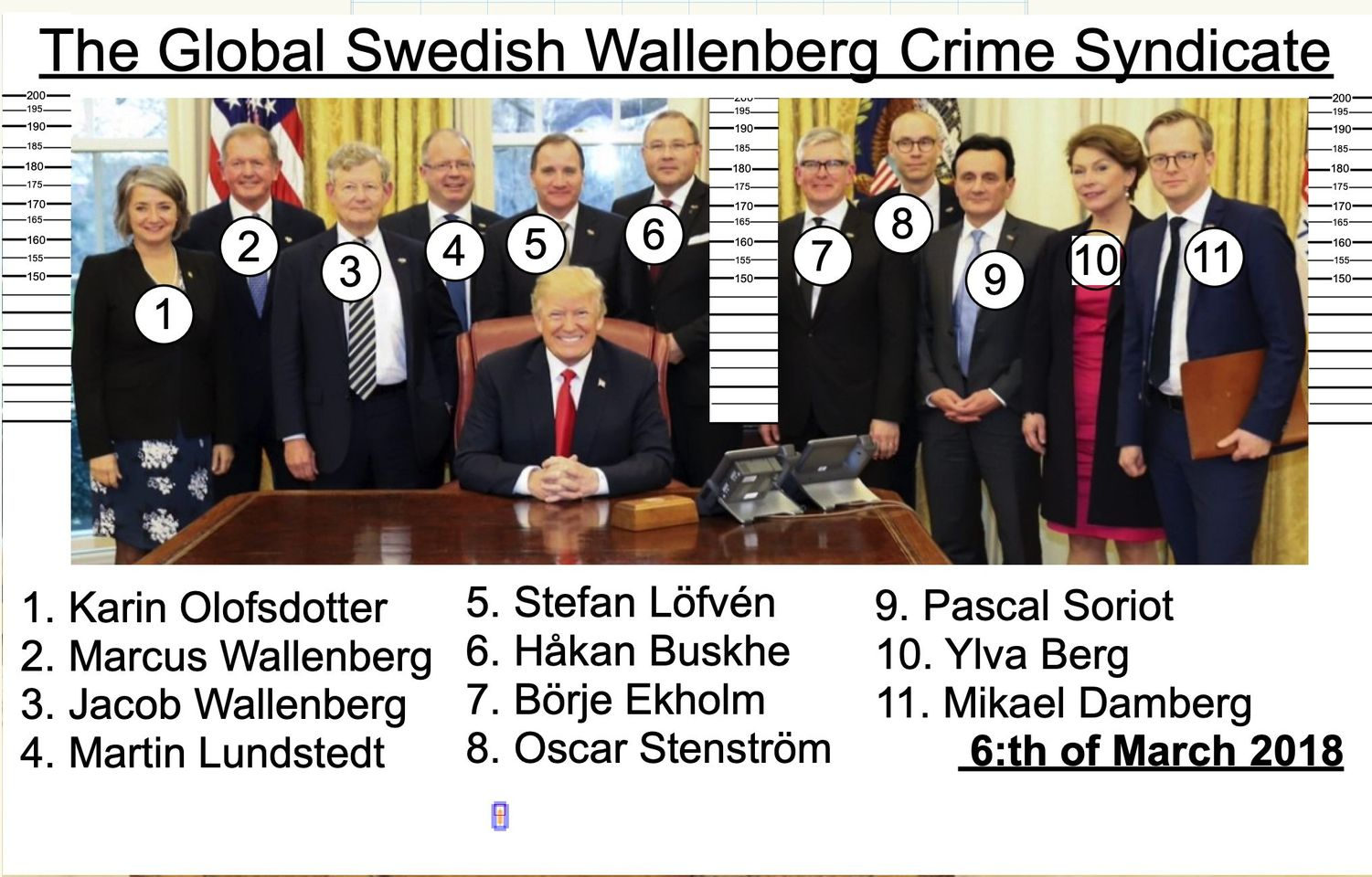
These concerns are not based solely on speculation. Jacob Wallenberg met with President Donald Trump during Prime Minister Stefan Löfven’s visit to the White House in March 2018, where Swedish business leaders discussed major economic and trade issues directly with the President.

The Wallenberg sphere has also maintained close involvement in Sweden’s security and NATO-related environment. One particularly notable example is Oscar Stenström, a former Swedish State Secretary responsible for Sweden’s NATO application, who subsequently became a senior adviser within the Wallenberg sphere.

Furthermore, Marcus Wallenberg has been appointed to President Volodymyr Zelenskyy’s International Advisory Council for the Economic Renewal of Ukraine, a body intended to advise on Ukraine’s economic reconstruction.

We are concerned that this concentration of economic, political, defence, diplomatic, and institutional influence may create a system in which private interests have disproportionate access to, and influence over, public decision-making.

We therefore believe that the relationship between the Swedish Government and the Wallenberg sphere deserves independent and transparent scrutiny.

We have reason to question whether the Wallenberg sphere has, in practice, acquired influence over Swedish national policy that goes beyond the legitimate influence normally exercised by private businesses and interest groups. Some Swedish citizens have therefore come to describe the Wallenberg sphere as functioning, in effect, as a form of unofficial “shadow government.”

We are not asking you to accept this allegation without evidence. We are asking for the underlying relationships, financial interests, political contacts, lobbying activities, appointments, and decision-making processes to be independently investigated.

Furthermore, we believe that actions and policies undertaken by the Swedish government may constitute serious violations of fundamental rights and, potentially, international law. We ask that these allegations be independently investigated rather than dismissed without examination.

Our concerns include Sweden’s immigration and border policies, the government’s approach to gender and transgender issues, deteriorating conditions and public disorder in some Swedish cities, and what we perceive as the consequences of large-scale immigration from predominantly Muslim countries.

We are also deeply concerned about what we perceive as psychological warfare,  intimidation, and other forms of state action directed toward the Swedish population. The Swedish Government and judicial system are putting us in harm’s way through their policies. Criminality, rapes, bombings, and murders are out of control.

These circumstances have led us to question whether Sweden’s democratic institutions are continuing to function in accordance with the principles of constitutional government, individual liberty, transparency, and human rights.

We therefore respectfully request that you, as Commander in Chief, consider whether the United States has any lawful authority or responsibility to assist in ensuring that the rights of the Swedish people are protected and that any credible allegations of unlawful conduct, foreign influence, conflicts of interest, or abuses of governmental power are independently investigated.

We are asking for lawful assistance, transparency, accountability, and an independent examination of the facts.

Please help us, CIC Trump

Sincerely,

Swedish Citizen

Cornelia Gustafzon

September 17, 2026

11:46 em · 17 sep. 2026

The Swedish Kings of Cyberwar in SwedishThe Swedish Kings of Cyberwar in Swedish

The Swedish Kings of Cyberwar is an article written by Hugh Eakin that was published in The New York Review of Books on January 19, 2017 – ONE DAY before Donald Trump's inauguration.
Original article: https://www.nybooks.com/articles/2017/01/19/the-swedish-kings-of-cyberwar/

Swedish version produced by Cornelia unfiltered
Video production: Socrates XVII
Narrator: Cornelia Gustafzon

The article in Swedish translated by Anna Iversen in PDF format:

The New York Review of Books


The Swedish kings of cyberwar

Hugh Eakin
On April 24, 2013, just weeks before Edward Snowden went public with his leaks about
mass surveillance by the National Security Agency (NSA), welcomed General Keith B. Alexander, then
head of the NSA, a group of Swedish intelligence officers to a secret three-day meeting at the NSA-
headquarters at Fort Meade, Maryland. The delegation included Ingvar Åkesson, long-time head of Sveriges
Försvarets radioanstalt (known as FRA), a shadowy Swedish state intelligence service, and five
members of Åkesson's senior staff. One of the aims of the meeting was to discuss Sweden's rise
importance to the NSA.
In a law from 2008, FRA had been given extended powers by the Swedish government to vacuum up all
communication that travels over fiber optic networks to and from Sweden – including e-mail, text messages
and phone calls. This was of great interest to the NSA, not least because a large proportion of the Russian
communication went via Sweden. In 2011, the Swedes began sharing their surveillance data with the NSA, which included—as NSA officials described it at the time of the meeting—a "unique collection [of
communications data] on high-priority Russian targets such as leadership, domestic policy and energy."
NSA officials noted the Swedish spy agency's unusual technical capabilities and reputation for secrecy
and also saw it as an ideal collaborator on its hacking and cyber warfare project, called
Quantum. One of the Quantum programs was an ambitious operation called WINTERLIGHT, which aimed to covertly hack into high-value foreign computers and computer networks to obtain not only communications data but also any information stored on the hard drives or servers in question.
Possible targets could be administrators of foreign computer networks, ministries, oil, defense and others
large corporations, as well as suspected terrorist groups or other designated individuals. Similar Quantum-
operations have targeted OPEC headquarters in Vienna, as well as Belgacom, a Belgian telecoms company whose
clients include the European Commission and the European Parliament.
According to NSA documents, WINTERLIGHT used a complex attack strategy to secretly
implant a malicious program on the target computer or network that was affected. NSA malware
would then divert all signals between these computers and the Internet via "rogue"
high-speed surveillance servers, called "FoxAcid" servers, which allowed the NSA to covertly
gain access to almost all of the user's personal data – and even manipulate data such as
was transferred from one user to another. The consequences for both espionage and offensive
cyber operations were extensive. Wired has described how the attack on the Belgian telecoms sector
could [map] the digital traces of selected workers, identify the IP [internet protocol] addresses of
work and personal computers as well as Skype, Gmail and social network accounts such as Facebook and LinkedIn.
Then they created fake pages, hosted on FoxAcid servers, to impersonate one, for example
employee's legitimate LinkedIn profile page.
[text under foto: President Barack Obama med dåvarande Sveriges utrikesminister Carl Bildt på Stockholm Arlanda Flygplats, september 2013. Vid en gemensam presskonferens samma dag med dåvarande statsminister Fredrik Reinfeldt diskuterade Obama NSA:s övervakning.]

Interestingly, WINTERLIGHT was a joint operation between the NSA, the Swedish FRA and the British GCHQ, but it appears that hacker attacks against computers and computer networks have been initiated by the Swedes. The FRA set up the implants on targeted computers – known in NSA parlance as 'tipping' – to redirect their signals to the surveillance servers, allowing GCHQ and the NSA to access their data in what are known as 'shots'. At the time of the April 2013 meeting, the NSA reported that "last month we received a message from our Swedish partner that GCHQ received FRA QUANTUM tips that led to 100 shots."

Then the extraordinary revelations that the Russian government was trying to influence the American
the 2016 presidential election with information hacked from the computers of the Democratic National Committee
and senior Democratic officials, cybersecurity has become an urgent national priority.
As US officials point out, the DNC hack is just the latest in an accelerating series of
Russia-linked cyberattacks targeted political and other institutions in the West, including it
Estonian Government and Media 2007, German Federal Government (Bundestag) 2015, Ukraine's Power Grid
2015 and Swedish media in March 2016. Much less noted, however, has been the extent to which the US
itself has coordinated with Sweden and other allies to develop hacking and surveillance tools far more advanced than the email "phishing" strategies used in recent Russian attacks. An important target for this technology is Russia itself.
NSA officials describe their Swedish counterparts as “extremely competent, technologically innovative
and reliable" and praised them for being "skilled at collecting a variety of communications."
Notably, the Swedish FRA had gained access to the NSA's most powerful analysis tool, called XKeyscore,
which, according to the NSA document, makes it possible to retrieve "almost everything a user does on the Internet" from
mass surveillance data.

The NSA further noted in its April 2013 report that the FRA “continues to access more data from
additional telecommunications companies" and that new Swedish legislation had also given the FRA expanded
powers to fight terrorism. According to the US agency, the FRA's wide leeway had done
Sweden to a more reliable surveillance ally than the UK. A document on the NSA's WINTERLIGHT program reports that "continued GCHQ involvement may be at risk due to UK legal/policy constraints, and in fact the NSA's aim all along has been … a bilateral agreement with the Swedish partner."


In early June 2013, less than six weeks after the Swedish delegation visited Fort Meade,
the first reports of NSA spying based on the Edward Snowden leaks were published in The
Guardian and The Washington Post. In the following weeks and months, the Snowdens triggered
revelations about the NSA's global surveillance efforts, and in particular its program of mass collection of
data, called PRISM, a protracted debate in the United States and finally led Congress to implement new ones
restrictions on the NSA in 2015. Similar scrutiny was carried out by Britain's GCHQ and its own program called TEMPORA, which aimed to tap directly into the transatlantic fiber optic cables to intercept what The Guardian described as "vast amounts of global emails, Facebook posts, internet history and conversations", which it shared with the NSA. But the controversy mostly ended there.
In the account that appeared in the British and American press, the NSA and GCHQ
the programs in general as dangerous anomalies – cases of extensive intelligence breaching by the two
most powerful governments in the Western Alliance. Insofar as continental European governments were mentioned it was
as victims of British and American espionage: the targets of one or the other had included
France's presidential palace and, most notoriously, German Chancellor Angela Merkel's mobile phone.
But what if some European governments themselves engaged in mass collection of data on private citizens,
with exactly the same methods – and perhaps with even less supervision?
While much is still unclear about the Swedish program, the FRA's status as one of the NSA's raises concerns
most valued foreign partners big questions about whether the American and British
the efforts were so unusual. Although it has hardly been mentioned in the international press, Sweden's has
advanced internet eavesdropping systems noted by Snowden himself. In a videotaped testimony to
The European Parliament in March 2014 Snowden said: “On the issue of mass surveillance, the difference is
between … NSA and [Swedish] FRA not a matter of technology, but rather of funding and manpower."
(The FRA currently has a budget of about $100 million and about 700 employees; the NSA is believed to have one
budget of about $10 billion and more than 30,000 employees.)

Swedish officials have not made any public statements about the WINTERLIGHT hacking program,
but in July 2013, when Germany and France pressured the EU to hold talks with US officials for
to learn more about NSA spying in Europe, Sweden joined Britain in vetoing the move and
argued that the EU had no authority to discuss matters of national security and intelligence.
[Text under foto: Ingvar Åkesson, chef för Sveriges Försvarets Radioanstalt (FRA) från 2003 till 2013. I april 2013 deltog hani ett hemligt tre dagars möte med dåvarande NSA-direktören Keith Alexander i Fort Meade, Maryland, för att diskutera Sveriges ökande betydelse för NSA.]

Recently, the current Swedish government, led by the Social Democrats, has admitted that
Sweden is pursuing "offensive" cyber warfare capabilities – which would include hacking – as well as technology to defend against cyber attacks. "The Snowden documents confirmed that there is a very intense
cooperation between Sweden and the United States," said Mark Klamberg, a Swedish legal specialist who has written
about the FRA Act. "At the top you have the NSA, and below that you have GCHQ, and below that you have… Sweden."
In fact, Sweden has spearheaded a rapid expansion of state surveillance in northern Europe.
Since Snowden's testimony, Europe has experienced several terrorist attacks, recruiting thousands
citizens as foreign fighters in Syria and a wider backlash against immigrants and
asylum seeker. In recent months, countries such as France and Germany to the Netherlands,
Austria, Denmark, Finland and Norway considered or passed legislation aimed at enabling
increased monitoring of their populations.

On November 17, the British Parliament passed the Investigatory Powers Act, legalizing a number of
various hacking and espionage activities by the British government; The Guardian has described it as
that it provides "the most extensive surveillance powers in the Western world." And with the accession
the administration of Donald Trump talking about a large-scale expansion of national security programs
in the US, including a possible return to mass collection of telephone data by the NSA – which was allegedly abandoned in
2015 NSA Reform – Could Advanced Western Democracies Be Entering a New Era of
secret government surveillance.
In many respects, Sweden appears an unlikely country to lead this attack. The Swedish state
widely regarded as a model social democracy and known for its advocacy of human rights,
its broad protection of social liberties, its government by consensus and its expansive welfare state. IN
unlike the US and UK, national security has never been a paramount concern:
Sweden has followed a policy of official neutrality for more than two hundred years, it does not belong to NATO, and it has
had only a marginal part in the "war on terror". For much of the last decade, it has
The Swedish government has also been a leading advocate for internet freedom in developing countries, which
it claims is a central feature of democracy.
With the advent of the Internet, there was the FRA – a spy agency dedicated to radio, radar and other
"signal reconnaissance" – in danger of becoming obsolete. In the early 2000s, technology began to be developed to
eavesdrop on the underwater fiber-optic cables that carry almost all intercontinental e-mail messages,
telephone calls and other communications now go through, and in 2007 and 2008 the Swedish proposed
government, then led by the bourgeois Moderate Party, the law that gives FRA broad access to cable traffic.
The spy agency would also be able to store the metadata it extracted – reportedly in a huge database
called Titan – for a year. At that time, public protests were held on the steps and groups of the Riksdag
as the US-based Electronic Frontier Foundation suggested that such extensive
surveillance powers would be unprecedented. But in June 2008, after the government made some
concessions, including the creation of a secret supervisory court, narrowly passed the law and the debate
pretty much stopped.
Five years later, when a Swedish TV channel revealed the Snowden documents that showed Sweden's extensive
collaboration with the NSA to spy on Internet users — and even hack into their computers — the response was muted. Unlike in the US, no parliamentary hearings were held. According to Klamberg, a Swedish legal scholar, members of parliament remain in the dark about many aspects of the FRA program and there may still be a lack of awareness of its scope. "When the legislation was passed," he said, "the message was that it was well regulated and that only small amounts of data would be stored. But when I study the law and read the reports from the Swedish Data Protection Authority, the picture emerges the opposite:
the monitoring and storage of data is huge, especially when it comes to metadata."
For the NSA and GCHQ, other analysts argue, the FRA law has provided cover for surveillance programs
of questionable legality. On December 21, the European Court of Justice sided with the challengers against sweeping
laws in Sweden and the UK that require telecom companies to store calls and text messages and
found that “EU legislation precludes national legislation which prescribes general and indiscriminate
retention of data.” Observers have noted similarities between the vaguely worded FRA law and a
US law called the FISA Amendments Act, which was also passed in 2008 and which the NSA has cited as
legal basis for its own PRISM programme. The Swedish government has also been adept at avoiding scrutiny of its surveillance cooperation with the United States, perhaps by keeping some of these arrangements informal. (According to a diplomatic cable published by Wikileaks, when an American delegation visited Sweden in November 2008 to try to conclude an intelligence cooperation agreement, the Swedish Ministry of Justice hesitated to say yes, arguing that "existing informal channels, covering a wide range of law enforcement and anti-terrorism cooperation, would be scrutinized more intensively by the Riksdag and perhaps compromised.")

Nor was Sweden the only Scandinavian country to adopt mass surveillance in the years before
Snowden's revelations. Several NSA documents also mention the Norwegian Intelligence Service (NIS), and in December 2013 the Norwegian newspaper Dagbladet, in collaboration with the US
journalist Glenn Greenwald, that Norway provided the NSA with tens of millions of messages every month.
Using NSA documents and sources in Norway, the paper revealed that the NIS targeted Russia in
in particular, and "conducted surveillance against politicians" as well as Russian military and energy targets. It also noted
that the NIS, with the help of the NSA, acquired a hundred million dollar "Windsor Blue derivative supercomputer",
called STEELWINTER, to analyze encrypted surveillance data, and that the NIS was working with the NSA's
cryptanalysis department to do so.
Like Sweden, Norway is often regarded as a successful social democracy with a long history of
advocacy for human rights. Norway in particular is known for its robust protection of
freedom of expression and its tradition of governmental openness. Like Sweden, it has long been ranked high among
Western nations in measures of citizens' trust in government institutions. And while Norway is
member of NATO, it has also remained mostly on the periphery of the war on terror. Still have
Norwegians have been largely unfazed by revelations about their government's secret collaboration with the NSA.
After Dagbladet's report on Norway's mass surveillance program, there was a short-lived controversy in
the press. But the head of Norwegian intelligence claimed that the data Norway collected was from
foreign rather than domestic communications and the controversy quickly ended. In Oslo, Karsten told
Friis, senior advisor at the Foreign Policy Institute in Norway, that many Norwegians are proud that their
country has become so important in US intelligence efforts. “There was a sense that we have this one
the capacity and we are not afraid to talk about it," Friis said. In an article in Dagbladet, Greenwald contested
the Norwegian spy chief's claim, claiming that NSA documents show that the data likely
includes communication from the Norwegians themselves.
On the other hand, Norwegians are concerned about monitoring by FRA, because about 80 percent of Norwegian
Internet traffic – also domestic communications from one Norwegian to another – passes through Sweden.
Partly as a result, the Norwegian Parliament has begun debating a so-called Digital Border Defenses-
law, which in practice would give Norwegian intelligence similar access to international fiber optics
cables that FRA has.

In October, Bjørn Erik Thon, head of the Norwegian Data Protection Authority, an authority that
responsible for privacy issues, that he had serious reservations about the bill, because it would
be very difficult to prevent the Norwegians' data from being collected as well, despite plans to "filter out"
data flows from Norway's own sources. He said his agency was working on a report that was critical
to the bill. But Thon added that the proposed legislation has met with little opposition among them
major parties or in the press and is likely to go through in the coming months.
"It's just not a big concern here."
Secret government wiretapping has a long history in Scandinavia. By virtue of its position in the north of Europe
flanked by Russia in the east, the Scandinavian peninsula was crucial for Western
intelligence officers during the Cold War, and both Norway and Sweden developed sophisticated
signals intelligence program. According to NSA documents, the US agency has had close ties to Norwegian intelligence as far back as the 1950s. With Norway's position as NATO's northern bridgehead to the east, the relationship continued until the Gorbachev period. A Norwegian newspaper recently described one
listening post in Vardø, in the far north of the country on the border with Russia, as a "giant ear towards the east".
But the NSA's relationship with Sweden may be the most interesting. Although Sweden was officially neutral
Sweden actually built very close ties to both NATO and the US security establishment at the end of
1940s and early 1950s and was deeply involved in Cold War espionage operations. Among
the intelligence services, the Swedes were noted for their technical skill. According to the Norwegian journalist
and the intelligence historian Alf Jacobsen used FRA in the 1970s and 1980s the Swedish
embassy in Helsinki to intercept Soviet military and diplomatic communications using
NSA equipment; and when working for the CIA, the Swedes successfully broke the diplomatic codes
for many countries, including Brazil, Zaire, China, Iran, Turkey, Japan and Czechoslovakia.1
In recent years, geographical proximity to Russia and the development of the Internet have given new reasons for
Sweden to maintain its technological lead: there are very few underwater fiber optic cables that
connecting Russia with the outside world – only six, according to the cable monitoring organization TeleGeography, of more than three hundred around the world – and the most important ones pass under the Baltic Sea. In July 2008, when Sweden passed its surveillance law, a diplomatic cable from the US Embassy in Stockholm, later published by WikiLeaks, noted that since "80 percent of Russia's foreign cable communications pass through Sweden, the law legalizes Sweden's surveillance of the majority of Russia's cross-border communications."

With the Russian military posing increasing threats to NATO allies since the war in Ukraine has such
espionage became even more important. Just as during the Cold War, it is often reported in the Swedish press about Russian
submarine and military activity in the region, and growing demands for a strengthened military alliance with NATO and the United States. (IN
In early 2015, Sweden joined NATO's Cyber ​​Defense Center, a research and training facility in Tallinn, Estonia, and in June 2016, Sweden signed a new "letter of intent" with the Pentagon, which
aims to strengthen a defense alliance.)
However, the recently completed Finnish undersea cable system Sea Lion, which carries Internet traffic from Finland directly to Germany, may enable many Russian communications to bypass Sweden. Last fall, the Finnish government began discussing its own surveillance legislation, which aims, among other things, to gain access to the new cable data. Some Western security analysts now see the Baltic Sea as a major arena in a new arms race in cyber warfare. In October 2015, The New York Times reported that Russian submarines and spy ships are aggressively operating near the vital undersea cables that carry nearly all global Internet communications, raising concerns among some U.S. military and intelligence officials that the Russians may plan to attack these lines in times of tension or conflict.

Among the many questions raised by Scandinavia's embrace of mass surveillance is one that has lingered
left on the sidelines throughout the Snowden debate: Do advanced democracies differ from their authoritarian counterparts in gaining broad access to citizens' privacy? In a fascinating new study
Swedish researchers Johan Eriksson and Johan Lagerkvist compared recent cybersecurity efforts in Sweden and China.2 At first glance, they note, the countries could not be more different: the Chinese government regulates its citizens' access to the Internet through a huge "firewall" and censorship system; Sweden has promoted Internet freedom – the idea that unrestricted access to the Internet can help mobilize citizens in developing countries and publicize human rights abuses – around the world. But when Internet access is set aside, the authors note, there is very little difference between the two:

Although Sweden is a liberal democracy and China is an authoritarian one-party state, both states have
advanced cyber surveillance systems and recently admitted for the first time offensive
cyber warfare capabilities.


Eriksson and Lagerkvist find it "somewhat puzzling" that mass collection of data and
communications surveillance has not become a major issue in election campaigns in Western countries – despite
"legal and moral problems related to the integrity and privacy of citizens, and the non-
transparent nature of government surveillance.” Such programs have often put Western leaders in a
contradictory situation. One of the most vocal proponents of Internet freedom is, for example, the
former Swedish Foreign Minister Carl Bildt. But Bildt is also a leading defender of Sweden
surveillance law of 2008, which his government pushed through. When Bildt was asked at a forum in 2013 about
Internet freedom how he could reconcile these two approaches, he explained that Sweden carried out surveillance in
a good purpose. "There is a difference between good states and slightly less good states," he said.
In fact, the characteristics that have made Sweden and Norway successful models for
advanced democracy has also made their populations more susceptible to state espionage. In Norway have
the government committee that brought forward the mass surveillance legislation now before Parliament
argued that such measures "can be justified as necessary in a democratic society." And as
Swedish and Norwegian researchers point out, Scandinavian citizens are inclined to assume that if the government
says it needs certain powers, it probably does.
In Oslo, Eirik Løkke, a researcher at a liberal Norwegian think tank who has just written a book about
privacy in the digital age, that Norwegians are much more concerned about Google's and
Facebook's powers to collect information about private individuals than those of their intelligence services
spying for the NSA. Such a position, he observed, may be the opposite of the United States, where consumers
routinely voluntarily hand over much of their private identities to internet companies, while they
views government surveillance with great skepticism.3
Still, it's far from clear whether US efforts to rein in the NSA will continue, after those
the explosive revelations about Russian hacking and the election. Even before the CIA's conclusions were reported in the press, and despite Trump's own refusal to acknowledge the Russian attack, there were indications that the
incoming administration would advocate a dramatic expansion of surveillance powers.
In late November, they noted that two Trump law enforcement appointees and
intelligence, Jeff Sessions as attorney general and Mike Pompeo as director of the CIA, are “leading
proponents of domestic government spying," Bloomberg News reported:
In a reversal of the restrictions imposed after Edward Snowden's revelations in 2013 about
mass collection of data by the NSA, Trump and Congress may move toward reinstating the collection of
bulk phone records, renew powers to collect the content of email and other internet activity, ease
on the restrictions on computer hacking and allowing the FBI to keep preliminary investigations open longer.

While we continue to erode our privacy, it is questionable how much these steps would
improve national security. Chris Soghoian, a privacy and cybersecurity expert for the ACLU,
told me, for all the billions of dollars the NSA and its allies have invested in "offensive" cyber technology,
the rather egregious Russian attacks on the DNC showed the extent to which we have failed to
implement basic security measures against cyber attacks at home. Among the many paradoxes in
the last US presidential election, one must really be the wave of anti-establishment and
populist anger that has brought a government to power poised to usher in what could be it
the largest expansion of covert government surveillance since the 9/11 attacks. If it does
can it come to align with some of the most open and advanced democracies in
Europe.


Sources:

  1. The New York Times: The Surveillance Engine: How the NSA Built Its Own Secret Google
    (https://www.nytimes.com/2013/08/29/us/nsa-foils-much-internet-encryption.html)
  2. The New York Times: Spy Agencies Probe Angry Birds and Other Apps for Personal Data
    (https://www.nytimes.com/2014/01/28/world/spy-agencies-scour-phone-apps-for-personal-
    data.html)
  3. The Guardian: XKeyscore: NSA tool collects 'nearly everything a user does on the internet'
    (https://www.theguardian.com/world/2013/jul/31/nsa-top-secret-program-online-data)
  4. The Guardian: How GCHQ stepped up its online spying game (https://www.theguardian.com/uk-
    news/2013/aug/02/gchq-nsa-prism)

Q- Quantum – FRA- NSA- Swedish Kings of cyberwar Q- Quantum – FRA- NSA- Swedish Kings of cyberwar 

The article in SVT from 2013:

FRA's US cooperation worries conflict researcher Agrell

FRA gets to take an active part in Quantum – an American data breach system that is very advanced. If used offensively, it can be perceived as directly hostile by other countries. 

According to secret documents leaked by Edward Snowden to SVT's Uppdrag review, the American intelligence service and the Swedish FRA have worked together in the so-called quantum project.

Conducting active signals intelligence and hacking computers in or outside Sweden, there is no room for that in Swedish legislation.

Can be perceived as an act of war

This worries peace and conflict researcher Wilhelm Agrell, who even fears that data breaches could be perceived as an act of war.

– Cyber ​​warfare, if it is directed against vital infrastructure in another country, can be tantamount to an armed attack. Of course, we are not there now, but data breaches are not just any triviality, says Wilhelm Agrell.

As usual, FRA says nothing about what their operations look like, or what goals they have with their participation in the quantum project.

However, the whole idea of ​​quantum technology is about directing cyber attacks against different targets, military, political or economic. One hacks in, and can then, for example, plant computer viruses or gain access to trade secrets.

The supervisor trusts the FRA

The Defense Intelligence Tribunal must approve all FRA intelligence. Cooperation with other countries must also be within the framework of what the court approved, according to chairman Runar Viksten. Everything must benefit Swedish interests and be aimed at foreign conditions.

Viksten does not want to answer whether the data breach, as described in the leaked material, is impermissible.

– The court does not get involved in which methods the FRA uses to access material, because it is not decisive in determining the breach of privacy, he says.

– Joint operations do not fit within the legislation. The closer that relationship is, the more difficult it will be to maintain the legislation's limitation, says Wilhelm Agrell.

The limitation is, among other things, that FRA must carefully filter which own information is handed over to other countries.

Former FRA head Ingvar Åkesson has assured the Riksdag's defense committee that the agency does not engage in data breaches and that in that case it would be illegal. According to the FRA, however, there is court authorization for all collection of information.

In-depth: Feel free to listen to or read the article Swedish Kings of Cyberwar in Swedish, click here.