The Swedish Family and Industrial Connections Behind the Early History of Davos
Estimated reading time: 10 minutes
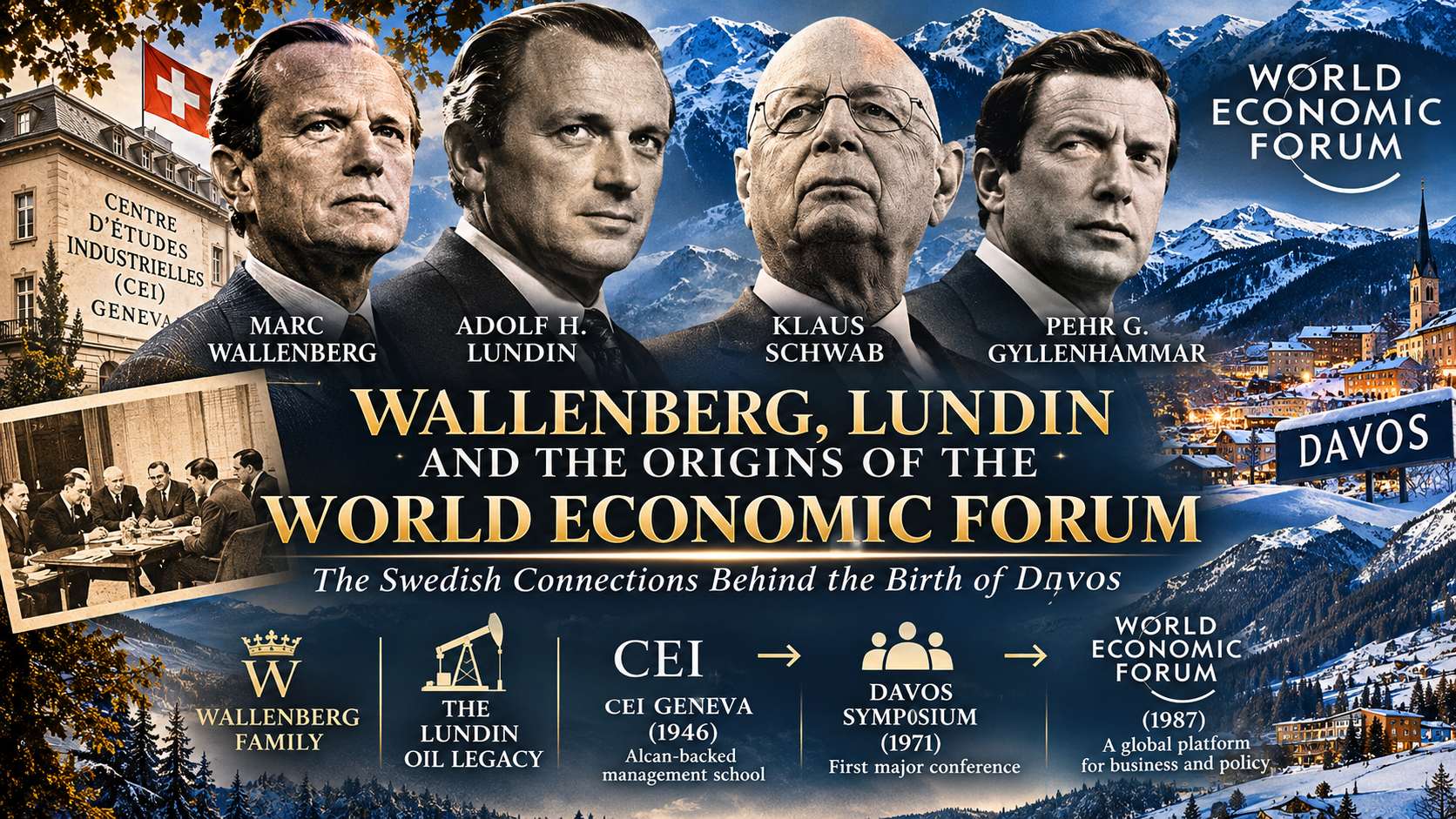
The founding of the World Economic Forum in 1971 is generally associated with German economist and engineer Klaus Schwab. Behind the first gathering in Davos, however, lies an institutional history involving international industry, a Swiss management school and members of the Swedish business establishment.
Among the individuals connected to this history was Adolf Henrik Lundin, the Swedish oil and mining entrepreneur whose marriage connected him directly to the Wallenberg family.
A remarkable account by Swedish foreign correspondent Svante Löfgren identifies Lundin and Pehr G. Gyllenhammar as participants in the discussions that gave rise to the original Davos seminar. Combined with independent biographical sources, academic research and the World Economic Forum’s own historical publications, his account reveals a Swedish dimension to the organisation’s origins that deserves considerably more attention.
1. The Journalist Who Knew Adolf Lundin
In his memoir Hemma för gott: Om 80 år med press & radio, Swedish journalist Svante Löfgren devoted an entire chapter to Adolf Lundin under the title Adolf Lundin – Gold, Oil & Gas.
Löfgren had worked as a foreign correspondent for several major Swedish newspapers and maintained personal contacts with Lundin during his years in Geneva. He followed Lundin’s international business activities for Svenska Dagbladet and published an extensive profile of the entrepreneur in Månadsjournalen in 1980.
On pages 390–391 of his memoir, Löfgren discusses Lundin’s involvement in the origins of the World Economic Forum.
He associates Lundin and Pehr G. Gyllenhammar with the decision to hold a management seminar in Davos in connection with an anniversary of the Centre d’Études Industrielles, known as CEI. According to Löfgren, Klaus Schwab subsequently developed the concept into a permanent international institution.
The significance of this account becomes apparent when examining Lundin’s professional position at CEI during the years immediately preceding the first Davos conference.
2. The Wallenberg, Wehtje and Lundin Families
In 1957, Adolf H. Lundin married Eva Wehtje, daughter of Walter Wehtje, former CEO of Investor AB. Eva’s sister, Olga Wehtje, married Marc Wallenberg, son of Marcus Wallenberg Jr.
Through their marriages to the Wehtje sisters, Adolf Lundin and Marc Wallenberg became brothers-in-law. Adolf Lundin was therefore the uncle by marriage of Marcus Wallenberg (born in 1956), the current chairman of SEB.
Jacob Wallenberg and Peter Wallenberg Jr are the sons of Marc’s younger brother, Peter Wallenberg Sr, and first cousins of Marcus Wallenberg.
These family connections illustrate the close relationships between the Lundin, Wehtje and Wallenberg families within the Swedish financial and industrial establishment.
3. From Swedish Industry to Geneva
After graduating as a mining engineer from the Royal Institute of Technology in Stockholm, Lundin entered the international petroleum industry.
His early career took him to Colombia, where he worked for Royal Dutch Shell. He subsequently returned to Europe and completed an MBA at the Centre d’Études Industrielles in Geneva in 1961, with financial assistance from Walter Wehtje.
Through his Swedish business contacts, Lundin obtained a position at Nynäs Petroleum, which belonged to the Axel Johnson industrial group.
In 1966, he returned to CEI, this time in a senior administrative capacity. His responsibilities included fundraising, recruitment and teaching petroleum economics.
Lundin’s position connected him with international industrial executives, management specialists and potential investors.
It was within this professional environment that Klaus Schwab entered the institution three years later.
4. Alcan and the Industrial Origins of CEI
The origins of CEI can be traced to 1946 and the Canadian aluminium company Alcan.
The institution was established to develop international management expertise during the economic reconstruction that followed the Second World War. It connected European business leaders with North American management practices and industrial experience.
CEI subsequently developed into an internationally connected business school. Its activities brought together corporate executives from different countries and sectors, creating opportunities for professional education, international networking and business cooperation.
In 2026, an academic article published in Cambridge University Press’s journal Contemporary European Historyexamined the institutional origins of the World Economic Forum and its relationship with international management education.
The research identifies CEI as the institution from which the WEF emerged in 1971 and confirms the financial involvement of Alcan in the school’s development.
The institutional background of Davos was therefore closely connected to international industrial management, rather than originating solely as an independent initiative by a single individual.
5. Adolf Lundin and Klaus Schwab: Geneva, 1969
The World Economic Forum’s own historical publication, The World Economic Forum: A Partner in Shaping History, confirms that Klaus Schwab joined CEI as a part-time professor in 1969.
At the time, Adolf Lundin had already occupied the position of deputy director for approximately three years.
Their professional activities consequently overlapped during 1969–1970, the period immediately preceding the establishment of the European Management Forum.
The historical chronology is significant because it places Lundin in a senior administrative position at the institution during Schwab’s arrival and the development of the environment from which the first Davos conference emerged.
Academic research into the WEF’s history also places the original conference within preparations for CEI’s 25th anniversary.
According to political scientist Jean-Christophe Graz, Schwab was entrusted with organising the anniversary event and proposed a major international conference as an alternative to a conventional celebration.
This institutional account provides important context for Löfgren’s description of Swedish involvement in the decision to organise the Davos seminar.
6. Marc Wallenberg and CEI’s International Network
Löfgren’s memoir describes another episode connecting the Geneva management school directly to the Wallenberg family.
According to his account, CEI encountered difficulties arranging a study trip for its participants. Adolf Lundin was asked to assist and, together with his brother-in-law Marc Wallenberg, organised an alternative programme in Sweden.
Löfgren describes the extensive access to Swedish business contacts that the two men were able to provide.
This account illustrates how the Lundin and Wallenberg family connection could be translated into practical institutional cooperation. International management education created opportunities for Swedish industrial leaders to establish relationships with executives from other countries.
The episode also helps explain why Lundin’s involvement with CEI extended beyond conventional academic responsibilities.
7. Pehr G. Gyllenhammar and the First Davos Conference
Perhaps the most revealing detail in Löfgren’s memoir is the reference to Pehr G. Gyllenhammar.
Gyllenhammar, who became chief executive of Volvo in 1971, would subsequently become one of Europe’s most prominent industrial leaders and an important advocate of European business cooperation.
Löfgren associates Gyllenhammar and Lundin with the decision to organise the management seminar in Davos, before describing Schwab’s subsequent development of the initiative.
The account identifies a potential Swedish contribution to the formative discussions surrounding the conference.
Although the memoir contains a chronological discrepancy concerning CEI’s anniversary, independent research confirms that the first Davos symposium emerged from preparations for the institution’s 25th anniversary in 1971.
The distinction between the origin of a conference idea and the legal establishment of the organisation is important. Löfgren’s account concerns the development of the seminar concept, while the subsequent foundation became the institution formally led by Schwab.
8. The Formal Establishment of the European Management Forum
The first European Management Symposium took place in Davos in 1971 and brought together approximately 440 participants from the European business community.
Its purpose was to explore management practices, international competitiveness and the challenges facing European companies.
According to the World Economic Forum’s historical records, the European Management Forum was formally established as a foundation on 8 February 1971, with an initial endowment of 25,000 Swiss francs.
Klaus Schwab became its principal executive and developed the symposium into a recurring international gathering.
The organisation progressively expanded its focus from European industrial management to international economics, politics and cooperation between governments and private-sector institutions.
In 1987, the European Management Forum adopted the name World Economic Forum.
1971: The Death of Marc Wallenberg and the Transformation of Swedish Banking
The year of the first Davos symposium was also a dramatic turning point in the history of the Wallenberg family.
Marc Wallenberg, brother-in-law of Adolf H. Lundin and chief executive of Stockholms Enskilda Bank since 1958, died by suicide in November 1971 at the age of 47.
His death occurred during the preparations for the merger between Stockholms Enskilda Bank and Skandinaviska Banken, a process involving considerable disagreements within the Wallenberg family. The merger was completed on 1 January 1972, creating what is today known as SEB.
Marc was the father of Marcus Wallenberg, born in 1956, who subsequently became chairman of SEB and a member of the Bilderberg Steering Committee.
The year 1971 thus marked two separate institutional turning points: the establishment of the European Management Forum in Switzerland and the transformation of the Wallenberg family’s banking interests in Sweden. Their chronological proximity is historically notable, although it does not establish a causal relationship.
9. From Industrial Management to Global Economic Policy
The development of the World Economic Forum was closely connected to the growing importance of international economic competitiveness.
The 2026 Cambridge University Press study traces the origins of the WEF’s competitiveness measurements to 1979, when Schwab initiated an assessment of European national economies.
These measurements developed into a broader international benchmarking system evaluating economic and institutional conditions.
Meanwhile, CEI eventually merged with another Swiss management school, IMEDE, which had been established by Nestlé. The combined institution became the International Institute for Management Development, IMD.
Beginning in 1989, the WEF and IMD jointly published international competitiveness indicators for several years.
This collaboration demonstrates that the institutional relationship between the World Economic Forum and its original management-school environment continued long after the first Davos symposium.
10. Swedish Family Connections Across Generations
The association between Lundin and the Wallenberg family provides a historical connection to Sweden’s international industrial network before WEF’s formal establishment.
Decades later, the Wallenberg organisation’s own publications identify Jacob Wallenberg’s involvement with the World Economic Forum as part of the family’s international network.
The same institutional material identifies engagements involving the Trilateral Commission, the Atlantic Council, Bilderberg and the European Round Table of Industrialists.
The family connection between Adolf Lundin and Marcus Wallenberg links two generations of international industrial and financial networking, from the institutional origins of Davos in the late 1960s to the Wallenberg family’s modern involvement in global economic and political forums.
These connections are particularly relevant when examining the long-term role of private industrial organisations in international economic discussions.
Conclusion: The Swedish Dimension of Davos
The institutional history of the World Economic Forum is more extensive than its familiar association with Klaus Schwab.
Its origins can be traced to a management school established with support from Canadian industry, where a Swedish oil entrepreneur closely connected to the Wallenberg family occupied a senior position during Schwab’s arrival.
Svante Löfgren’s account adds another dimension by identifying Lundin and Gyllenhammar in connection with the original seminar initiative and Marc Wallenberg in the development of CEI’s Swedish business contacts.
Independent biographical and academic sources establish the professional positions, institutional relationships and family connections underlying this account.
The precise contribution made by each individual to the original conference preparations remains a subject for archival research. Nevertheless, the documented connections justify including Adolf Lundin and the Swedish industrial establishment in the broader history of the environment from which the World Economic Forum emerged.
The story of Davos began not only with an individual founder, but within an existing international network of industrial corporations, management institutions and business leaders.
Sources and Historical Documents
1. Svante Löfgren, Hemma för gott: Om 80 år med press & radio.
ISBN 978-91-633-1211-3. Chapter 30, Adolf Lundin – guld, olja & gas, particularly pages 390–391.
https://www.las-en-bok.com/hemma_for_gott.pdf
2. Jonathan Kandell, The Life and Death of Adolf Lundin.
Institutional Investor, 16 November 2006. Based partly on Lundin’s final interview.
3. World Economic Forum, A Partner in Shaping History: The First 40 Years.
Official institutional history documenting Schwab’s appointment at CEI in 1969.
https://www3.weforum.org/docs/WEF_First40Years_Book_2010.pdf
4. World Economic Forum, A Partner in Shaping History.
Historical account of the formal establishment and initial endowment of the European Management Forum.
https://www3.weforum.org/docs/WEF_A_Partner_in_Shaping_History.pdf
5. Inventing the Global Competitiveness Race: The World Economic Forum, the IMD and the Neoliberal Benchmarking Tool They Created.
Contemporary European History, Cambridge University Press, 2026.
6. Jean-Christophe Graz, How Powerful Are Transnational Elite Clubs? The Social Myth of the World Economic Forum.
Academic research published in 2003.
7. Parag Khanna, The World Economic Forum: An Anatomy of Multi-Stakeholder Global Policy Making.
London School of Economics, doctoral thesis, 2010. Chapter 3: The WEF’s Founding and Early Years.
https://researchonline.lse.ac.uk/id/eprint/133388/1/U615338.pdf
8. World Economic Forum, Klaus Schwab: Official Biography.
https://www.weforum.org/about/klaus-schwab
9. Wallenberg, Networks and Additional Engagements.
Institutional publication, 2017, pages 38–39.
https://www.wallenberg.com/sites/default/files/wallenberg_about_us_english_lowres_0.pdf