who holds a Wallenberg professorship. Magda sat in the WEF, IMF and represents nothing but a corrupt political backstage…
So anyone who thinks Klaus Schwabb controls anything in the WEF World Economic Forum is mistaken!
Adolf Lundin was the son of the chemist Harry Lundin and the brother of the head of KSI, Bertil Lundin.[2] His mother Maria Lundin, née von Wagner, was born into a German-speaking family in Odessa. His uncle Willy von Wagner died in 1943 on behalf of Germany during the occupation of Norway.[3] He was married to Eva Lundin, née Wehtje, who belonged to the family that controlled Skånska Cement; her sister was married to Marc Wallenberg. Lundin was the father of Ian H. Lundin and Lukas H. Lundin. At the end of 1950 he searched in vain for oil in Colombia for Shell. Through his father-in-law Walter Wehtje, he got a job in the early 1960s at Ax:son Johnson-owned Nynäs Petroleum.
The text that is marked translates to "Less known is that he founded the world economic forum, that today plays a big role in geopolitics comparable to the UN."
"My involvement as a member of the Shanghai Mayor's International Council for 25 years, and the corresponding involvement in Tsinghua University's International Council, gives me insights and contact points to Chinese society that give me the opportunity to express views on how trade and other exchanges should be conducted. We in the family believe in keeping the dialogue open and straight."
"Wallenberg on China: "Nothing to gain from confrontation" On Monday, October 21 this year – just a day after thousands of protesters clashed with police in Hong Kong in yet another showdown – Jacob Wallenberg sat down in a beige, throne-like armchair in a room in Shanghai. Next to him was another man in a suit in a similar chair.
The whole thing resembled a summit meeting between two world leaders.
Which it, in its way, was.
The man is not just anyone. His name is Li Qiang, he is the secretary of the Communist Party in Shanghai. As a member of the party's 25-member Politburo, the party's governing body, he is one of the most powerful men in all of China.
The American Maurice R Greenberg, former head of the American insurance giant AIG, was also present at the meeting.
The event is in the picture. It is published on the online edition of the state-owned daily newspaper Shanghai Daily together with a short summary:
"Li thanked the two guests for their participation in the creation of IBLAC and their valuable advice and suggestions for Shanghai's social and economic development."
IBLAC stands for International Business Leaders Advisory Council and is a council of global business leaders linked to the mayor of Shanghai. Jacob Wallenberg and Maurice Greenberg were in town for the council's annual meeting. Which was also the reason for the meeting with Li Qiang.
It is not unusual for Jacob Wallenberg to meet a person from China's top management. Wallenberg has been a member of IBLAC for many years, and was also its chairman for a period.
Contacts with high-level Chinese political leaders have been important for many larger companies that have operated in China over the years, says Kristina Sandklef, senior China advisor at the consulting firm Consilio International.
– In general, it is useful to have political contacts when conducting business in China. It makes life easier in every way. It can be enough to have a picture in the reception with a representative from your own company together with a local leader of the Communist Party, so that visitors know you have contacts, says Kristina Sandklef.
According to Oscar Almén, researcher and China expert at Total Defense's research institute FOI, the role of politics in Chinese business life has increased in recent years.
– Considering that politics is so present in China's closed system, and has become even more present during Xi Jinping's time in power, it is clear that political contacts are generally good for foreign companies to have, says Oscar Almén, who also recently published a review of Chinese company purchases in Sweden.
Exactly how the Wallenberg family's political connections have helped the group's companies is difficult to determine. Clearly, China today is of enormous importance to the Wallenberg group and its companies, and has been so for several years. In 2018 alone, six of the Wallenberg group's largest industrial companies had revenues in China of over SEK 130 billion, according to SvD's calculations. That is 80 percent more than the same six companies brought in from China in 2010.
These are listed companies that are owned in several stages, via the listed management company Investor and the unlisted FAM, which in turn is owned and controlled by the Wallenberg foundations. FAM and Investor own shares with large voting rights, which give the family and its representatives a leading position in the companies.
For several of the companies, China is today the second largest market.
In the workshop giant Atlas Copco, Chinese customers accounted for 18 percent of sales last year. In ABB, the same figure was 15 percent. In the ball bearing manufacturer SKF, 16 percent.
This can be compared with the share of Sweden's exports to China, which in 2018 was 4.7 percent. Admittedly, the mentioned companies are global and China represents the equivalent of 19 percent of the world economy, calculated as GDP. But it is still clear that China is a far more important market for the Wallenberg family's company than for several other Swedish global companies. For example, the China share of Sandvik's sales was only 7 percent and of Assa Abloy's 6 percent.
This hospital visit subsequently happened to create a special bond between me and Jiang Zemin.
Should China's latest threat, as formulated by ambassador Gui Congyou last week in an interview with Göteborgs-Posten, to "restrict exchange and cooperation in economics and trade" with Sweden become serious, it could have major consequences for the Wallenberg group's companies. And thus for the Swedish shareholders and pension savers who have money invested in the companies.
Swedish occupational pension companies, for example, have tens of billions invested in the Wallenberg group, and are thus dependent on the income from China. In Investor alone, the civil servants' Alecta and the labor movement's AMF are second and third on the list of largest owners after the Wallenberg foundations. Alecta's pensioners today own Investor shares worth SEK 23.6 billion, and AMF's pensioners and fund unit owners SEK 17.7 billion, according to the ownership service Holdings.
Peter Wallenberg receives President Hu Jintao during his visit to Sweden in the summer of 2007. Erik Belfrage, Hans Stråberg, Carl-Henric Svanberg, Peter Wallenberg Jr, Marcus Wallenberg and Jacob Wallenberg sit along the wall.
The Wallenberg family's financial contacts with China go back a long way. Jacob's father Peter Wallenberg has told in the newspaper "Företagsminnen" that he visited China already at the end of the 1970s, in connection with Deng Xiaoping becoming leader and initiating the economic reform program that today – four decades later – has made China the world's second largest economy.
Peter Wallenberg was then able to establish personal relationships with China's absolute top echelon. During a trip in the country, he was invited to dinner by the then mayor of Shanghai, Jiang Zemin. At dinner, Peter Wallenberg mistakenly thought he had a heart attack and was taken to hospital.
"This hospital visit then happened to create a special bond between me and Jiang Zemin, after all, he had helped save my life. 'What about your old heart?', he jokingly asked when we met again," said Peter Wallenberg to Företagsminnen.
When Jiang Zemin succeeded Deng Xiaoping as leader in 1989, the Wallenberg family was thus in direct contact with the top. The relationship continued when Hu Jintao then took over power in 2002. When Hu Jintao visited Stockholm in the summer of 2007, Peter Wallenberg was one of those who received the president.
There is much evidence that the close relations have remained close even after 2012, when Xi Jinping became president. The Li Qiang whom Jacob Wallenberg met the other month is, according to the South China Morning Post, close to Xi Jinping. According to the newspaper, Li Qiang is one of Xi Jinping's allies from Zhejiang province. According to the newspaper, Li Qiang was Xi Jinping's secretary for three years, when he was the leader of the Communist Party in Zhejiang.
Li Qiang's representative in Shanghai, Han Zheng, is another of the party leaders with whom Jacob Wallenberg has had contact over the years. And Han Zheng is not just anyone. Today, he is one of seven members of the Politburo's innermost circle, Xi Jinping's so-called "standing committee". It is Han Zheng who can be seen in the picture next to Jacob Wallenberg, at a press conference in 2011.
Jacob Wallenberg with Han Zheng in 2011, when Han Zheng was mayor of Shanghai. Today, he is one of seven in the inner circle of the Communist Party's Politburo, its so-called "standing committee" led by President Xi Jinping.
In parallel with the Wallenberg family cultivating its political relationships, the group's companies have built up a considerable presence on the ground in China. Today, the country is not only an important market for the group. Several of the companies have large production facilities in the country. SKF today, for example, has nine Chinese factories that are subcontractors to the automotive industry. China is also the country where SKF has the most employees in the world.
We have also seen before that this type of threat is a way of showing domestic politics that you dare to stand up to Western states.
ABB is another Wallenberg giant with a large Chinese presence. In November 2018, the group inaugurated a manufacturing and development center in Xiamen, which when completed will be the group's largest innovation and manufacturing facility with 3,500 employees, a total investment of approximately SEK 3 billion. In 2018, ABB also decided to build a new robot factory in Shanghai.
The Wallenberg companies also usually cooperate on networks and political contacts worldwide. Johan Forssell, CEO of the group's investment company Investor, confirmed as recently as the other week that it is very much continuing. According to Forssell, one of the most important things Investor can contribute to the companies is the network in Asia, and especially in China.
Admittedly, several of the above-mentioned companies are not entirely Swedish. ABB, Astra Zeneca and Stora Enso even have headquarters abroad. But given how well-known the Wallenbergs are in China, it is probably obvious to the authorities in the country that the family is its largest owner. And that the companies could be affected by an economic conflict.
According to Oscar Almén, researcher at FOI, the consequences depend on which means China chooses to respond with.
– If they choose the trade route, with tariffs and the like, then the issue ends up in the EU, which regulates Swedish trade relations. Then there are ways to make it more unofficial, where Swedish companies in China can be affected in a number of other ways, says Oscar Almén.
– You can compare it to what happened to the salmon after the conflict with Norway. Sanitary tests for imported salmon became stricter and the possibility of obtaining import licenses became more difficult. However, it was not the Chinese government that officially implemented this. Through small means, it could produce big effects, he says.
According to Oscar Almén, however, it is not certain that China will actually go ahead with its threat.
– China must make a calculation of how costly it can be, the country is also dependent on several of the companies that operate in the country. We have also seen in the past that this kind of threat is a way to show domestic politics that you dare to stand up to Western states and it also works as a way to scare others not to challenge China in the future.
The Wallenberg family has repeatedly had to answer for their close connections to China and how that rhymes with the country's problems with human rights. All along, the family has defended itself by saying that their presence contributes to economic development and thus strengthens the direction towards democracy.
Like, for example, Jacob Wallenberg in Ekot's Saturday interview in 2006:
"It has been an incredible development thanks to the fact that you actually approve of economic development. And then I think the democratic development also follows. Or, rather, I don't think so. I am completely convinced that it is so."
That increased wealth in China would lead to increased democracy is an argument that is becoming increasingly difficult to assert.
The question is even more relevant today. Several politicians and human rights organizations are clear in their conclusion that under Xi Jinping in power, China has taken several steps in a more repressive, less democratic direction.
As Human Right Watch begins its latest report on the situation in the country.
"President Xi Jinping, born in 1953, has indicated his intention to rule indefinitely after China's legislature in March added an amendment to the constitution aimed at abolishing the outer term limit for the presidency. This move was also characteristic of the increasing repression."
Oscar Almén at FOI is skeptical of the belief that economic development would also improve the situation for human rights.
– That increased wealth in China would lead to increased democracy is an argument that is becoming increasingly difficult to assert. Today, China is moving more and more towards an autocratic system, on all levels, with reduced freedoms and increased political control, he says, but points out that there are occasional exceptions that go in the opposite direction.
– The opportunity for individual citizens to sue the state has increased in recent years and we have also seen more people who have taken advantage of that opportunity. That's important to remember, even if the overall trend is toward more political control.
Several recent events have also strengthened the thesis that the regime in Beijing is moving in a more repressive direction. One example is the repeated revelations of China's treatment of minorities in Xinjiang province, where over a million people have been put in various camps and prisons.
Representatives of the Chinese regime have described the camps primarily as schools, where the inmates were students. But as several international media and organizations have shown, it is rather about far more brutal institutions where anyone who resists is punished. The New York Times recently revealed that the hard-line measures were ordered from China's top political leadership. In a speech to party representatives, President Xi Jinping is said to have demanded that "no mercy" should be shown to the Muslim minority population and that the country used all the "tools of dictatorship" in that work.
The development in Hong Kong is another current example. The authorities' treatment of the protesters and the bill they were protesting are both seen as examples of a more hardline approach by the central government in Beijing.
For Sweden, the imprisonment of the Swedish-Chinese publisher Gui Minhai has turned up the criticism against the methods of the Chinese state power. Which is now the background to Ambassador Gui Congyou's threat in the GP the other day about "countermeasures". When and how these will be put into practice is still unclear. Foreign Minister Ann Linde told Ekot after the statement that the Foreign Ministry "did not receive any concrete information about this from Beijing" via the normal channels.
In the GP interview, Gui Congyou repeats the response that China often uses when people or organizations in other countries criticize the government's actions and policies:
"The policies of the Chinese government are China's internal affairs. No countries, organizations or private individuals have the right to interfere," he says in the interview.
SvD has asked Jacob Wallenberg a number of specific questions about how he views the group's activities in China today and the family's contacts with the country's political leadership. Jacob Wallenberg did not want to answer the questions directly, but instead formulated a written statement to SvD.
In the statement, he writes that the family generally "has a strong belief that trade and openness favors economic development and creates conditions for increased prosperity for all and also contributes to peaceful coexistence between countries. This also applies to China.".
Jacob Wallenberg emphasizes, however, that the country's expansion is not viewed uncritically.
"China's economic growth and ambition do not mean that one should be naive about the political role China wishes to play, and therefore it is important to place the same demands on China in terms of trade and competition as are placed on other developed countries. It must be a level playing field."
Jacob Wallenberg writes that he has spoken on several occasions with China's leaders about the country's problems with human rights. But he also repeats his previously expressed belief that with economic development should also come increased civil liberties and rights in the long run.
"That this has not yet happened in China, I regret, which I have also repeatedly and clearly raised with Chinese leaders. But politics – not business – should deal with political issues. I believe that increased transparency and openness is a prerequisite for continued long-term economic development in China."
In the statement, however, Jacob Wallenberg mentions nothing about any specific issues that he has discussed with the Chinese leaders he met, such as the issue of the imprisoned Swedish-Chinese publisher Gui Minhai and the prison camps in Xinjiang. Nor if he believes that the threats from the Chinese ambassador can affect the Wallenberg companies' large presence in China.
"The relationship with China is complicated. I advocate dialogue and long-termism, continued trade and exchange at all levels. We have nothing to gain from confrontation, but we must stand up for our values and use our trusted contact points to highlight our concerns and common challenges."
Jacob Wallenberg writes that they will continue to cultivate contacts with the Chinese leaders in the future.
"Since the opening of China, the family has strived for close relations with the political leadership in China. Hopefully, this has benefited the companies' opportunities to establish themselves and grow in the Chinese market," writes Jacob Wallenberg.
Nor does he harbor any thoughts of quitting as a member of IBLAC in Shanghai, where he meets Politburo members such as Li Qiang and Han Zheng.
"My involvement as a member of the Shanghai Mayor's International Council for 25 years, and the corresponding involvement in Tsinghua University's International Council, gives me insights and contact points to Chinese society that give me the opportunity to express views on how trade and other exchanges should be conducted. We in the family believe in keeping the dialogue open and straight."
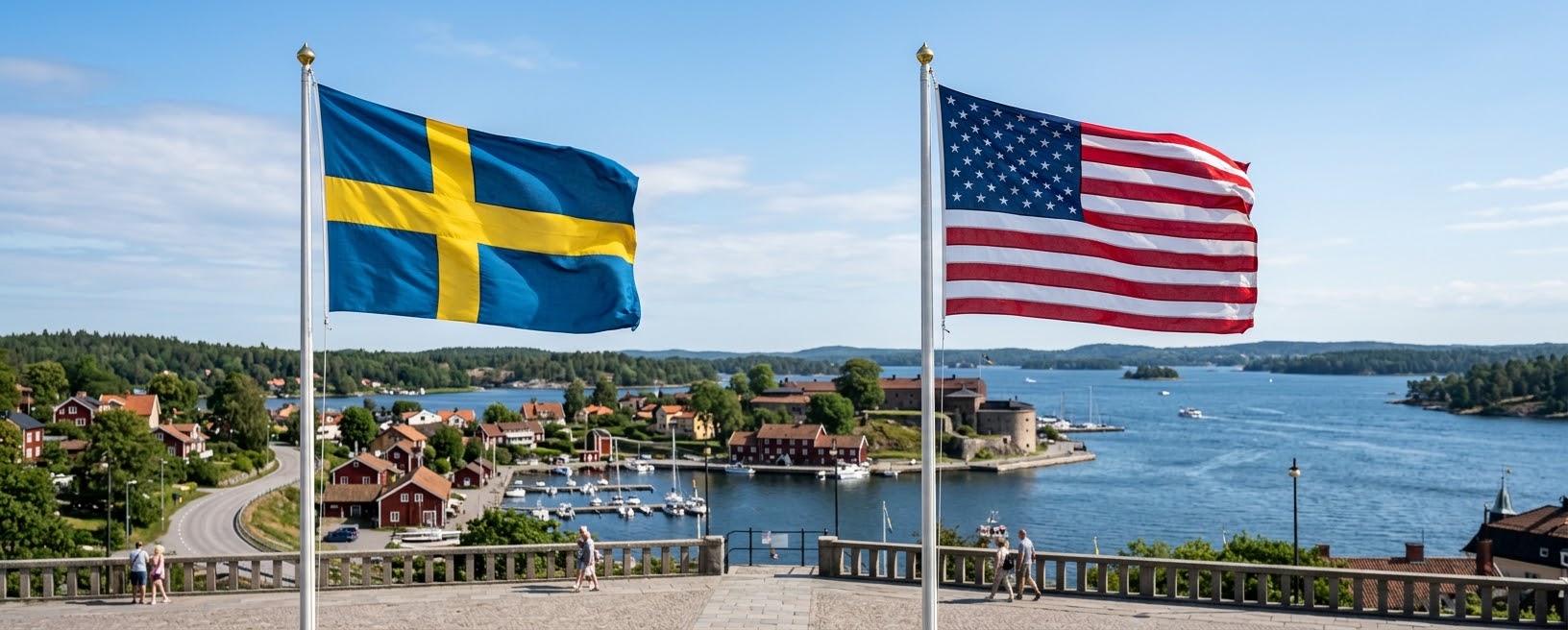
Swedens connection to the USA goes back to the vikings. Difficult truths about Sweden, Wallenberg and the deep state. How Jake see two directions for humanity and the future that lies ahead. Hide technology that could save the human race and the planet.
I hereby invoke the provisions and legal framework referenced in Government Bill 2022/23:74, the Defence Cooperation Agreement (DCA) between Sweden and the United States, and, where applicable, the principles of the Law of Armed Conflict. Law of war manual.
I respectfully request that the United States Government and the U.S. military examine the circumstances described below and determine whether any form of lawful administrative or other assistance is available under applicable U.S. and international law.
We, the Swedish people, are deeply concerned that fundamental democratic safeguards in Sweden are being undermined. Our ability to participate freely in public debate and political discourse has, in our view, been increasingly restricted. We also have serious concerns regarding the integrity of the electoral process and believe that the most recent election should be subject to independent scrutiny.
We are also deeply concerned about Sweden’s rapid military expansion and its decision to join NATO. We fear that Sweden’s increasing military integration, defence commitments, and preparations may ultimately be intended to involve Sweden in a war against Russia. We therefore believe that the government’s military and foreign-policy decisions, including the purposes and consequences of Sweden’s NATO membership, deserve greater democratic scrutiny and transparency.
We are also deeply concerned about the extraordinary influence of the Wallenberg family and the wider Wallenberg sphere over Swedish industry, finance, strategic infrastructure, research, defence, and economic policy.
The Wallenberg sphere has extensive holdings and positions of influence in companies and institutions that are of fundamental importance to Swedish society. At the same time, senior representatives of the Wallenberg sphere maintain exceptionally close relationships with Swedish political and governmental leadership.
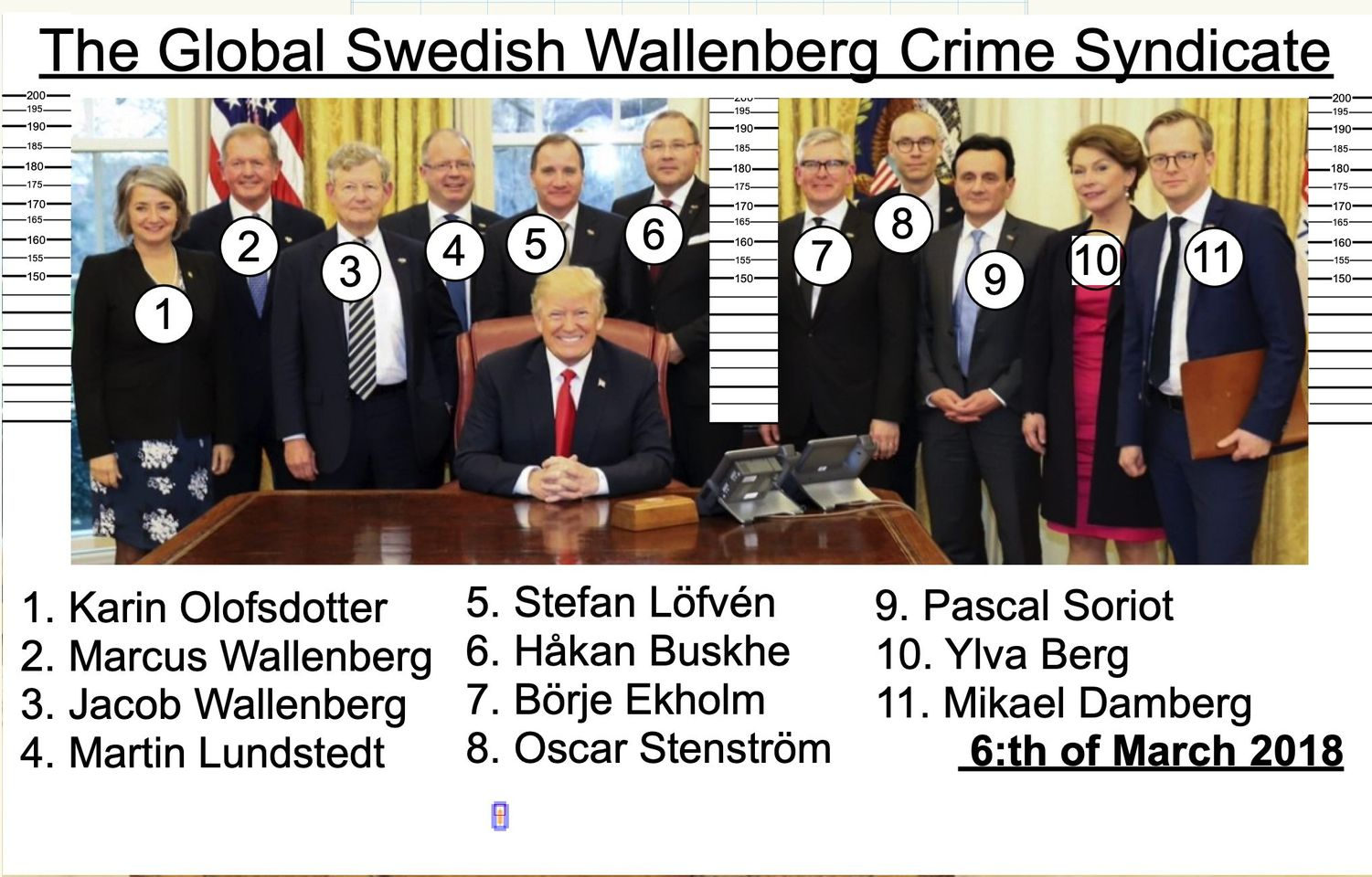
These concerns are not based solely on speculation. Jacob Wallenberg met with President Donald Trump during Prime Minister Stefan Löfven’s visit to the White House in March 2018, where Swedish business leaders discussed major economic and trade issues directly with the President.
The Wallenberg sphere has also maintained close involvement in Sweden’s security and NATO-related environment. One particularly notable example is Oscar Stenström, a former Swedish State Secretary responsible for Sweden’s NATO application, who subsequently became a senior adviser within the Wallenberg sphere.
Furthermore, Marcus Wallenberg has been appointed to President Volodymyr Zelenskyy’s International Advisory Council for the Economic Renewal of Ukraine, a body intended to advise on Ukraine’s economic reconstruction.
We are concerned that this concentration of economic, political, defence, diplomatic, and institutional influence may create a system in which private interests have disproportionate access to, and influence over, public decision-making.
We therefore believe that the relationship between the Swedish Government and the Wallenberg sphere deserves independent and transparent scrutiny.
We have reason to question whether the Wallenberg sphere has, in practice, acquired influence over Swedish national policy that goes beyond the legitimate influence normally exercised by private businesses and interest groups. Some Swedish citizens have therefore come to describe the Wallenberg sphere as functioning, in effect, as a form of unofficial “shadow government.”
We are not asking you to accept this allegation without evidence. We are asking for the underlying relationships, financial interests, political contacts, lobbying activities, appointments, and decision-making processes to be independently investigated.
Furthermore, we believe that actions and policies undertaken by the Swedish government may constitute serious violations of fundamental rights and, potentially, international law. We ask that these allegations be independently investigated rather than dismissed without examination.
Our concerns include Sweden’s immigration and border policies, the government’s approach to gender and transgender issues, deteriorating conditions and public disorder in some Swedish cities, and what we perceive as the consequences of large-scale immigration from predominantly Muslim countries.
We are also deeply concerned about what we perceive as psychological warfare, intimidation, and other forms of state action directed toward the Swedish population. The Swedish Government and judicial system are putting us in harm’s way through their policies. Criminality, rapes, bombings, and murders are out of control.
These circumstances have led us to question whether Sweden’s democratic institutions are continuing to function in accordance with the principles of constitutional government, individual liberty, transparency, and human rights.
We therefore respectfully request that you, as Commander in Chief, consider whether the United States has any lawful authority or responsibility to assist in ensuring that the rights of the Swedish people are protected and that any credible allegations of unlawful conduct, foreign influence, conflicts of interest, or abuses of governmental power are independently investigated.
We are asking for lawful assistance, transparency, accountability, and an independent examination of the facts.
FRA's US cooperation worries conflict researcher Agrell
FRA gets to take an active part in Quantum – an American data breach system that is very advanced. If used offensively, it can be perceived as directly hostile by other countries.
According to secret documents leaked by Edward Snowden to SVT's Uppdrag review, the American intelligence service and the Swedish FRA have worked together in the so-called quantum project.
Conducting active signals intelligence and hacking computers in or outside Sweden, there is no room for that in Swedish legislation.
Can be perceived as an act of war
This worries peace and conflict researcher Wilhelm Agrell, who even fears that data breaches could be perceived as an act of war.
– Cyber warfare, if it is directed against vital infrastructure in another country, can be tantamount to an armed attack. Of course, we are not there now, but data breaches are not just any triviality, says Wilhelm Agrell.
As usual, FRA says nothing about what their operations look like, or what goals they have with their participation in the quantum project.
However, the whole idea of quantum technology is about directing cyber attacks against different targets, military, political or economic. One hacks in, and can then, for example, plant computer viruses or gain access to trade secrets.
The supervisor trusts the FRA
The Defense Intelligence Tribunal must approve all FRA intelligence. Cooperation with other countries must also be within the framework of what the court approved, according to chairman Runar Viksten. Everything must benefit Swedish interests and be aimed at foreign conditions.
Viksten does not want to answer whether the data breach, as described in the leaked material, is impermissible.
– The court does not get involved in which methods the FRA uses to access material, because it is not decisive in determining the breach of privacy, he says.
– Joint operations do not fit within the legislation. The closer that relationship is, the more difficult it will be to maintain the legislation's limitation, says Wilhelm Agrell.
The limitation is, among other things, that FRA must carefully filter which own information is handed over to other countries.
Former FRA head Ingvar Åkesson has assured the Riksdag's defense committee that the agency does not engage in data breaches and that in that case it would be illegal. According to the FRA, however, there is court authorization for all collection of information.